Policy Blog

Key features in a nutshell

A policy blog is a written analysis of a policy issue, about 900 to 2000 words. Readers like this brevity, and that’s why a catchy title that attracts readers` attention on social media and an easy writing style are essential.

  • Policy blogs are great for sharing timely analyses of current policy issues. Scientists can also use them to present research findings from academic publications relevant to current policy debates; a blog post that is widely read and linked can also increase the citation rates of the academic paper in question
  • To have their posts read by policymakers, scientists can regularly publish their blog posts on their website or via platforms like Medium or WordPress, which can be very time-consuming; or they can also publish their blog posts via an existing series of research institutions, think tanks, NGOs, and scientists
  • If you publish a post on your website, make sure your website allows it to be shared via social media or forwarded via e-mail
  • Make sure you announce your blog posts via social media


How does the format work?

Policy blogs are well structured and easy to read. They are great for sharing timely analyses of current policy issues. Scientists can also use them to present research findings from academic publications relevant to current policy debates. A widely read and linked blog post can also increase the citation rates of the academic paper in question. But blog posts are not simply summaries of existing research.

A blog post is typically structured as follows: a catchy title, an introductory paragraph with the key messages – phrased in a way that grabs the reader’s attention – followed by a brief analysis of the issue and research findings and a concluding paragraph. That`s enough for a policy blog. Visual elements like charts or tables are very helpful for explaining complex issues and keeping the reader’s attention.

Scientists should keep sentences short and use a writing style that is more informal than academic publications. They should think about their readership. If they want to focus on policy professionals in government ministries, agencies, or research services in parliamentary bodies who have expert knowledge of the topics covered in the policy blogs, scientists can use a technical writing style. if they want to reach members of parliament or their staff, and they should spell out acronyms unless they are commonly known (e.g., EU).

Policy blogs or blogs in general offer an excellent opportunity to use hyperlinks rather than footnotes or endnotes, which make the text shorter and easier to follow.

A short bio of three to four sentences should be included at the beginning or end. This bio should provide information on expertise, key publications, and policy experience rather than information on the visiting fellowship in 2007. Scientists should also add links to their websites and social media channels. Adding a comments section to the blog sites is an excellent way for scientists to interact with their readers if they wish to do so.


Challenges (and how to address them)

A blog is a concise text. Scientists therefore need to consider the key messages they want to convey. They can use an existing academic publication as the basis of a blog post. But they should present the findings of the publication that are relevant rather than summarising the publication itself. For that reason, scientists can dispense with sections on methods and literature reviews when writing blog posts.

Another question is: How do blog posts reach the right audience? Scientists have two options. First, they can publish their blog posts on their website or platforms like Medium or WordPress. This approach works if scientists are well known in the policy world or if policymakers follow their social media accounts. Second, scientists should blog regularly if they want to publish their blog posts via their websites or blogging platforms.

Alternatively, scientists can identify well-known blog series published by other research institutions, think tanks, or NGOs. Many blog series welcome contributions from external scientists, who can also approach colleagues who are well-known bloggers regarding a joint blog post.


Tasks and resources

Scientists

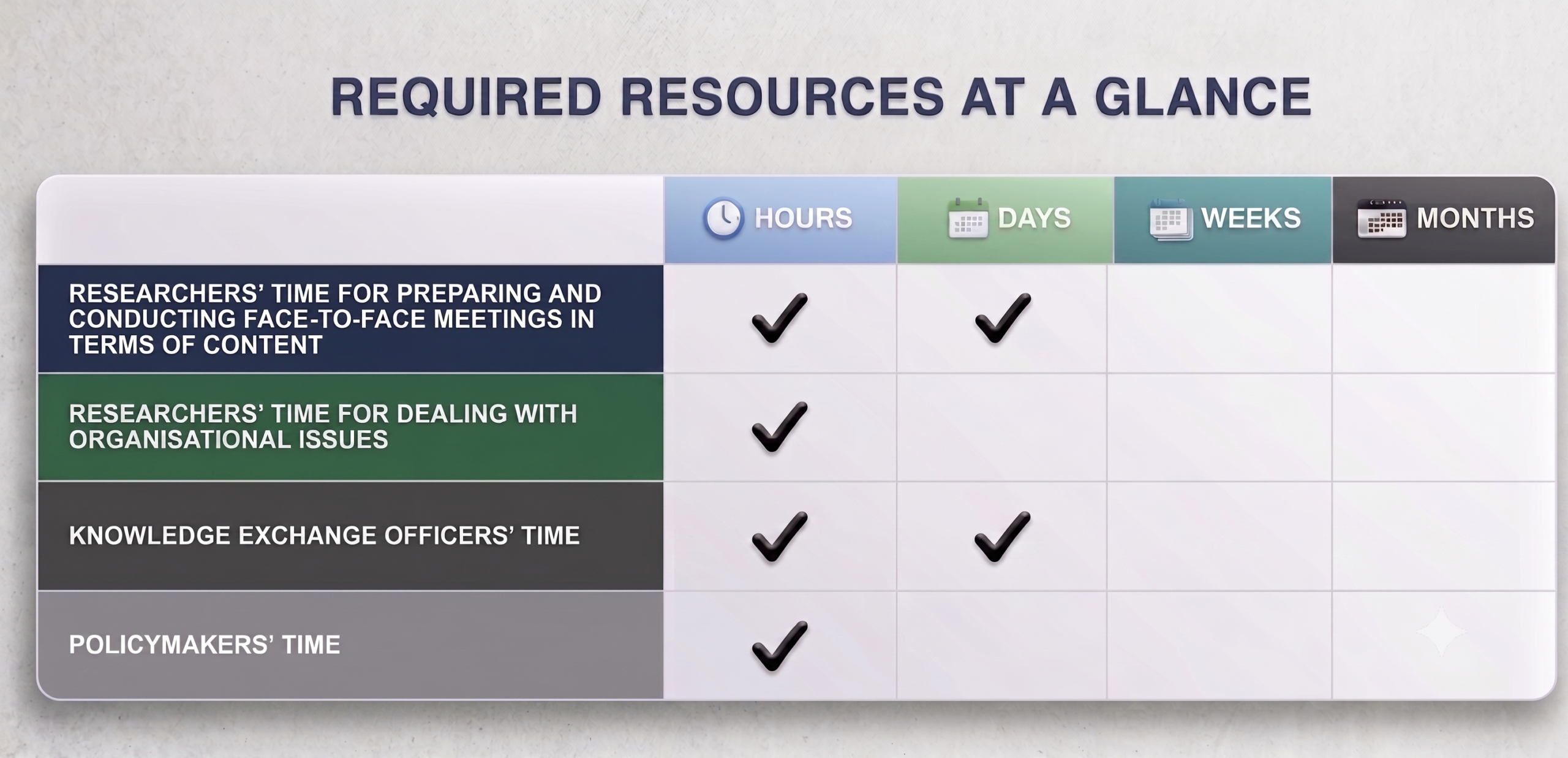
Content. Scientists can identify possible topics for policy blogs by following policy debates. They may also have to read about a current policy issue and reflect on the key messages when writing the post.

Organisational issues. Scientists must be certain the policy blog will reach policymakers. If they need mailing lists, websites, or social media channels to disseminate the policy blogs, they should approach research centres, think tanks, or NGOs that have tremendous reach and accept policy blogs from external contributors. (See section on challenges)

Resources with respect to time. Scientists should be able to write a blog n a couple of hours. Nonetheless, they might have to conduct original research when analysing a timely issue. They should be constantly asking themselves if they can extract a policy blog from a journal article or other lengthy publication.

Knowledge exchange managers and research managers (Support Stuff)

Knowledge exchange managers can assist scientists in writing policy blogs by informing them about current policy issues. Knowledge exchange officers can follow media coverage, subscribe to policymaking institutions’ newsletters, and read official documents such as strategy papers or legislation. Knowledge exchange managers can read research articles and use Google or ChatGPT to link research output to current policy debates. They can talk to scientists regarding current policy issues and make suggestions for the structure and content of a policy blog. After reading the scientists’ journal articles, press officers often send drafts for press releases to scientists on current research results, which the scientists can then comment on. Knowledge exchange officers can operate in a similar fashion and produce draft policy blogs which scientists can develop further. Such an approach saves time for scientists.

Knowledge exchange managers are vital in disseminating policy blogs. They can identify readers by browsing organisation charts or committee members in parliaments. They can communicate the policy briefs via mailing lists, websites, and social media. If they need more reach regarding social media followers, mailing list recipients, or website visitors, knowledge exchange managers can identify other research institutions, think tanks, or NGOs with a broad reach and accept external contributions.


Sources and further reading

Cairney, Paul. 2016. Writing a policy paper and blog post, accessed on 21 August 2024.

Dunleavy, Patrick. 2026. How to write a blog post from your journal article in eleven easy steps, accessed on 21 August 2024.

Evidence and Policy Blog. (no date).

Bibby, Bick. 2019. Blogging for a policy audience, accessed on 21 August 2024.


See also contributions on the following issues

Understanding policy relevance, policy briefs, and timing.


Do you want to know more about the policy engagement toolkit?

Do you want to share your experience in policy engagement? Do you think about contributing to the policy engagement toolkit? Feel free to contact Tome Sandevski via science-policy@pvw.uni-frankfurt.de

Policy Brief

Key features in a nutshell

  • a policy brief is a written analysis of a policy issue no more than a few pages long
  • policy briefs usually present both scientific findings and policy recommendations
  • policy briefs can analyse recent events; scientists can also write them to synthesise policy-relevant knowledge from journal articles or other lengthy scholarly work.


How does the format work?

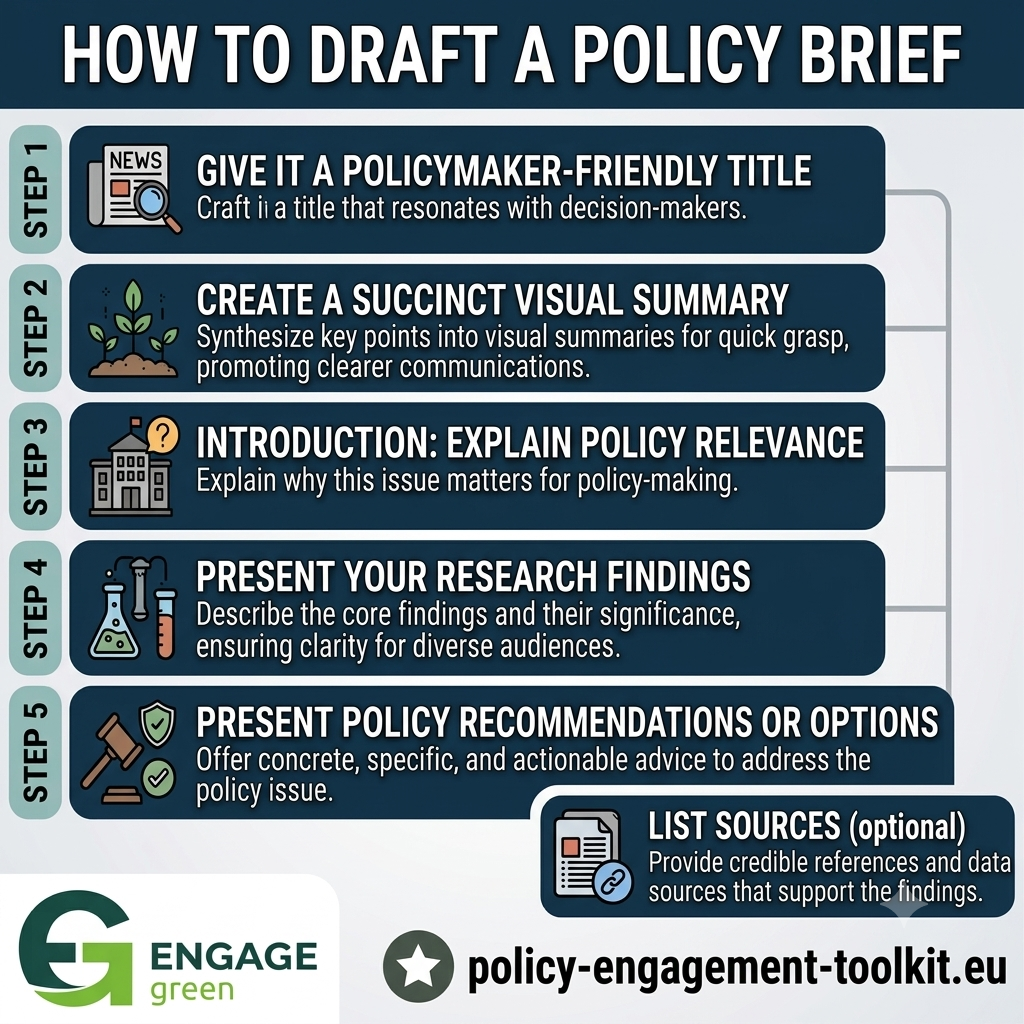
Policy briefs are well-structured and easy-to-read. They are usually comprised of six parts: title, summary, introduction of policy issue, presentation of research findings, policy recommendations, sources, and appendix.

It should be noted that scientists compete for the attention of policymakers with businesses, lobby organisations, NGOs, and think tanks, whose staff are usually trained and experienced in writing policy briefs.

The first page of the policy brief is the most important. Scientists must understand that many policymakers will only read the first page or paragraph. Therefore, scientists must choose a catchy title reflecting the policy’s relevance or key findings. Examples of catchy titles can be found below.

The summary presents the key messages and should not exceed two paragraphs. Therefore, present your key messages in the summary using visualisation features like a textbox, thick print, bullet points, or a combination of them. Focus on 2-4 key messages. If your topic requires more than 2-4 key messages, consider publishing two policy briefs instead of one.

The following section introduces the policy issue. Explain clearly and concisely why the issue matters for policymaking. If clarification is needed on whether the issue is relevant for policymakers, read our post.

The following section will present your research findings: What, after reading this section, will the policymaker know that she didn’t know before? Why are these findings important? This section leads to the policy recommendations which are supposed to help policymakers draft or implement policies. Provide specific recommendations and avoid generalisations (“The government has to increase its efforts to save the environment”). Policy recommendations should be sound, even if policymakers are not likely to take them up in the short term.

In many cases, it took scientists decades to see concrete actions resulting from their policy recommendations. But scientists should know the political, legal, and financial implications of their policy recommendations’. Scientists and policymakers can argue which recommendations are politically, financially, and legally feasible, but scientists should refrain from recommendations that will never be implemented, such “to save electricity, Parliament should make the production and consumption of electricity illegal.” In some countries (e.g., Germany), policy briefs focus on analysis rather than policy recommendations.

The final section should include the sources or appendices, such as data sets. We recommend publishing data sets, a section on methods, and other lengthy information on your website and providing the URL in the sources section rather than adding pages of appendices to your policy brief.

Regarding style, keep sentences short and easy to understand. Think about your audience: if you want to focus on experts in policymaking institutions, you can employ a rather technical writing style. Avoid jargon and acronyms if you expect generalists to read your policy brief. Always let peers read your paper.

As in other contexts, timing is critical if scientists want to achieve impact. Our article on timing is available here.


Tasks and resources

Scientists

Content. Scientists can write the policy brief on their own. If they are too busy to do so, they can outline the structure and main arguments to knowledge exchange managers who can then write the policy briefs.

Organisational issues. Scientists must know if the policy briefs will reach policymakers. If they don’t have mailing lists, websites, or social media channels to disseminate the policy briefs, they should approach research centres, think tanks, or NGOs with tremendous reach and accept policy briefs from external contributors.

Resources regarding time. Scientists should be able to write a policy brief in a couple of hours. However, they might have to conduct original research when analysing a timely issue. They should be constantly asking themselves if they can extract a policy brief from a journal article or other lengthy publication.

Knowledge exchange managers and research managers (Support Stuff)

Knowledge exchange managers can assist scientists in writing policy briefs by informing them about current policy issues. To do so, knowledge exchange officers can follow media coverage, subscribe to policymaking institutions’ newsletters and read official documents like strategy papers or legislation. Knowledge exchange managers can read research articles and use Google or ChatGPT to link research output with current policy debates.

Knowledge exchange managers can talk to scientists regarding current policy issues and make suggestions for the structure and content of a policy brief. After reading the scientists ‘ journal articles, press officers often send drafts for press releases to scientists on current research results, which the scientist can then comment ons. Knowledge exchange officers operate in a similar fashion and produce draft policy briefs which scientists can comment on. Such an approach saves time for scientists.

Knowledge exchange managers are vital in disseminating policy briefs. They can identify readers by browsing organisation charts or committee members in parliaments. They can communicate the policy briefs via mailing lists, websites, and social media. If they lack reach regarding social media followers, mailing list recipients, or website visitors, knowledge exchange managers can identify other research institutions, think tanks, or NGOs with a broad reach and accept external contributions.


Sources and further reading

Did COVID-19 accelerate the green transition? An international assessment of fiscal spending measures to support low-carbon technologies, OECD Policy Brief, 19 October 2023.

Egorov, Konstantin, Why did Russian economy not collapse under sanctions: Pre-war evidence, SAFE Policy Letter No. 102. September 2023.

See also contributions on the following issues

Understanding policy relevance, policy blogs, and timing.

Do you want to know more about the policy engagement toolkit?

Do you want to share your experience in policy engagement? Do you think about contributing to the policy engagement toolkit? Feel free to contact Tome Sandevski via science-policy@uni-frankfurt.de

The Hackathon: An Intensive Interdisciplinary Seminar

What is a hackathon?

“Hackathon” is a combination of the words “hack” and “marathon.” It is an innovative format in which participants come together to brainstorm ideas and create solutions within a short period of time.

Also referred to as an “innovathon” or “ideathon,” a hackathon brings people together to use collective creativity to imagine and develop new ideas. This collaborative and intense format is designed to inspire innovation and deliver concrete results quickly.


What is our format about?

Hackathons have become increasingly popular over the past five years. They provide students with an opportunity to showcase their skills, explore new ideas, and collaborate with others from different backgrounds.

Hackathons are valuable for institutions because they can help students come up with innovative solutions together to address real challenges. It is also an effective way to strengthen the interaction and connections between universities and practice partners such as policymakers.

In our case, the hackathon format takes place during a week-long seminar dedicated to the topic of public policy design. This seminar option is open to two Master’s students from all disciplines at the university, and we expect 15 to 30 students per session.

Students can develop unique, practical ideas in just a week through intensive teamwork. Hackathons also highlight the value of multidisciplinary collaboration and structure the creative process around specific goals, especially – in our case – where students from all disciplines meet to work in groups of four to five students and combine different approaches to complex questions.


How does the format work?

We organize a five-day hackathon in a non-working week, dedicated to introductory courses (resulting in ECTS credits) where students from all disciplines can explore topics, they have not yet encountered in their studies.  Our format is an in-person event and involves numerous on-site meetings where students can meet with key players in each year’s thematic area of activity.


The key steps

Step 1: Define the challenge

It is important to start by selecting a sponsor and working with them to define the theme or the topic and a related challenge. The challenge should be realistic and achievable within the timeframe. Effective communication is also important to attract motivated participants.

Step 2: Event launch

Kick off the hackathon with an opening session. The teacher explains the schedule and objectives for the week. The sponsor presents the challenge, including constraints and key considerations. Additional contributors, like associations or beneficiaries, may provide input to guide the students.

Step 3: Idea generation

Throughout the week, students take part in seminars and workshops led by instructors and experts. These sessions guide them as they brainstorm and refine their ideas.

Step 4: Prototyping

Once the groups have a clear idea, they move to the prototyping phase. This includes expert-led workshops and autonomous teamwork to create a concrete solution.

Step 5: Presentations and feedback

At the end of the week, the groups present their projects to the sponsor. These presentations may be followed by discussions and/or feedback to further refine the ideas.

Step 6: Post-event follow-up

It is important to stay in touch with both the sponsors and the students/participants after the event. This allows questions to be addressed and adjustments to be made along the practical implementation of the ideas developed. This follow-up stage also helps maintain good relationships with the sponsor and sets the stage for future collaboration.

For universities, grading a hackathon can be challenging. Instead, participation and engagement can be evaluated or feedback collected through a satisfaction survey.


Tasks and resources

A hackathon is a short, collaborative experience designed to inspire innovation and work in the field. Resources need to include an adequate assignment for the format and an external sponsor who is available for a few days.


Examples

https://www.univ-lyon2.fr/sciences-et-societe/les-poles-de-specialites/motif-design-des-politiques-publiques


Sources and further reading

https://www.bibliotheque-initiatives.fonction-publique.gouv.fr/files/2023-11/HACKATHON-LE-GUIDE-PRATIQUE.pdf


Do you want to know more about the policy engagement toolkit?

Do you want to share your experience in policy engagement? Do you think about contributing to the policy engagement toolkit? Feel free to contact Tome Sandevski via science-policy@pvw.uni-frankfurt.de

Format: Capsule

Introduction: What is the format about?

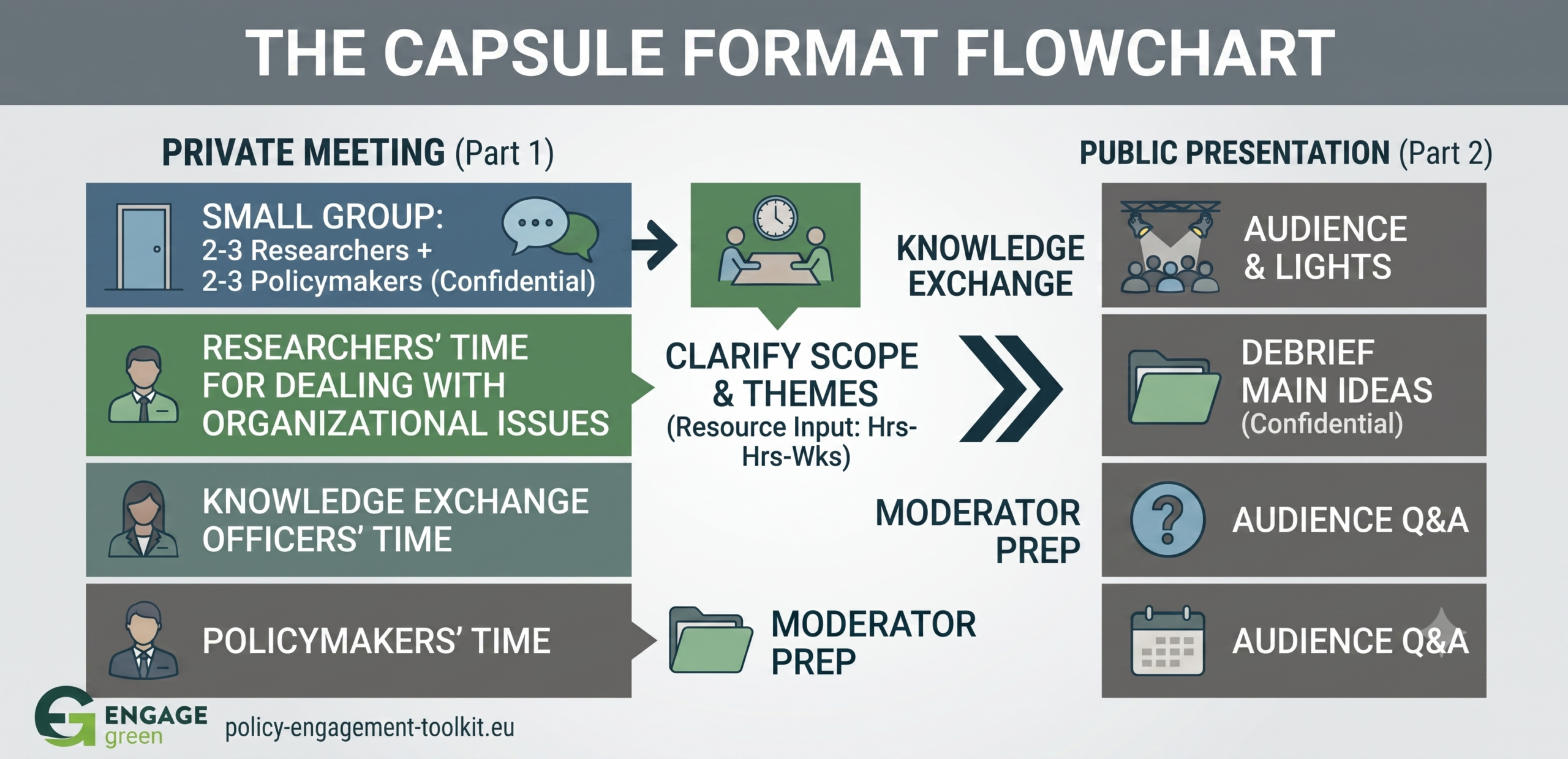
  • A capsule format is a discussion in closed, small group sessions between researchers and policymakers (private). As a rule, these involve two researchers and two policymakers, but there can be less or more if necessary. A small audience may also be present in this discussion.
  • It is a free format that allows participants to engage in free exchange without concern about a large audience listening to, after which the main points that emerged from the discussion are presented to the audience
  • Topics must be open to discussion and the themes defined in advance because there is a public presentation later of the discussion, open to questions from the audience.


How does the format work?

Part 1: The private meeting

The capsule format is based on a confidential and informal setting that is designed to encourage open and constructive discussions.

Generally, two or three policymakers meet with two or three researchers, ideally from different disciplines. The workshop is organized by knowledge exchange officers from the university when, as in our case, we have identified a common theme. The capsule was organized as part of a two-day conference, which gave us the opportunity to bring together researchers and policymakers interested in the topic and provide them with an important opportunity for private discussion on the subject. The meeting is closed to the public and the media. Participants are invited to freely share their knowledge, challenges, and questions without concerns about public communication or political position.

This format aims to create a climate of trust and can lead to mutually beneficial relationships in the future.

Policymakers can ask questions without fear of judgment, and researchers who are not accustomed to speaking in public can present complex or even sensitive findings.

This capsule format also makes it possible to move beyond short-term thinking by opening up new areas for action. These dialogues can be one-off events or part of a cyclical process.

Part 2: The public presentation

At the end of the private session, a public debriefing can be organized to share the main ideas discussed while respecting the confidentiality of individual comments. This time allows for broader reflection and highlights the value of the discussion. In our case, the private session took place when the audience broke up for lunch. When they returned, the public session was included in the conference schedule for the day, which enabled us to have a significant, interested, and dynamic audience.


Challenges and how to address them

The main challenge of this format for support staff (knowledge exchange managers and research managers) is to maintain a common thread throughout the discussion to ensure the coherence and progression of the exchanges. To this end, the choice of moderator is crucial: he or she must have properly prepared the topics in advance, know how to rephrase comments, and make connections between the concerns of the participants, especially during the second phase of the public presentation.


Tasks and resources

Content: The content is very open, but the moderator must have thoroughly prepared the discussion topic and the limits of the researchers’ field of expertise and the limits of the policymakers’ field of activity for the discussion to be productive.

Although the format is fairly open, it requires a certain amount of preparation time for all participants. In fact, a meeting prior to the discussion is very useful for everyone to clarify their area of expertise and also to define the topics and limits of the discussion.


Examples

https://www.univ-lyon2.fr/sciences-et-societe/nos-projets/review-of-the-capsule-meeting-between-policy-makers-and-reseachers-on-the-key-topic-the-management-of-urban-wastelands


Do you want to know more about the policy engagement toolkit?

Do you want to share your experience in policy engagement? Do you think about contributing to the policy engagement toolkit? Feel free to contact Tome Sandevski via science-policy@pvw.uni-frankfurt.de

UGR County Councils: A regional Science-Policy Dialogue Model for Sustainable Development

Summary: Key features in a nutshell

  • Ten regional UGR County Councils, one per county of the Granada province
  • Living Lab and Quadruple Helix approach linking universities, governments, businesses, and citizens
  • Participatory identification of local challenges in water management, soil restoration, sustainable mobility, and cultural heritage
  • Science-policy pairing between researchers and public officials for locally relevant solutions
  • Institutional framework ensuring long-term coordination and knowledge transfer between academia and territorial authorities


Description

The UGR County Councils are a regional model for science-policy dialogue developed by the University of Granada (Spain) within the Erasmus+ ENGAGEgreen project. The initiative is a response to the province’s urgent environmental and social challenges—such as drought, soil degradation, and rural depopulation—by creating ten County Councils, one per county, that connect academia, policymakers, the private sector, and civil society.

Using the Living Lab methodology and the Quadruple Helix model, the Councils foster collaborative experimentation and evidence-based policymaking. They serve as locally rooted platforms for co-creation, capacity building, and participatory governance, advancing sustainable development at the regional level.


How does the format work?

1. Introduction

Granada’s pressing environmental issues revealed a lack of structured mechanisms to integrate scientific evidence into policymaking. To overcome this, the UGR established ten County Councils to institutionalize dialogue between science and policy at the territorial level.

2. Objectives

  • Foster inclusive and structured dialogue between academia, public administration, civil society, and the private sector.
  • Identify and prioritize local challenges through participatory platforms.
  • Pilot a scalable model of science-policy pairing capable of replication in other European regions.
  • Strengthen institutional capacities for knowledge transfer and consolidate the university’s civic engagement mission.

3. Methodology

The Councils employ a Living Lab approach that promotes real-world experimentation and stakeholder cocreation of locally relevant solutions.

They integrate the Quadruple and Quintuple Helix logic, ensuring the participation of:

  • Academic institutions
  • Public administrations
  • Private sector actors
  • Civil-society organizations


Recruitment and participation combined institutional communication (emails, websites) with informal word-of-mouth channels to reach local policymakers and citizens.

Activities used hybrid formats (online and in-person) such as webinars, cocreation workshops, and capacity-building sessions designed to foster dialogue, mutual learning, and joint decision making.

4. Pilot implementation highlights

The UGR County Councils were formally launched in January 2025 during the First Impronta Granada Meeting, which gathered 143 participants for the first province-wide encounter. Since then, the initiative has evolved into a structured network of approximately 230 active participants across ten counties in Granada.

The councils have facilitated science policy dialogue on key environmental issues, including webinars and seminars on soil restoration, drought management, and biotechnological alternatives for pest control, co-organized with local authorities and scientific experts.

Stakeholder engagement reflects the project’s Quadruple Helix foundation, combining public administrations, academic institutions, civil society, and private sector actors.

A total of over 15 multiformat activities have been organized, including:

  • Webinars on soil restoration and drought with regional agencies
  • A seminar on sustainable pest control co-led by UGR biotechnology experts and local mayors
  • Capacity-building workshops and collaborative working sessions, generating more than eight localized action proposals, several of which are being integrated into municipal and regional policy agendas
  • Codesigned, place-based solutions addressing water governance, ecological transition, and rural innovation rooted in territorial realities.
  • Science-policy pairing mechanisms, enabling researchers to act as regional mediators and catalyze evidence-based decision making at the municipal level.

 5. Results and impact

  • National and international visibility through participation in conferences, dissemination via institutional networks, and continuous media outreach
  • Development of a flexible governance model, balancing central coordination with local autonomy and self-organization
  • Institutional recognition and symbolic incentives, such as participation certificates and the forthcoming Best UGR County Council Award, reinforcing long-term stakeholder engagement
  • Hybrid participation formats (online and in-person) expanded accessibility, especially in rural areas, strengthening inclusivity and plural representation

Overall, the UGR County Councils have demonstrated the potential of universities as regional mediators, fostering collaborative solutions that address environmental and social challenges through sustained science-policy dialogue.


Challenges

  • Historically weak links between academia and local governments required trust-building
  • Balancing academic coordination with local autonomy
  • Ensuring equitable representation of all quadruple-helix sectors
  • Managing logistics and accessibility for rural territories
  • Translating dialogue outcomes into concrete, actionable policies
  • Difficulties maintaining consistent participation across all counties


Tasks and resources

Scientists

  • Contribute research insights on sustainability, soil, water, and cultural heritage
  • Act as regional mediators, facilitating evidence-based discussions
  • Support monitoring and evaluation through data analysis and policy translation

Knowledge exchange managers and research managers

  • Coordinate the creation of ten county-based councils and manage logistics
  • Design and facilitate cocreation workshops and training sessions
  • Ensure alignment between local priorities and ENGAGEgreen objectives
  • Compile reports and communication materials for dissemination (websites, media)

Policymakers

  • Participate in workshops and webinars to share challenges and priorities
  • Provide local data, administrative context, and feedback on proposed solutions
  • Integrate cocreated proposals into municipal or county policy agendas


Examples

  • Launch event (January 2025): First Impronta Granada Meeting was attended by 143 participants, marking the establishment of all ten UGR County Councils
  • Ongoing network: Approximately 230 active participants across the province
  • Thematic webinars: On soil restoration, drought management, and biotechnological pest control, co-organized with local authorities and researchers
  • Workshops: Generated over 10 localized action proposals, several now under implementation in municipal policies
  • Hybrid formats: Online and in-person participation strengthened inclusivity and accessibility for rural communities


Do you want to know more about the policy engagement toolkit?

Do you want to share your experience in policy engagement? Do you think about contributing to the policy engagement toolkit? Feel free to contact Tome Sandevski via science-policy@pvw.uni-frankfurt.de

How to involve and interact with various stakeholders

How to involve and interact with various stakeholders including policymakers, academic researchers, local businesses, and community representatives


Description

Successfully involving and interacting with a broad range of stakeholders is crucial for ensuring that local development projects are comprehensive, inclusive, and sustainable.

Stakeholder engagement is not a one-off activity but a continuous process that requires clear communication, transparent decision-making, and ongoing collaboration between academia, policymakers, businesses, and civil society. Understanding the roles and expectations of each stakeholder group is fundamental to creating a cooperative environment in which all voices are heard and valued.

This contribution explores methods and best practices for engaging stakeholders and facilitating their active participation in territorial development initiatives. Furthermore, it addresses strategies for managing conflicting interests that may arise among stakeholders in collaborative territorial projects.


Summary: Key Features in a Nutshell

  • Objective: To create a framework for engaging stakeholders in territorial development projects by facilitating cooperation and mutual understanding across different sectors.
  • Approach: A multi-phase strategy involving stakeholder identification, consultation, collaboration, and continuous feedback loops to ensure that every stakeholder remains actively involved throughout the process.
  • Outcome: The creation of inclusive and sustainable solutions that reflect the interests and needs of all relevant stakeholders.


How Does the Format Work?

  1. Stakeholder Mapping and Identification: The first step in involving and interacting with stakeholders is to identify who the key stakeholders are and understand their role in the project. This includes policymakers, academic researchers, local businesses, community representatives, and other relevant actors connected to the issue at stake. Stakeholder identification can be carried out through several complementary methods: drawing on the knowledge and networks of the people already involved in the project, conducting internet and website searches, reviewing institutional documents and previous initiatives, consulting directories and public databases, asking affected groups and community organisations directly, and using snowball techniques in which initial contacts suggest additional relevant actors. Workshops, interviews, surveys, and participatory mapping exercises can also help to broaden and validate the stakeholder map. This process allows project leaders to determine who is affected by the project, who has relevant expertise, who holds decision-making power, and who can contribute resources, legitimacy, or implementation capacity to support the project’s success.
  2. Consultation and Needs Assessment: Once stakeholders are identified, the next step is to engage them in the decision-making process through consultation. This can be done through surveys, focus groups, community meetings, or online consultations. The goal is to gather insights into their needs, expectations, and concerns. For example, in a territorial development project, policymakers might be interested in economic growth, while local communities might prioritize sustainability and preservation of cultural heritage.
  3. Co-Creation and Collaborative Workshops: After gathering input from stakeholders, the next step is to move from consultation to co-creation. This is where stakeholders come together in collaborative workshops to design solutions. These workshops should be structured in a way that allows for inclusive participation and ensures that each stakeholder group has the opportunity to share their perspectives. For example, UGR researchers might provide scientific evidence and policy analysis, while local businesses might share their knowledge of the regional economy and market trends.
  4. Managing Conflicting Interests: In any collaborative territorial project, stakeholders may have conflicting interests, especially when the goals of local governments, academic researchers, and businesses differ. Managing these conflicts is crucial for maintaining productive relationships.


Strategies for managing conflicting interests include:

  • Open communication and transparency about each stakeholder’s objectives and constraints.
  • Compromise and negotiation, where stakeholders find common ground or agree to trade-offs that balance their interests.
  • Third-party facilitation to mediate disputes and provide neutral perspectives that encourage cooperation.
  • Building trust by involving all stakeholders in the decision-making process, ensuring that everyone feels their voice is valued and that they are contributing to the shared vision.
  1. Continuous Feedback and Adaptation: Stakeholder engagement does not end after the initial consultation or workshop. It is important to create feedback loops and ongoing communication channels to ensure that stakeholders remain involved throughout the project. This can include regular updates, surveys to gauge satisfaction, and public meetings to review progress. Feedback helps identify potential issues early on and allows for adjustments to be made to keep the project aligned with stakeholder expectations.
  2. Digital Platforms for Ongoing Interaction: One of the most effective ways to involve and interact with stakeholders is through digital platforms. Tools like the Impronta Granada website allow stakeholders to access information about ongoing projects, provide feedback, and connect with other participants. Platforms like these are crucial for maintaining engagement, especially in geographically dispersed areas where face-to-face meetings may be impractical.


Challenges

  • Diverse Interests: Involving diverse stakeholders means dealing with different interests and priorities. Balancing these can be difficult, especially when stakeholders have conflicting objectives or limited resources. Managing these differences requires strong communication and the ability to find common ground.
  • Sustaining Engagement: While initial engagement is often high, sustaining long-term involvement from stakeholders —particularly those with other competing priorities (e.g., researchers with heavy academic workloads or policymakers facing budget constraints)— can be challenging.
  • Communication Barriers: Ensuring that communication remains clear and effective across all stakeholder groups is key to preventing misunderstandings. Language differences, technical jargon, or varying levels of engagement can create barriers to effective collaboration.


Tasks and Resources

Scientists

  • Tasks:
    • Provide research data and scientific analysis to inform the decision-making process.
    • Participate in collaborative workshops and consultations to share knowledge and develop solutions.
  • Required Resources:
    • Time for fieldwork and data dissemination.
    • Communication tools to share research findings and connect with other stakeholders.

Knowledge Exchange Managers and Research Managers:

  • Tasks:
    • Facilitate stakeholder engagement by organizing workshops and consultations.
    • Ensure that knowledge exchange is effective and that the views of all stakeholders are represented in the project design.
  • Required Resources:
    • Digital platforms for ongoing interaction and data collection (e.g., websites, survey tools, communication channels).

Policymakers

  • Tasks:
    • Provide policy frameworks and resources to support collaborative projects.
    • Ensure that the solutions developed through stakeholder engagement align with local governance priorities.
  • Required Resources:
    • Policy expertise to facilitate discussions and create alignment between stakeholders.
    • Budget and funding for project implementation and follow-up activities.


Examples

UGR County Councils refers to the initiative led by the University of Granada (UGR) under the Erasmus+ ENGAGEgreen project, aiming to foster collaboration between academic researchers, local governments, and community stakeholders. This initiative focuses on addressing territorial challenges through co-created, research-driven solutions. The Second Impronta Granada Meeting is the third pilot event organized by UGR as part of this project, bringing together researchers, policymakers, and local communities to discuss and develop strategies for sustainable development in rural and urban areas.

  1. Second Impronta Granada Meeting and UGR County Councils: UGR County Councils successfully involved multiple stakeholders by creating multi-stakeholder platforms where researchers, local governments, and civil society could collaborate. The online preparatory meetings and subsequent interactive workshops that took place at the Second Impronta Granada Meeting ensured that researchers could present their work and directly engage with local needs, while policymakers provided real-world context for academic research.
  2. Impronta Granada Website: The Impronta Granada website provided an accessible platform for stakeholder interaction. Actor profiles and UGR project entries were featured, allowing researchers to connect with policymakers, businesses, and local communities. The website also served as a tool for feedback and continuing engagement, ensuring that local stakeholders remained informed and involved in the projects.


Sources and Further Reading

Policy Sessions at Academic Conferences

Description – Key features in a nutshell

  • policy sessions at academic conferences are a great way to gain perspectives on current research issues
  • they are well-suited for connecting policymakers with scientists from various research areas, institutions, and countries
  • the convenors can organise the sessions as roundtables, presentations by scientists and policymakers followed by Q&A, panel discussions, world cafes, fishbowls, and other formats that make dialogue between scientists and policymakers possible
  • The convenors must decide on the goals, content, structure, and target groups when organising policy sessions

How does the format work?

Academic conferences are essential for sharing the latest research results with scientific peers. Such conferences can also offer excellent opportunities to establish dialogue between scientists and policymakers. While the content of pure academic sessions might also be relevant for policymakers, discussions in academic sessions might be difficult for policymakers unfamiliar with scientific debates, methodologies, technical terms, or scholarly jargon. Policy sessions, which can also be called stakeholder outreach sessions, are a great way to open the conference to non-academic audiences. Policy sessions can occur as roundtables, panel discussions, and presentations by scientists and policymakers followed by Q&A, world cafes, fishbowls, or other formats, allowing for dialogue between scientists and policymakers.

The convenors of smaller academic conferences can include policy sessions when planning its conferences. Convenors of large conferences can call for proposals for policy sessions.

Conveners must take the sessions` content, structure, and target groups into consideration. Do they want to cover specific issues requiring technical knowledge or debate “big questions”? The latter is better suited for members of parliament or ministers, while the former for policy professionals in ministries or agencies with specialised knowledge. In any case, they must select timely policy issues relevant to policymakers.

Academic conferences are essential for learning about state-of-the-art academic research. But listening to paper presentations for several hours can be exhausting for scientists, however. Therefore, policy sessions in the afternoon or evening can provide a welcome change to paper presentations.

Also, the most fruitful discussions with policymakers often occur during the coffee break rather than on the podium. Therefore, the convenors should provide a setting that allows for informal conversation. For example, they can opt for buffets and high tables, allowing participants to change tables and talk to different scientists.


Challenges (and ways to address them)

Members of parliament and ministers are notoriously busy and receive dozens of requests regarding event participation every week. Convenors should therefore consider the type of policymakers they want to invite. If they wish the policymakers to participate in panel discussions hundreds will attend, they can focus on ministers or those in similar positions. If they want to invite policymakers to small roundtable discussions, they should consider addressing policy officers at the level of units. Policy session convenors should also consider making the sessions more appealing to policymakers. For example, participating in a panel discussion with scientists and stakeholders from the third sector or the business world appeals to politicians eager to engage in stakeholder dialogue. Convenors of the session should not be offended if policymakers, including ministers or members of parliaments, suggest sending their staff on their behalf unless they have planned to involve very distinguished scientists like Nobel Prize laureates in the policy discussion.

While creating new knowledge is a goal in itself in science, policymakers need to look for the policy relevance of research findings. Discussions on theoretical debates or methodological approaches are vital in academic conferences, which might take more work for policymakers to follow. Therefore, scientists should focus on sharing their relevant knowledge rather than on issues that policymakers don’t understand. Scientists should also inform policymakers that many scientists lack extensive knowledge of policymaking challenges and the functioning of policymaking institutions like parliaments or ministries.


Tasks and resources

Scientists

The scientists convening the session must plan its structure, prepare guiding questions for the moderator and participants, and write a session abstract.

If they need to become more familiar with the policy issues, the scientists who convene the session or play a significant role, such as panellists, should study the issues by consulting official publications like strategy papers, laws or proposed legislation. They should also read the bios or job descriptions of participating policymakers (politicians). For job descriptions, policy officers; organisation charts are beneficial. They should think about the key messages they want to communicate to policymakers.

Support staff (knowledge exchange managers and research managers)

Support staff can help identify possible topics for the policy sessions, suggest including them as part of the academic events, brief the participating scientists on current policy issues. They can also provide assistance regarding the session’s organisation, like booking meeting rooms or hotel rooms. They can also help prepare press releases and social media posts before or after the policy session.

Policymakers

While scientists must present their knowledge in an understandable way to policymakers, policymakers must also show the challenges of policymaking to a lay audience. Elected politicians are used to talking to their constituents and participating in public events. This might be different for policymakers working in ministries or agencies. If policymakers have not had prior contact with scientists, they should prepare key messages that are easy to understand. They should also provide basic knowledge about their institutions’ work and policy challenges.

Academic conferences are a great way to connect with various scientists. Policymakers (or their assistants) should therefore check the list of participants and panels to identify scientists whom they might like to meet.

Finally, support staff can help policymakers register for the conference. The application procedure for large conferences can be very complicated, so support staff should conduct the registration process on behalf of the policymakers.

Required funding for activities

Depending on the location and duration of the conference, expenses can include catering, conference equipment, rent for the conference venue, travel, and accommodation. Travel and other costs can be included in grant applications for conference funding. If conference participants have to pay a conference fee, the convenors should ensure that policymakers are exempt from paying the fees.

Policy sessions at conferences are a resource-friendly format because the scientists will attend the conference anyway.


Examples

Dr Fabienne Pradella on organising policy sessions on the Sustainable Development Goals and healthy nutrition at the annual conventions of the German Society for Epidemiology (DGEpi).


Do you want to know more about the policy engagement toolkit?

Do you want to share your experience in policy engagement? Do you think about contributing to the policy engagement toolkit? Feel free to contact Tome Sandevski via science-policy@pvw.uni-frankfurt.de
Methods: How to Implement Participatory Approaches

Summary: Key features in a nutshell

  • Objective: To implement participatory methods that ensure broad community involvement in the decision-making process regarding local development
  • Approach: Combining online consultations, interactive workshops, and collaborative projects where diverse stakeholders come together to identify challenges and co-design solutions
  • Outcome: A democratic process where solutions reflect the needs and contributions of all stakeholders, creating ownership and ensuring sustainability in the implementation phase


Description

Implementing participatory approaches requires engaging diverse stakeholders – local communities, researchers, policymakers, citizenship, and businesses – to co-create solutions that address regional challenges. Effective participatory methods empower communities to play an active role in shaping local development strategies, ensuring that solutions are not only scientifically informed but also locally relevant and sustainable.

UGR County Councils refers to the initiative led by the University of Granada (UGR) under the Erasmus + ENGAGEgreen project which aims to foster collaboration between academic researchers, local governments, and community stakeholders. This initiative focuses on addressing regional challenges through co-created, research-driven solutions and exemplifies a successful model for participatory governance in the context of territorial development.


How does the format work?

  • Stakeholder Identification. The participatory approach begins with the identification and mapping of relevant stakeholders, a process coordinated by Medialab UGR within the framework of the Impronta initiative. This mapping includes not only governmental actors and researchers but also civil society organisations, local businesses, and community members who hold valuable knowledge about local challenges.
  • Data Collection and Consultation. Online surveys, focus groups, and interactive workshops are used to collect input from these stakeholders. UGR County Councils, for instance, used online preparatory meetings to gather insights from stakeholders, prior to the in-person Second Impronta Granada meeting and its interactive workshops. This method ensures that diverse voices are heard from the outset.
  • Co-Creation and Collaborative Planning. Once needs are identified, co-creation workshops are organised by Medialab UGR within the framework of the Impronta initiative, bringing together researchers, policymakers, civil society, and local businesses to collaboratively develop action plans. These workshops are conducted in real time, allowing for immediate feedback and adaptation. This approach was implemented In the Second Impronta Granada Meeting through the organisation of micropresentations, coordinated by Medialab UGR, where researchers showcased their projects and received direct input from local stakeholders.
  • Public Visibility and Ongoing Engagement. Digital platforms such as the Impronta Granada website help maintain visibility and engagement. Research projects, community initiatives, and stakeholder profiles are made publicly available, allowing all participants to track progress and contribute to the discussion. Actor profiles and UGR project entries are key tools in ensuring continuous participation and keeping the community engaged.


Challenges

  • Coordination and Communication. In complex multi-stakeholder projects, ensuring clear communication between actors can be challenging. The UGR County Councils initiative highlights the need for dedicated facilitation to coordinate between different sectors and ensure that all voices are heard.
  • While initial participation can be strong, maintaining engagement over time is a common challenge. Researchers, policymakers, and community leaders need to be committed to continuous collaboration beyond the initial workshops or meetings.


Tasks and resources

Scientists

  • Tasks
    • Provide research findings that inform the participatory process
    • Facilitate workshops and co-creation activities
  • Required resources
    • Research dissemination tools, such as databases, interactive websites, and community-based data collection tools.

Knowledge exchange managers and research managers

  • Tasks
    • Coordinate stakeholder engagement
    • Manage the organisation of online and in-person consultations
    • Ensure that feedback is effectively incorporated into the development process
  • Required resources
    • Communication tools (e.g., websites, social media platforms); workshop materials (e.g., visual aids, data collection tools).

Policymakers

  • Tasks
    • Create policy frameworks that reflect the inputs from the participatory process
    • Allocate resources for implementation
    • Ensure continuous engagement with community leaders
  • Required resources
    • Policy expertise and financial resources to support the implementation of the co-created solutions.


Examples

ENGAGEgreen Project and UGR County Councils

The Erasmus + ENGAGEgreen project and the UGR County Councils initiative highlight how participatory approaches can effectively connect academic research with local governance. As part of this approach, several preparatory activities were carried out, including the first Impronta Granada Meeting in January 2025, followed by the UGR County Councils meeting in July 2025, and the second Impronta Granada Meeting in December 2025, where researchers, local policymakers, businesses, and civil society actors came together to identify and address regional challenges such as sustainable tourism, heritage preservation, and economic development. These meetings helped align UGR research with the needs of the Poniente Granadino and other regions by actively involving researchers in discussions about local priorities. During these events, UGR researchers presented their ongoing projects, with some projects being mapped through an Excel database that catalogued research topics, researcher affiliations, and their relevant county councils. This process also helped to integrate research findings into the local policy discussions, encouraging collaboration between academia and local actors. Additionally, the Impronta Granada website was crucial in ensuring visibility for these UGR researchers, as it included actor profiles and project listings, categorised by UGR County Councils, which allowed stakeholders to filter and connect with relevant research in their regions. The use of online workshops and micropresentations allowed for continuous engagement and co-creation of solutions, making sure that academic knowledge was aligned with local development goals and integrated into long-term strategies.


Sources and further reading


Do you want to know more about the policy engagement toolkit?

Do you want to share your experience in policy engagement? Do you think about contributing to the policy engagement toolkit? Feel free to contact Tome Sandevski via science-policy@pvw.uni-frankfurt.de

Guided Tours of Research Sites as a Policy Engagement Format

Description – Key features in a nutshell

  • guided tours are a great interactive experience: scientists can present their research and policymakers can ask questions
  • guided tours are an easy to organise format allowing for the involvement of scientists who are usually not in touch with policymakers and vice versa
  • the research sites or labs must allow for a high degree of visualisation of research issues
  • the scientists must communicate clearly and concisely and allow for questions from the policymakers


How does the format work?

Guided tours of research sites provide great opportunities for policymakers to gain better understanding of research activities and their possible applications. Researchers can demonstrate machines or applications and thus not only explain underlying mechanisms but also elaborate on possible applications which are of relevance to policymakers.

A single researcher can guide policymakers through a lab or other research site. Alternatively, the policymakers might move from station to station, which are explained by different researchers at the respective station. Guided tours can create a lasting impact because they activate various senses.

Policymakers listen to the information provided by the scientists while simultaneously seeing, touching, or even smelling objects or applications. Visits allow scientists to present their current research. Since policymakers can ask scientists questions and vice versa, visits of research sites are a great interactive experience for both sides.

Policymakers can visit research sites on an individual basis, in small or larger groups. Groups of policymakers can include participants from a single or various policymaking institutions. The duration of guided tours can vary between an hour or several hours depending on the size of the research site, the number of stations, and the time the scientists want to spend preparing and conducting the guided tours. Guided tours of research sites can be organised as stand-alone events or as parts of conferences, workshops, or other events that allow the participants to interact.

The scientists must communicate clearly and concisely and leave enough time for questions from the policymakers. Early career researchers or senior scientists can conduct guided tours.

The research sites should allow for a high degree of visualisation. For example, while scientists might conduct groundbreaking research on health issues in a lab, showing rows of test tubes and petri dishes might not add value to the transfer of knowledge via formats like Powerpoint presentations or lectures. Guided tours through labs, where policymaker see how robots move or where they can use virtual-reality-headsets, may, however, help them better understand the potentials and challenges of technological innovations.


Tasks and resources

Scientists

Content. Researchers need to prepare brief presentations for the objects and applications they would like to show. If various scientists are involved in the guided tour, coordination will be needed between the researchers. Depending on the structure of the tour, the number of participants, and the background of the participant, the guides may ask the policymakers before the tour regarding the issues they are most interested in and structure the tour accordingly.

Organisational issues. Scientists may also have to rearrange or even clean up the objects they would like to present. The scientists must also assess whether the scientists at the research sites can work as usual or whether their work will be interrupted during the guided tour.

Resources in terms of time. Conducting guided tours should not take more than a couple of hours. If the scientists never prepared presentations on the objects and applications they want to show to the policymakers, preparing the presentations to an outside audience can take several hours and a day or two. But once scientists have prepared the presentations and the course of the tour, replicating the exercise the next time will take less time.

If the researchers opt to evaluate the format, they will have to prepare an evaluation sheet which has to be sent to the policymakers after the tour.

Resources in terms of funding. Possible items include catering, reimbursement of travel costs for policymakers, advertisement of the event, or compensation for participating researchers.

Knowledge exchange managers and research managers

Knowledge exchange managers can provide crucial support to researchers by identifying policymakers and inviting policymakers. Knowledge exchange managers can follow current policy developments to brief scientists about topics of great interest to policymakers.

In addition, knowledge exchange managers can provide support by designing leaflets and sharepics, prepare social media posts and press releases, organise catering (if needed), help the guests from policymaking institutions with directions, and deal with administrative issues like granting access to research sites to guests and following safety protocols.

Knowledge exchange managers should provide a list of the policymakers attending the guided tours to the scientists. They can write follow-up mails to both policymakers and scientists to stay in touch after the guided tours.

Knowledge exchange officers can disseminate evaluation sheets to the policymakers and scientists or conduct feedback-calls with them.


Do you want to know more about the policy engagement toolkit?

Do you want to share your experience in policy engagement? Do you think about contributing to the policy engagement toolkit? Feel free to contact Tome Sandevski via science-policy@pvw.uni-frankfurt.de

Pairing schemes focusing on multiple face-to-face or virtual meetings

Description – Key features in a nutshell

  • this format enables scientists to conduct face-to-face meetings with policymakers in one day or over several days – and vice versa
  • by conducting meetings with policymakers, scientists learn about policy perspectives on their research, while policymakers learn scientific perspectives on the policy issues they are dealing with
  • face-to-face meetings are a very effective means of knowledge exchange and can establish long-term networks between scientists and policymakers

How does the format work?

The process is straightforward: scientists and policymakers have informal chats on policy issues. The policymakers thus gain scientific perspectives on the policy issues they are dealing with.

The scientists learn policy perspectives on their research topics. The policymakers can ask specific questions (e.g., How do smartphones affect the reading abilities of school children in primary schools?) or general questions (e.g., How is digitalisation changing the finance industry? How do algorithms work?) or general questions. The meetings usually last one hour and can take place as one-to-one meetings or in small group settings.


What are the features of such programmes?

  • Bidirectional knowledge transfer. While policymaking professionals learn about academic expertise, the participating researchers learn about policy perspectives on their research.
  • Dialogue greatly increases knowledge. Face-to-face meetings are a very effective means of communication, and the interlocutors can decide on the topics they want to discuss.
  • Voluntary nature. Only deeply motivated people apply and participate in meetings.
  • Time efficiency. The policymaking professionals can pick the researchers they want to meet from comprehensive lists instead of browsing websites for hours to identify possible experts. Similarly, the participating scientists receive requests for meetings from the programmes’ office, including possible time slots and the interests of the policymaking professionals.
  • Open dialogue in an informal setting. The meetings offer a rare opportunity for both sides to have thorough and open conversations. Unlike hearings in parliaments or formal meetings in ministries, they take place in an informal setting, which helps participants open up. No records of the meetings are produced.
  • Diversity in terms of academic disciplines. If, for example, a policymaker asks how energy consumption can be reduced, meetings can be conducted with researchers from architecture on energy saving construction, meetings with engineering experts on energy-saving technical solutions, and economists on the issues of energy taxes. Likewise, scientists can meet policymakers from various units of the same institution or multiple institutions.
  • Bringing together people who would have never met otherwise. Many policymakers have yet to contact scientists, and meetings are an easy way to connect such policymakers with scientists.
  • The format enables us to connect many scientists with many policymakers. For example, the Rhine-Main Universities organised 2,800 meetings between 300 policymakers and 750 scientists.

How do universities connect with policymaking institutions? Universities can ask policymakers to submit lists of topics (e.g., biodiversity, climate change) they are interested in. The universities then assess whether they can organise face-to-face meetings with scientists. If their assessment is positive, the universities can propose possible dates for meetings with scientists or ask the policymakers to submit possible dates. Alternatively, universities can ask policymaking institutions if they want scientists to conduct face-to-face meetings with policymakers. the universities can then share lists of scientists interested in visiting policymaking institutions to conduct meetings.

What are the benefits of enhancing institutional capacity building and researchers` competencies regarding policy engagement?

Such programmes can have a huge impact on enhancing institutional capacities since they can involve hundreds or even thousands of researchers who can connect with policymakers and learn about current challenges in policymaking.


Tasks and resources

Scientists

Scientists should examine the websites of the participating policymaking institutions to gain an overview of their policy issues. If the policymakers have submitted lists of questions, the scientists should consider possible answers in advance. Of course, the scientists also have to conduct the meetings.

Knowledge exchange managers and research managers

While meetings between policymakers and scientists usually last about an hour, organising the meetings is very time-consuming. When conducting such formats for the first time, knowledge exchange managers or research managers must inform scientists and policymakers about the format. They must match the scientists’ expertise with the policymakers’ areas of interest, which can take several weeks, depending on the format and number of participants. The managers have to schedule the meetings, compile lists of participants and conduct brief evaluations.

Policymakers

To derive great benefit from the meetings, the policymakers should prepare for the meeting by visiting the websites of the scientist to learn more about their areas of expertise. If policymakers meet scientists from academic disciplines with whom they need to become more familiar, they should read a short article on the respective academic discipline. A Wikipedia article will do in most cases. It’s perfectly fine for policymakers not to be familiar with the expertise of the scientists they meet. However, policymakers should understand why the meetings take place. Otherwise, they might spend too much time discussing the researcher`s expertise rather than policy issues. Policymakers should also prepare questions or topics they would like to focus on.


Do you want to know more about the policy engagement toolkit?

Do you want to share your experience in policy engagement? Do you think about contributing to the policy engagement toolkit? Feel free to contact Tome Sandevski via science-policy@pvw.uni-frankfurt.de

Other