Author: Science Policy

Case Study on the Local Health Contracts in France

Case Study on the Local Health Contracts in France and in the context of the SHAPE-med@Lyon project


What is the format about

A local health contract is an agreement between a local authority (city, metropolitan area, community of municipalities) and the Regional Health Agency. The objective is to adapt public health policies to the real needs of the local population, taking into account their specific characteristics. This multistakeholder governance model is central to the link between research and policy.

There are two priority objectives for local areas:

=> To reduce social and territorial health inequalities

=> To implement solutions for local healthcare provision.

The local health contracts (CLS) contribute to the development of local health dynamics. They enable the Regional Health Agency’s project to be aligned with the expectations of local authorities in order to implement actions that are as close as possible to the population.

Unlike major national strategies, local health contracts operate on the local level, aiming to reduce social and regional health inequalities and improve access to care.


How does it work

The Local Health Contract operates primarily on the basis of a shared regional diagnosis. Local stakeholders, universities (including scientists), healthcare professionals, associations, and residents participate in analyzing the health situation: the population’s state of health, living conditions, access to care, etc. This diagnosis makes it possible to define priorities for activity that is tailored to current conditions on the local level.

Once the strategy has been established, the local authority and the Regional Health Agency sign a contract that is valid for an average of five years. The contract covers several strategic areas (prevention, mental health, environmental health, youth health, etc.) and sets out a series of practical actions.

In Lyon, for example, the Local Health Contract for 2022-27 presents more than 40 actions organized around four main areas and a cross-cutting focus on environmental health.

The Local Health Contracts are managed by a steering committee that includes representatives from the city, the Regional Health Agency, and the partners involved, while scientific bodies (such as the Local Health Scientific Council in Lyon) provide independent expertise.


Challenges and how to address them

Implementing a Local Health Contract raises several challenges:

The first one is Concertation, because bringing together institutions, associations, residents, and researchers in one place requires a considerable capacity for coordination.  This concertation is generally organized by the local authorities and the regional health agency.

Furthermore, priorities are not always shared, and a balance must be found between political demands and scientific realities.  Researchers are essential for providing data-based expertise, helping analyze regional health determinants, and evaluating the impact of actions taken. Their key mission is to ensure methodological rigor and to provide scientific knowledge for public decision making.

Another challenge concerns knowledge of the region, as this requires a solid diagnosis. There are, of course, funding limitations, as the Local Health Contracts is based on a multiannual contract, while local authority budgets can change with political cycles.

Finally, the evaluation of the efficiency of a local health policy requires tools shared between partners.

These difficulties help to explain why the SHAPE-med@lyon project in Lyon was created, which aims to bring together research, innovation, and regional leadership. The goal is to support the Local Heath Contracts with scientific data to build a shared culture of evaluation.


Tasks and resources

The success of a Local Health Contract relies on a number of coordinated stages:

First, there is a mobilization phase in which the various stakeholders commit to working together to build the project. This dynamic partnership, particularly between researchers and policymakers, is essential to guarantee sustainability beyond political cycles.

Then, a local diagnosis is carried out by both the local authorities and the regional health agency with the researchers’ expertise, combining all types of data. Based on this diagnosis, the steering committee defines priority areas and targets for action: these will be assigned to specific managers, with dedicated resources and identified managers.

Once the contract is signed, operational implementation begins: coordination between institutions, launch of actions, etc.

Among the examples of action, we can highlight SONAR@lyon, a Nature-Based Solutions Observatory that uses a One Health Approach in the Lyon metropolitan area, a project supervised by Ms. Caillaud from Lumière University: https://greps.univ-lyon2.fr/projets/projets-nationaux/sonarlyon

Throughout the process, regular reviews allow for adjustments to be made to the measures, certain things to be corrected, and successes to be built on.


Ressources 

https://www.univ-lyon2.fr/universite/shape-medlyon

https://www.ars.sante.fr/les-contrats-locaux-de-sante

https://www.lyon.fr/actions-et-projets/les-plans-daction-strategiques/le-contrat-local-de-sante

Introduction to The Public Factory

Description

The Public Factory is a structure that opened in Lyon at the start of the 2018 academic year. The Public Factory offers modular, user-friendly spaces for student and teaching communities, as well as local stakeholders (government departments, local authorities, businesses, associations). The Public Factory is made up of a range of spaces where people can meet, get together, and take part in events, as well as learning, sharing, and debating.


What is the format about?

Its aim is to develop a scientific, artistic, and civic program in line with the activities of the school, Science Po Lyon and its Foundation, but it was also created on the basis of a Political Science teaching program designed to involve fourth-year students in concrete and complex issues of general interest to which the humanities and social sciences can provide useful food for thought and answers.

The aim of the Public Factory is to create links between students, researchers, policymakers (state, local and hospital civil servants, institutions, elected representatives), semi-public and socioeconomic players around issues of transforming public action. The University of Lyon 2, the IAE Lyon 3, the ENS, and the University of Lyon also participate by mobilizing their students for certain projects while developing a science, arts, and civic program linked to the activities of the school, Science Po Lyon and its Foundation.

Over a period of six years, the Public Factory has carried out nearly 50 projects involving more than 300 students and 40 different partners. Every year, around a hundred students work with local authorities, government departments, businesses, and associations that are committed to tackling issues of public interest.


How does the format work?

Public Factory projects are carried out in the form of action training. They are based on phases of research and immersion in the field, enabling students to meet the various players involved in or impacted by the theme of the project. This is a pedagogical method of in-situation training with an enhanced creative and professional dimension. The common theme is the action-research approach to teaching by Kurt Lewin.


More concretely, here are the different steps in a Public Factory project

1) Each year, there is a call for expressions of interest concerning public policy projects.

When the request is received, the problem is approached and rethought in consultation with the teams at the Public Factory and the lecturers. This is the step of collaborative work and redefinition of the scope of intervention and expectations.

Parallel to this, students form groups of eight to ten students from September to April (out of a total of around 100 students).

2) The central idea is to immerse the project teams in the field to understand how the various stakeholders experience the chosen problem. Parallel to this, the project teams draw up a literature review to guide their work through the literature relevant to their subject.

3) Finally, a feedback session is organized for each project, giving the students the opportunity to present their conclusions and recommendations to all the partners, teachers, and professionals present. Each year, we can count on around 15 projects for around 100 students. The results of the work are free, as the Public Factory wishes to be part of the knowledge commons.


Examples

Public Factory website: https://www.sciencespo-lyon.fr/public-factory/

Projects for the year 2025-26: sciencespo-lyon.fr/public-factory/dispositif-pedagogique/projets-de-lannee-en-cours-2/


Sources and further reading

Action-Research and Kurt Lewin: https://cedrea.net/La-demarche-de-recherche-action-une-rupture-epistemologique


Do you want to know more about the policy engagement toolkit?

Do you want to share your experience in policy engagement? Do you think about contributing to the policy engagement toolkit? Feel free to contact Tome Sandevski via science-policy@pvw.uni-frankfurt.de
Format: Capsule

Introduction: What is the format about?

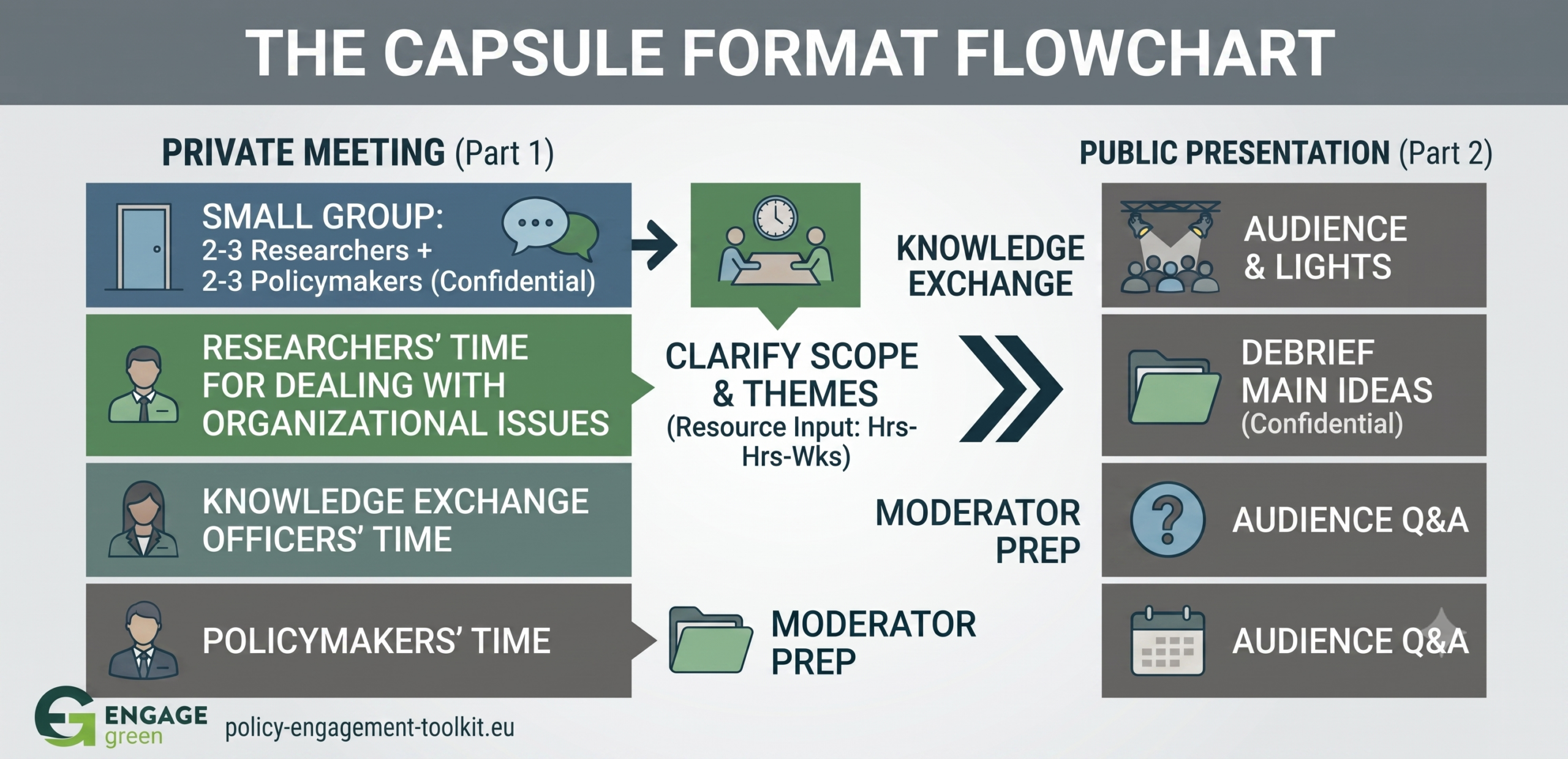
  • A capsule format is a discussion in closed, small group sessions between researchers and policymakers (private). As a rule, these involve two researchers and two policymakers, but there can be less or more if necessary. A small audience may also be present in this discussion.
  • It is a free format that allows participants to engage in free exchange without concern about a large audience listening to, after which the main points that emerged from the discussion are presented to the audience
  • Topics must be open to discussion and the themes defined in advance because there is a public presentation later of the discussion, open to questions from the audience.


How does the format work?

Part 1: The private meeting

The capsule format is based on a confidential and informal setting that is designed to encourage open and constructive discussions.

Generally, two or three policymakers meet with two or three researchers, ideally from different disciplines. The workshop is organized by knowledge exchange officers from the university when, as in our case, we have identified a common theme. The capsule was organized as part of a two-day conference, which gave us the opportunity to bring together researchers and policymakers interested in the topic and provide them with an important opportunity for private discussion on the subject. The meeting is closed to the public and the media. Participants are invited to freely share their knowledge, challenges, and questions without concerns about public communication or political position.

This format aims to create a climate of trust and can lead to mutually beneficial relationships in the future.

Policymakers can ask questions without fear of judgment, and researchers who are not accustomed to speaking in public can present complex or even sensitive findings.

This capsule format also makes it possible to move beyond short-term thinking by opening up new areas for action. These dialogues can be one-off events or part of a cyclical process.

Part 2: The public presentation

At the end of the private session, a public debriefing can be organized to share the main ideas discussed while respecting the confidentiality of individual comments. This time allows for broader reflection and highlights the value of the discussion. In our case, the private session took place when the audience broke up for lunch. When they returned, the public session was included in the conference schedule for the day, which enabled us to have a significant, interested, and dynamic audience.


Challenges and how to address them

The main challenge of this format for support staff (knowledge exchange managers and research managers) is to maintain a common thread throughout the discussion to ensure the coherence and progression of the exchanges. To this end, the choice of moderator is crucial: he or she must have properly prepared the topics in advance, know how to rephrase comments, and make connections between the concerns of the participants, especially during the second phase of the public presentation.


Tasks and resources

Content: The content is very open, but the moderator must have thoroughly prepared the discussion topic and the limits of the researchers’ field of expertise and the limits of the policymakers’ field of activity for the discussion to be productive.

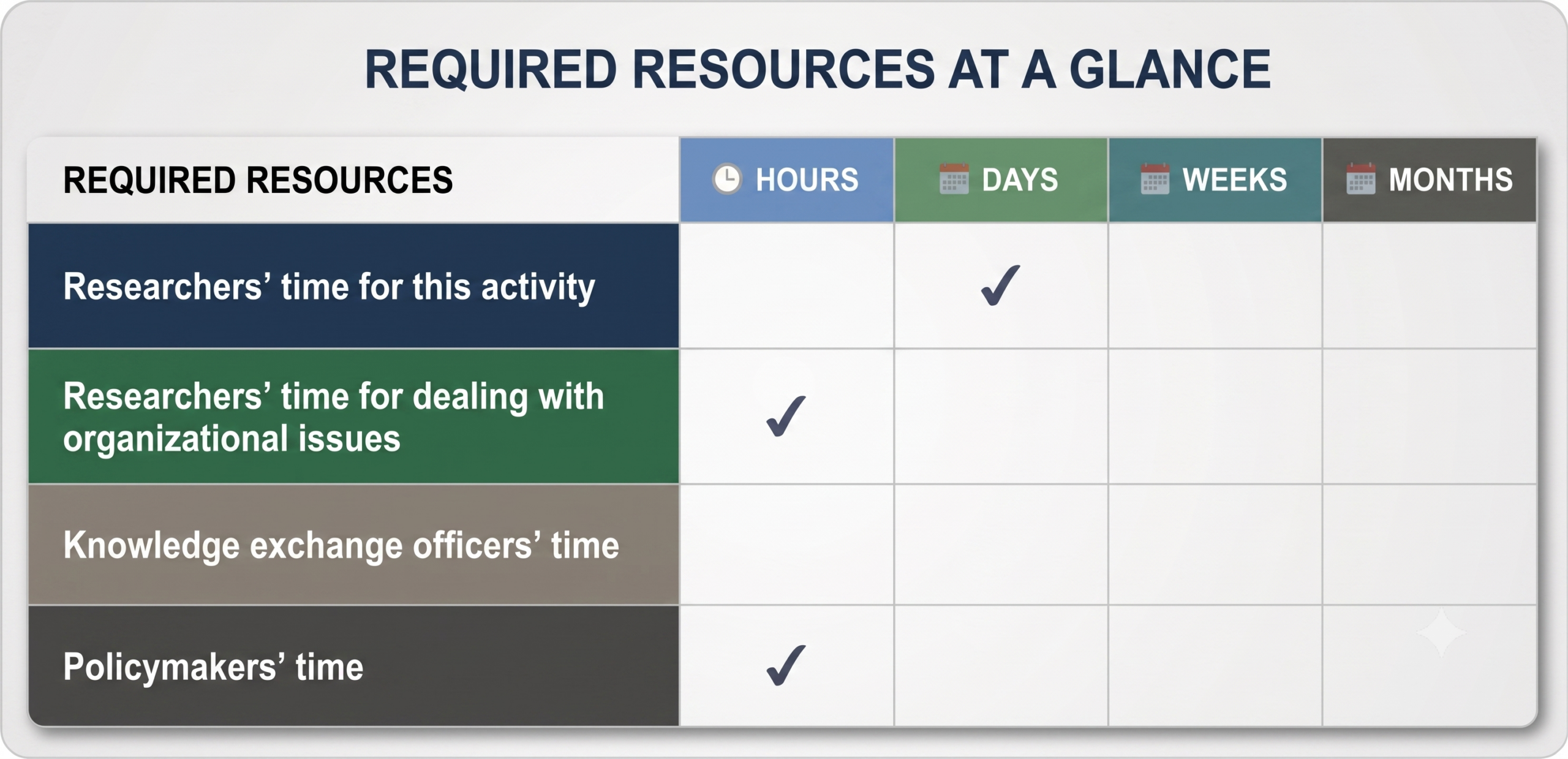
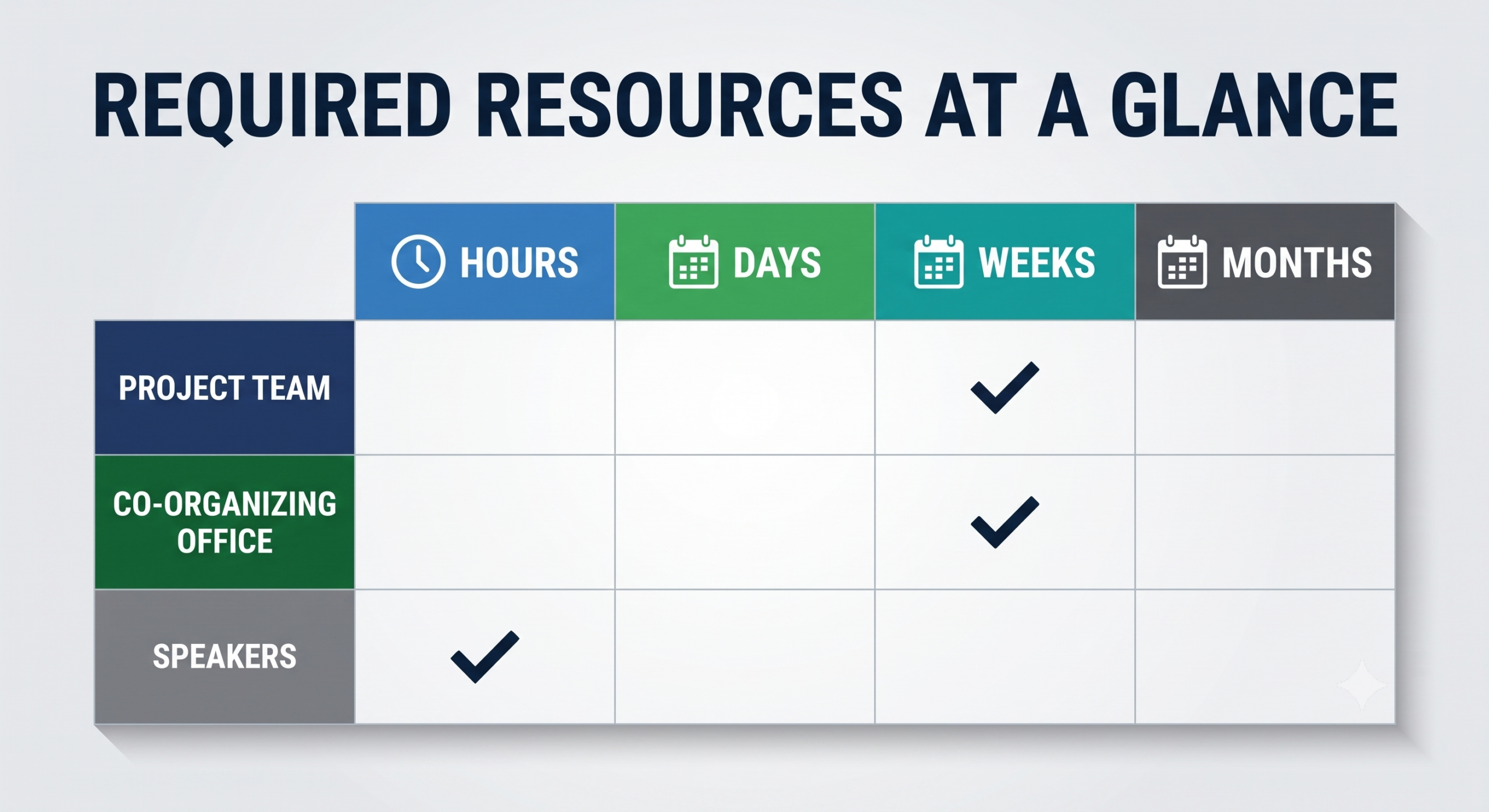
Although the format is fairly open, it requires a certain amount of preparation time for all participants. In fact, a meeting prior to the discussion is very useful for everyone to clarify their area of expertise and also to define the topics and limits of the discussion.


Examples

https://www.univ-lyon2.fr/sciences-et-societe/nos-projets/review-of-the-capsule-meeting-between-policy-makers-and-reseachers-on-the-key-topic-the-management-of-urban-wastelands


Do you want to know more about the policy engagement toolkit?

Do you want to share your experience in policy engagement? Do you think about contributing to the policy engagement toolkit? Feel free to contact Tome Sandevski via science-policy@pvw.uni-frankfurt.de

Introduction to Science Shops

What is a Science Shop?

“Science Shops are organizations that make knowledge available to civil society organizations that don’t have the means to pay or carry out research themselves. Science Shops can be embedded within other organizations (universities, research institutions, companies) or established as independent organizations in the form of non-governmental or other not-for-profit organizations.” (Science Shop Establishment Guide)


Key features at a glance

  • A Science Shop creates dialogue between civil society organizations and the research community to support these initiatives
  • A Science Shop is concerned with sharing ideas and developing appropriate responses
  • For each project, public feedback and/or an accessible deliverable are used to make all the knowledge recommendations that have emerged available


Introduction

What is the format about?

Associations, local authorities, and citizens’ groups sometimes need specific insights and knowledge to consolidate their actions, assess their impact, or discover new approaches.

The Science Shops provide a link between the research community and civil society, encouraging dialogue and collaboration between them.

Thanks to the space for exchange and monitoring, they offer potential for experimentation, particularly through seminars and workshops.

Associations, citizens’ groups, and local authorities are supported in their questioning by researchers who mobilize students in the form of internships, challenges, or group work.


How does the format work?

  1. The Call for interest => formulation of requests. This call for expressions of interest is open for a fairly long period of approximately four months (generally from February to May) so that all applications can be received and properly processed collectively.

A question of general interest is submitted to the Science Shop, studied, and reformulated in coordination with a scientific committee to develop specialized support.

  1. The Scientific Committee => selection of projects. Each year, the Science Shop brings together a scientific committee composed of experts who examine the applications submitted through the call for expressions of interest and select around fifteen projects to be carried out each year. In some cases, the scientific committee redirects applications to other formats.
  2. The design and dissemination of offers => Applications and interviews
  3. The completion of group tutorial projects and of individual placements

A team of researchers or students is then contacted and put together by the science shop to carry out a field study and work with these civil society players to develop a practical response to their problem.

  1. The dissertations / presentations / presentation of results => potential political decision makers in attendance

A public presentation and/or an accessible final publication will make available all the knowledge that has emerged.


Tasks and resources

This is a program to support the stakeholders in a project, promoting dialogue and collaboration between civil society organizations and scientific research.

It supports researchers who want to be more in touch with different stakeholders in the field and is interested in participatory research projects. They will become involved by taking part in seminars and workshops and will benefit from centralized resources on the theme of participatory research.

The Science Shop gives researchers the opportunity to supervise a student or a group project and to support the implementation of research in conjunction with all the players involved.

It also allows them to take part in the work of exploring and supporting social demand, enabling them to find and advise partner structures for collective student projects or personal projects.

For large-scale research projects, they can call on the expertise of the science shop’s third-party supervisors (participatory research supervisors).


Examples

Boutique des sciences de l’Université Lumière Lyon 2 https://www.univ-lyon2.fr/sciences-et-societe/boutique-des-sciences


Sources and further reading

Leaflet Boutique des Sciences ULL2: https://www.calameo.com/read/0074134546a08abe69437

Guide pratique de la recherche participative (A practical guide to participatory research French version): https://lemouvementassociatif-aura.org/wp-content/uploads/bsk-pdf-manager/2024/11/GUIDE-RECHERCHE-PARTICIPATIVE.pdf

Website : le mouvement associatif : https://lemouvementassociatif-aura.org/nos-4-champs-actions/actions-innovation-sociale-associations-mouvement-associatif-auvergne-rhone-alpes/


Living Knowledge Network – the formal international network of Science Shops and Community Based Research : https://livingknowledge.org/

And their Science Shop Establishment Guide (pdf version) : https://www.scishops.eu/wp-content/uploads/2019/07/SciShops_D4.4_Guide.pdf.pdf

Other