Author: Tome Sandevski

Conversations that Open Doors

A World Café on Policy Careers and How Policymaking Institutions Work. A Case Study from Goethe-University Frankfurt


Key features in a nutshell

  • This event format brings early-career researchers into direct conversation with practitioners from regional and national ministries and government agencies, the European Commission, NGOs, and media in a relaxed, small-group setting
  • Using the World Café method, participants rotate between tables across three discussion rounds, allowing them to engage with multiple practitioners and perspectives in a single session
  • Early-career researchers gain firsthand insight into how ministries and other policy institutions actually work – knowledge that cannot be obtained from reading official documents alone
  • The format addresses a structural gap in many academic careers: researchers rarely have the opportunity to ask practitioners directly about career pathways, entry requirements, and the realities of working at the science-policy interface

How does the format work?

This event format was developed and is co-organized by the Policy Engagement Unit at Goethe University Frankfurt – through the Mercator Science-Policy Fellowship Programme and the Erasmus+ project ENGAGEgreen — and the Goethe Research Academy for Early Career Researchers (GRADE). The combination of science-policy expertise and graduate school infrastructure makes it particularly effective, as it addresses two knowledge gaps simultaneously.

First, early-career researchers often do not know how to make their research expertise available to professionals in ministries, the European Commission, NGOs, or media – and they rarely understand what those institutions actually need in terms of scientific input. Second, early-career researchers face a fundamental career decision: whether to pursue a path in academia or beyond. Direct conversations with practitioners provide them with a realistic picture of what non-academic careers at the science-policy interface actually look like.

Since its launch in 2019, the format has been continuously refined. To date, more than 60 policymakers and practitioners and 250 early-career researchers from Goethe University Frankfurt, TU Darmstadt, and Johannes Gutenberg University Mainz have participated.

The event can be organized in five steps.

Step 1: Write the event description

A clear event description helps attract the right participants – both early-career researchers and practitioners. The description should explain the purpose of the event, the key discussion questions, and the methods used. It serves as the basis for announcements in course catalogues, newsletters, and websites.

A sample event description:

Constructive dialogue among science, policy, media, and civil society requires more than good communication from researchers. Policy institutions, NGOs, and the media also need staff who can understand scientific findings and bring them to bear on societal decision making. This event explores how researchers can successfully make the transition from academia to ministries and other policy organizations, the European Commission, international organizations, NGOs, and media — and what challenges await them along the way.

We discuss the following questions with policymaking professionals and representatives from media and NGOs:

  • In what contexts do you draw on scientific expertise, and how do you access and use research findings?
  • What career pathways exist in your organization, and what are the entry prospects for doctoral researchers?
  • What competencies and experiences are most important for making the transition from academia?
  • How does working in a policy institution, NGO, or media organization differ from academia – with respect to pace, decision making, and ways of working – and why?

Methods: brief inputs by practitioners from various organizations; Q&A with the audience; small-group discussions; informal lunch with practitioners.

Step 2: Plan and organize the event

Fix the date and book the room five to seven months in advance. The room should comfortably accommodate 30 to 60 people. Use a banquet layout: round or rectangular tables with five to eight chairs each. Depending on the number of practitioners invited, you will need between five to twelve tables.

Once the event description is finalized, include it in the course catalogue of your graduate school or early-career researcher support structure so that participants can register in advance. A waiting list system is useful for popular editions of the event.

Step 3: Recruit practitioners and table facilitators

Reach out to policymakers and representatives from NGOs and media by contacting practitioners who are fellows or alumni of science-policy programs at your institution or partner universities. Human resources offices at ministries and public agencies can also be useful points of contact. Provide the event description and invite practitioners to join as experts. Aim to recruit between six to ten practitioners per event — enough to offer participants a meaningful choice of tables and perspectives across three rounds.

At the same time, recruit colleagues to serve as table facilitators. Their role is to keep discussions on track, ensure all participants have a chance to speak, and note down the questions raised by early-career researchers for later evaluation.

Step 4: Run the event

Practitioners typically arrive 15 to 30 minutes before the start of the event. Each practitioner is assigned to a table for the duration of the event. A typical program is as follows:

A typical event outline looks like this:

09:30-10:00: Arrival, registration, and informal get-together

10:00-10:10: Introduction: hosting organizations and event format. In our case: Introduction of the ENGAGEgreen project, the Mercator Science-Policy Fellowship-Programme and the Goethe Research Academy for Early Career Researchers.

10:10-10:40: Each practitioner introduces themselves. Guiding questions for the introduction: What are the tasks of your organization? What are your individual tasks? When do you need scientific evidence? Via which channels do you gain access to scientific evidence (e.g., policy briefs, commissioned research reports, expert talks, policy events)? What are typical career paths in your organization?

10:40-11:20: The early-career researchers move to the tables. First discussion round (Q&A session at the tables). Early-career researchers and table facilitators move to a new table after each round. Practitioners remain at their tables throughout. This allows each practitioner to speak with three different groups over the course of the event, and each participant to meet at least three different practitioners.

11:20-11:30: Coffee break

11:30-12:20: The early-career researchers move to the next table of their choice. The practitioners remain at their tables. Second small-group discussion round.

12:20-12:30: Coffee break

12:30-13:10: The early-career researchers move to the next table of their choice. The practitioners remain at their tables. Third small-group discussion round.

13:10-13:20: Invite two or three practitioners and two or three early-career researchers to share their reflections in plenary: What was the most interesting thing you learned today? What surprised you most? Close by sharing a QR code linking to the electronic feedback form. Distributing the QR code at this moment – when participants are still in the room – consistently yields response rates of 70 percent or higher.

13:20-14:20: Light lunch and networking

Step 5: Evaluate and follow up

Process the participant feedback promptly and use it to adjust the format for future editions. Send thank-you notes to all practitioners within a few days of the event. Where participants have noted recurring questions or knowledge gaps, consider compiling these into a practical Q&A handout for future participants.


Tasks and resources: Brief description of the tasks and resources needed by scientists, knowledge exchange officers/research managers, and policymakers

Workshop facilitators

Organizers are responsible for the full event cycle: writing the event description and announcing it via the relevant course catalogue or newsletter; booking the room, arranging seating, microphones, and catering; recruiting practitioners and table facilitators; and processing feedback after the event. The preparation phase typically spans several weeks.

Scientists

Early-career researchers should set aside approximately 3.5 to 4.5 hours for the event, including the informal lunch. Organizers may wish to share the key discussion questions in advance so that participants can prepare their own questions for practitioners.

Policymakers

Practitioners should set aside approximately 3.5 to 4.5 hours, including the informal lunch. Some practitioners bring career information materials to share with participants; this is encouraged and adds practical value to the conversations.

Sources and further reading

Do you want to know more about the policy engagement toolkit?

Do you want to share your experience in policy engagement? Do you think about contributing to the policy engagement toolkit? Feel free to contact Tome Sandevski via science-policy@pvw.uni-frankfurt.de


Why Engage – or Not? An Icebreaker Exercise on the Pros and Cons of Policy Engagement

Key features in a nutshell

  • This exercise invites participants to discuss the reasons for and against engaging with policymakers; while reasons such as impact, the politicization of expertise, and lack of resources and recognition tend to come up immediately; less obvious motivations such as the benefits of policy engagement for research itself, or the intrinsic rewards of the work are rarely mentioned; this quick, interactive exercise helps workshop participants surface and discuss their underlying assumptions regarding academic policy engagement
  • The exercise activates participants in the opening minutes of the workshop, with positive effects on their engagement and participation throughout the session
  • The exercise works equally well in in-person and in virtual workshop settings.

How does the format work?

An active audience is essential for a successful policy engagement workshop. It is equally important to surface the assumptions participants bring with them about what policy engagement is, why it matters, and what makes it difficult. This simple icebreaker achieves both goals in 10-20 minutes.

Step 1: Generate pro and con reasons

Divide participants into groups of two to four. Ask each group to discuss the following questions:

Cite four reasons why researchers should engage with policymakers; cite four reasons why they might choose not to.

In in-person workshops: provide cards and marker pens so groups can write down their answers – one reason per card.
In virtual workshops: use a tool like Mentimeter or a shared digital whiteboard.

Duration: 10 minutes

Step 2: Collect the answers

Ask one group to present their reasons; invite the other groups to add any reasons not yet mentioned.

In in-person workshops, ask groups to pin their cards to a pinboard. Take a photo of the results for documentation.
In virtual workshops, take a screenshot of the compiled answers.

Duration: 10 minutes

Step 3: Debrief

The answers can usually be grouped into the following categories. Facilitators should use these as a guide for the debrief discussion rather than as a fixed script.


Reasons in favor of policy engagement

Impact. Scientific evidence can improve the quality of policy decisions. Many researchers work on salient issues – health, energy, environment, climate, conflict, education – and want their findings to make a difference in the real world.

Giving back to society. Most research is funded by taxpayers. Researchers want to demonstrate the societal value of their work.

Access to funding. Commissioned research can be an important funding stream. Researchers may also engage with policymakers to raise awareness of their field and advocate for research budgets. This response is worth noting in the debrief: it shows that many participants do not yet distinguish between policy engagement and science advice on the one hand and lobbying, government affairs, and fundraising on the other. Making this distinction explicit is important, and this exercise therefore pairs well with a subsequent session on the differences between policy engagement and these related but distinct activities.

Benefits for research. Engaging with policymakers can help researchers gain new perspectives, identify emerging policy challenges, and generate new research questions or hypotheses. In surveys conducted among researchers participating in the joint policy engagement activities of the Rhine-Main Universities, around 60 percent report that engagement with policymakers has given them new ideas that benefit their own research. Policy engagement can also open doors to interviews with policymakers, access to data or internal documents, and partnerships with public institutions for research projects. This reason is rarely mentioned spontaneously, and it is worth drawing participants’ attention to it explicitly.

A rewarding experience. Policy engagement can be intrinsically motivating and genuinely enjoyable. This reason is almost never mentioned unprompted, and is worth addressing directly: researchers should only pursue policy engagement activities they find meaningful or at least tolerable. Intrinsic motivation is the most reliable predictor of sustained engagement. As a rule of thumb for participants: do not commit to activities you actively dislike!


Reasons against policy engagement

Lack of understanding of policymaking and policy engagement formats. Many researchers do not understand how policymaking works or which policy engagement formats exist beyond policy briefs, lengthy reports, or formal expert bodies. Workshops on policy engagement must therefore address both: how policy processes work, and the full range of formats available to researchers.

Perceived lack of impact. Workshop participants frequently report frustrating experiences: a 100-page commissioned report whose recommendations were ignored; a year’s work on an expert body that produced no policy change. Such experiences reflect a mismatch between researchers’ expectations and the realities of policymaking. This is often rooted in limited knowledge of how policy processes actually work and can be revisited productively when the workshop turns to explaining policymaking processes in more depth.

Lack of time and resources. Researchers face competing demands – research, teaching, administrative obligations – and often perceive policy engagement as time-consuming or expensive. This is a legitimate concern, but it is also a misconception worth addressing: policy engagement takes many forms, some of which require months of sustained effort, while others can be completed in a matter of hours or days.

Lack of recognition. While science communication and knowledge exchange are becoming increasingly valued in academic institutions, many researchers, particularly those doing fundamental research, remain concerned that engaging with policymakers may be seen as insufficiently academic. Recognition and reward systems for policy engagement are developing in many countries but remain underdeveloped in others.

Politicization of expertise. Many researchers worry about being associated with particular political parties or ideologies when taking public positions on policy issues. They fear being drawn into political debates or being held personally responsible for government decisions informed by their research. These concerns are reinforced by well-documented cases in which scientists were publicly attacked by politicians, media, or social media users for providing scientific evidence on contested issues.

Requirements from superiors or funding agencies. Funding agencies increasingly require projects to demonstrate policy impact. Institutional leaders sometimes ask researchers to produce policy publications or participate in policy events. While there may be good reasons for such requirements, they frequently generate frustration when researchers feel obliged to perform tasks they find meaningless or poorly suited to their expertise. Researchers in this situation should identify the policy engagement activities they are most likely to find meaningful and communicate clearly to their superiors about what they can realistically contribute. Where impact documentation is required, the goal should be to find activities that are both documentable and genuinely valued by the researcher.


Conclusions

The responses generated by this exercise will resurface throughout the workshop. Facilitators should note which reasons and which misconceptions appear most prominently in their group. They should use them as reference points when introducing subsequent topics such as policymaking processes, policy engagement formats, or the distinction between science advice and lobbying.


Tasks and resources: Brief description of the tasks and resources needed by scientists, knowledge exchange officers/research managers and policymakers

Workshop facilitators

Provide cards and marker pens for in-person workshops or set up a digital tool such as Mentimeter for virtual sessions. Communicate clearly at the outset that there are no right or wrong answers. The goal is to allow honest reflections to arise. Enforce the time limit: this is an icebreaker, not a full discussion, and should not exceed 20 minutes in total. Document the answers by photographing the pinboard or taking a screenshot.

Researchers, research managers, and other participants

Participants are encouraged to state their honest reasons for and against policy engagement without censoring themselves in search of the “right” answer. The exercise is most valuable when participants share genuine concerns and motivations.

Policymakers

If policymakers are present, they are invited to share their own perspective on why researchers should, or should not, engage with them. Facilitators can use this as an opportunity to contrast the researchers’ responses with those of the policymakers, often generating productive discussion.


Do you want to know more about the policy engagement toolkit?

Do you want to share your experience in policy engagement? Do you think about contributing to the policy engagement toolkit? Feel free to contact Tome Sandevski via science-policy@pvw.uni-frankfurt.de


Lost in Translation: How Researchers Lose Policymakers in 24 Slides

Key features in a nutshell

  • This exercise helps participants identify the key elements of effectively presenting their research expertise to policymakers by analyzing a fictitious presentation from the perspective of a policymaker.
  • By stepping into the shoes of a policymaker, participants experience firsthand why slide count, language, and content selection matter — and what a difference the right framing makes.
  • Participants leave the exercise with a practical set of dos and don’ts for structuring, framing, and delivering research presentations to policy audiences.

How does the format work?

Step 1: Review the slides

Distribute an electronic or printed version of the fictitious presentation (LINK WILL FOLLOW) and ask participants to work through the slides using the following scenario:

You are working for a Member of the European Parliament. A friend of yours is a researcher who coordinates an EU project on sustainable public transportation in Europe.

The European Public Transportation Association has invited your friend to present the research findings from the EU project as well as policy recommendations for the future of sustainable public transportation in Europe at its policy conference in Brussels. The organizers made it very clear that the presentation must not exceed 10 minutes.

The conference will bring together 300 policymakers from the local, regional, national, and EU levels, as well as representatives from public transportation companies, civil society, and academia. Since your friend has never given a presentation to policymakers, he asks you for feedback on the draft version of his presentation.Do you have any suggestions on how to improve the presentation?”

Step 2: Test what stuck

After participants have reviewed the slides, ask them to close the presentation and answer the following questions from memory:

  • Seventeen researchers are mentioned in the presentation. How many of their names do you remember?
  • What do you remember about the four universities involved?
  • Do you recall the numbers of students, staff, and research institutes mentioned?
  • Do you remember the names of the predecessor projects of the SUSTRA(I)N project?

Most participants will struggle, and that is the point. Use their responses to open a discussion on why this information did not stick, and what that tells us about how research presentations are typically structured.

The fictitious presentation has 24 slides. The first 16 describe the project and consortium rather than presenting policy-relevant findings. That is far too many. Policymakers engage with researchers because of their expertise – not because their university has five departments and 32 research institutes.

  • Start with three key messages you want the policymakers to remember. Structure your presentation around the key messages
  • Use only 1-2 slides to briefly present your consortium, institution, or project

The presentation also relies heavily on acronyms that audiences outside the research community are unlikely to recognize. The slide-by-slide analysis typically surfaces the following issues, which facilitators can use to structure the debrief discussion:

Other slides also offer room for improvement:

  • Slide 5: The four academic partners are described in detail, while the 14 practice partners are not named; when giving a presentation at a conference organized and attended by practitioners, practitioner partners should also be mentioned
  • Slide 16: The eight work packages are presented, including the ones on theory and method development; interestingly, the work packages on long-term assessment of public infrastructure (WP6), perceptions of mobility in rural areas (WP7), and policy recommendations and practitioner training (WP8) are not mentioned in the remainder of the presentation
  • Slide 19:

=> Dispense with slides on theory or methods that policymakers are very unlikely to understand

  • Slide 18: When interacting with policymakers, researchers often complain about the lack of funding; sometimes, they do so before even mentioning their research findings, as in this case; while research funding is very important, the presented research project did not analyze research funding as such, and, therefore, complaining about the lack of research funding leaves a rude and unprofessional impression:
  • It is perfectly fine for researchers to discuss research funding issues with policymakers, but they should not hijack events to do so. Researchers should arrange separate meetings with policymakers to discuss research funding. They should use formal channels, such as consultations or position papers, or through academic associations. Also, they should be transparent about funding from the outset rather than taking policymakers by surprise, which might have the opposite effect than the one intended.

Slide 20: While researchers should clearly present their findings and criticize policy outcomes, they should not use language that policymakers can receive as inappropriate or disrespectful. Also, having 32 acronyms on a slide is too much, even if most of them are known.

  • Use respectful language when presenting critical research findings to policymakers.

Slide 21: The research project found that the government struggles with the long-term implementation of public transportation strategies and legal acts, especially during times of crisis. To ensure long-term implementation, the researchers recommend close cooperation between governing and opposition parties as well as earmarking a dedicated reserve for times of crisis. These recommendations are not realistic.

  • Focus on policy recommendations

Step 3 (optional)

Ask participants to revise the presentation: reduce the number of slides and adjust the remaining ones to make the presentation more effective for a policy audience.

Step 4 (optional)

Ask participants to compile a list of ten dos and don’ts for presenting research to policymakers.

  • The full exercise takes between 20 and 40 minutes, depending on how much discussion the debrief generates


Tasks and resources: Brief description of the tasks and resources needed by scientists, knowledge exchange officers/research managers, and policymakers

Workshop facilitators

Share the fictitious presentation with participants ahead of or at the start of the session. Guide participants through the scenario, facilitate the memory test in Step 2, and lead the debrief discussion. Familiarity with common pitfalls in science-policy communication is helpful but not required – the fictitious presentation is designed to make the issues visible without prior expertise.

Scientists and other participants

Review the fictitious presentation individually or in pairs. Contribute to the debrief discussion by sharing observations from the policymaker’s perspective. For Steps 3 and 4, participants revise the presentation and/or develop their own dos and don’ts list.

Policymakers

If policymakers are present, invite them to share what they look for in a research presentation – and what puts them off. Their perspective is often the most memorable part of the exercise and adds a dimension of authenticity that no facilitator can replicate.


Workshop Exercise — Giving Presentations to Policymaker

Scenario: You work for a Member of the European Parliament. One of your friends is a researcher who coordinates an EU project on sustainable public transportation in Europe. Your friend has been invited to present the project’s research findings and policy recommendations at a conference in Brussels.

See the full presentation


Do you want to know more about the policy engagement toolkit?

Do you want to share your experience in policy engagement? Do you think about contributing to the policy engagement toolkit? Feel free to contact Tome Sandevski via science-policy@pvw.uni-frankfurt.de


Understanding Policy Priorities: A Key Documents Exercise

Key features in a nutshell

  • This exercise helps participants identify policy areas relevant to their research by exploring key policy documents such as government programs or sectoral strategies
  • By reading the documents in full or using the table of contents and search function participants practice an efficient, targeted approach to navigating lengthy policy documents

How does the format work?

Most local, regional, or national governments in OECD countries, the European Commission, international organizations, and political parties publish documents that set out their priorities: government programs, strategic plans, work programs, or party platforms. These documents are essential reading for researchers who want to engage with policymakers effectively: they reveal which issues are on the political agenda, what language policymakers use to describe them, and where potential entry points for science-policy engagement exist. This exercise introduces participants to this type of document and asks them to map their own research expertise onto current policy priorities.

Step 1: Choose your document

Ask participants to select a policy priority document relevant to their institutional or national context. Depending on the workshop audience, facilitators may preselect two to four documents or invite participants to choose their own.

Step 2: Navigate efficiently

Participants can read the documents in full if they want to. Alternatively, ask them to only use two tools: the table of contents to get an overview of the document’s structure and the search function to look up terms related to their research.

Ask participants to reflect on the following questions as they browse:

  • Do you find topics in this document on which you have research expertise?
  • Which policy issues are of particular interest to you?
  • What language does the document use to describe the issues you work on? Does it match the terminology you use in your research? Do you understand the terminology?
  • Are there topics you expected to find that are absent or unexpected topics that are prominently featured?

Step 3: Debrief

Facilitate a short plenary discussion. Useful questions include:

  • Where did you find the strongest connections to your own research?
  • Were there any surprises, topics that were more prominent or less prominent than you expected?
  • Did the language used in the document differ from how you would describe the same issues in an academic context? What does that tell you about how to communicate your research to policymakers?

The debrief typically takes 10–20 minutes, and productive conversations about the gap between academic and policy language often arise Steps 1 and 2 can be sent to participants in advance, with Step 3 conducted as a plenary discussion during the workshop. The full exercise – including the debrief – takes between 30 and 60 minutes, depending on group size and the depth of discussion.


Tasks and resources: Brief description of the tasks and resources needed by scientists, knowledge exchange officers/research managers, and policymakers

Workshop facilitators

Select two to four documents in advance that are most relevant to the workshop audience and share them with participants before the session if possible. For international audiences, prepare a short overview of the types of policy priority documents that exist at national, EU, and international levels. Facilitate the debrief discussion, paying particular attention to differences in language between academic and policy documents –  this is often the most productive thread.

Scientists and other participants

Browse the selected document using the table of contents and search function, reflect on the questions in Step 2, and contribute to the debrief. Participants who already engage with policymakers are encouraged to reflect on whether they have previously used documents like these to prepare for meetings or to identify relevant contacts.

Policymakers

If policymakers are present, invite them to share how they themselves use documents such as coalition agreements or work programs in their day-to-day work – and how they would expect researchers to engage with them. Their perspective on the gap between political language and research language is often illuminating.


Do you want to know more about the policy engagement toolkit?

Do you want to share your experience in policy engagement? Do you think about contributing to the policy engagement toolkit? Feel free to contact Tome Sandevski via science-policy@pvw.uni-frankfurt.de


Understanding Policymaking Institutions: An Organisational Chart Exercise

Key features in a nutshell

  • This exercise helps participants understand how policymaking institutions are structured by exploring the organizational charts of ministries, the European Commission, international organizations, and other public bodies.
  • By mapping their own research expertise onto the internal structure of a ministry or directorate-general, participants identify concrete entry points for science-policy engagement.
  • Rather than overwhelming participants with theoretical lectures on governance, this method uses a practical, discovery-led approach where scientists look up real-world organizational structures.

How does the format work?

Organizational charts are one of the most underused tools in science-policy engagement. They reveal not just what a ministry or directorate-general works on, but how it is structured:  which units exist, what they cover, and where the interfaces between policy areas lie. For researchers trying to identify the right contact within a large institution, an organizational chart is an essential starting point.

This exercise asks participants to explore the organizational charts of policymaking institutions relevant to their own research and to compare what they find with what they expected.

Step 1: Choose your institution

Ask participants to identify a policymaking institution relevant to their research expertise and visit its website. Participants can choose ministries at the national or, where applicable, regional level, directorates general of the European Commission, and international organizations.

Step 2: Predict before you explore

Before looking at the organizational charts, ask participants to write down five policy issues they expect the institution to work on. For example, a researcher focusing on energy might expect to find units covering renewable energy, nuclear energy, electricity grids, and energy taxation.

This prediction step is important: it activates prior assumptions and makes the comparison in Step 3 more revealing.

Step 3: Explore the organizational chart

Ask participants to look up the organizational chart of their chosen institution and compare it with their predictions:

  • Which of the policy issues you expected are reflected in the chart?
  • Which topics did you not expect to find?
  • Are there units whose remit is unclear from the name alone?
  • Compare the organizational structure of a regional or national ministry with the organizational chart of a directorate general of the European Commission or international organization: What differences do you notice in how they are structured?

Step 4: Debrief

Facilitate a plenary discussion. Discuss the questions asked in step 3. Additional helpful questions are:

  • What surprised you most about the organizational chart?
  • Where would you direct a policy brief or an event invitation based on what you found?
  • Did the structure help you identify a specific unit or contact person you had not previously considered?

The debrief typically takes 15–30 minutes and often generates lively discussion. The full exercise – including the prediction step and debrief – takes between 30 and 60 minutes, depending on group size and the depth of discussion. Steps 1–3 can be sent to participants in advance, with Step 4 conducted as a plenary discussion during the workshop.


Tasks and resources: Brief description of the tasks and resources needed by scientists, knowledge exchange officers/research managers, and policymakers

Workshop facilitators

Prepare a short overview of how the relevant institutions are structured (e.g., the standard structure of a German federal ministry or the DG system of the European Commission) to share with participants before or during Step 3. Facilitate the debrief discussion. No specialist knowledge of the institutions is required– the exercise is designed to surface participants’ own discoveries.

Scientists and other participants

Identify a relevant policymaking institution, make their predictions in Step 2, explore the organizational chart in Step 3, and contribute to the debrief. Participants who already have contacts within a ministry or directorate general of the European Commission are encouraged to reflect on where exactly those contacts sit within the institutional structure and what that tells them about the scope of their existing network.

Policymakers

If policymakers are present, invite them to comment on how their own institution’s organizational chart reflects – or not – day-to-day realities. In practice, formal structures and informal working relationships often diverge, and policymakers can offer invaluable insight into how decisions actually flow within an institution.


Do you want to know more about the policy engagement toolkit?

Do you want to share your experience in policy engagement? Do you think about contributing to the policy engagement toolkit? Feel free to contact Tome Sandevski via science-policy@pvw.uni-frankfurt.de


Don’t Waste Your Time and Funding: Why Dissemination Matters as Much as Content

Key features in a nutshell

  • To avoid wasting time and funding on unread policy publications or poorly attended events, researchers and knowledge mobilizers must plan dissemination strategies from the very beginning
  • Effective dissemination combines several reinforcing strategies: stakeholder mapping and personalized outreach, media and social media, personal networks, and the dissemination channels of partner organizations

What is the issue?

Researchers who are invited by policymakers to conduct commissioned research, participate in expert bodies, attend parliamentary hearings, or speak at policy events enjoy direct access to decision makers — a significant advantage. Researchers new to policy engagement, however, face a different challenge: gaining visibility among policymakers in the first place.

The risk is real. A well-researched policy publication that no policymakers read or a carefully organized policy event that attracts only other researchers, represents a significant loss of time and resources. The solution is not to only focus on content; it is to plan dissemination from the very beginning of a project, with the same care and deliberateness as the research itself. The following strategies are possible:


Strategy 1: Stakeholder mapping and personalized outreach

Researchers or knowledge mobilizers can identify their target audience by browsing the organizational charts and websites of relevant policymaking institutions: local and regional governments, national ministries and agencies, parliaments, political parties, EU institutions, and international organizations. From this, they can build a targeted mailing list.

The effort required varies enormously depending on the scope of the topic. A policy publication on cycling behavior in a single neighborhood may be relevant to only a handful of policymakers – mapping them might take a few hours. A publication on cycling behavior across 214 cities in 25 European countries may be relevant to policymakers at the local, national, and EU level. Mapping them and researching their contact details could take weeks or months.

Wherever possible, researchers should avoid sending a single generic message to all recipients. Personalized outreach, even when based on a common template, is far more effective. The same policy report on cycling, for example, might be relevant to very different audiences for very different reasons:

  • A ministry of transportation responsible for traffic regulation, road planning, and signage
  • A ministry of education looking to address cycling in school curricula
  • A mayor’s office seeking to position the city as a cycling-friendly destination for tourists
  • Members of parliament advocating for active lifestyles and long-term public health

Each of these recipients deserves a message that speaks directly to their remit and interests. Researchers should use a personal hook in every message: one sentence that explains why this particular publication or event is relevant to this particular recipient.

Finally, every outreach message should include an explicit offer of availability: researchers should state that they are happy to arrange a virtual meeting or phone call to discuss the findings in more detail.


Strategy 2: Media, social media, and dissemination platforms

Press releases remain a relevant tool for increasing the visibility of publications and events, particularly when issued through an institution’s communications office. Announcing policy publications or events via social media can also be effective – researchers and knowledge mobilizers can connect with policymakers directly and invite them to follow their personal or institutional accounts. Specialized policy platforms such as EU Agenda or Euractiv reach many policymakers and policy professionals and can be used to announce events or publications.


Strategy 3: Personal networks

Colleagues, collaborators, and alumni contacts who are well connected with policymakers are a valuable dissemination resource. Researchers and knowledge mobilizers can ask trusted contacts to introduce them to relevant policymakers, forward publications or event invitations to their networks, or share content on social media. A personal recommendation from a trusted intermediary is often more effective than a cold outreach message.


Strategy 4: Dissemination channels of partner organizations

Research institutions, think tanks, NGOs, foundations, and associations that already enjoy high visibility among policymakers can serve as important dissemination partners. Researchers and knowledge mobilizers should explore whether these organizations publish guest contributions in their newsletters or publication series, a well-placed guest article can reach a far larger and more relevant audience than putting a policy brief on the institutional website.

Inviting experts from think tanks, NGOs, foundations, or other organizations to participate in policy events also serves a dual purpose: it adds diversity and credibility to the event, and it expands its reach, as invited guests typically share event information through their own social media channels and communications networks.


Combining strategies

The strategies above are not mutually exclusive, they reinforce one another. Researchers and knowledge mobilizers should assess the resources they can realistically invest in dissemination and select the combination of strategies that best fits their topic, target audience, and institutional context.


Tasks and resources

Researchers

Researchers sometimes underestimate the importance of dissemination. The most important mindset shift is this: producing scientific evidence is not enough. Researchers should plan at least some dissemination activities themselves, particularly personalized outreach to policymakers they know or have identified through stakeholder mapping.

Knowledge mobilizers

Knowledge mobilizers play a central role in making dissemination efficient and sustainable. Once a stakeholder map has been built and a mailing list created, it can be maintained and reused for future activities. Knowledge mobilizers should develop reusable templates for email messages, social media posts, and press releases that can be adapted to each new publication or event. They should also help researchers identify partner organizations like think tanks, NGOs, foundations, and associations that can extend the reach of their work.


Do you want to know more about the policy engagement toolkit?

Do you want to share your experience in policy engagement? Do you think about contributing to the policy engagement toolkit? Feel free to contact Tome Sandevski at science-policy@pvw.uni-frankfurt.de


Resources and further reading

Baron, Nancy (2010), Escape from the Ivory Tower: A Guide to Making Your Science Matter. Island Press.

Swann, Michelle (2012), Writing Professional Emails: The Step-by-Step Guide.

Willis, Christina C. (2020), Sustainable Networking for Researchers and Engineers, https://doi.org/10.1117/3.2535500.


Providing Evidence on School Closures during the COVID-19 Pandemic

Interview with Professor Reyn van Ewijk (Chair of Statistics and Econometrics at Johannes Gutenberg University Mainz)

Prof. Dr. Reyn van Ewijk is Professor of Statistics and Econometrics at Johannes Gutenberg University Mainz. He has a background in economics, psychology, and epidemiology. In his research, he uses econometric statistical methods, in particular so-called natural experiments, to study human health. He uses large databases such as biobanks and registry data.

Professor von Ewijk, in the summer of 2021 you provided the German Academy of Pediatric and Adolescent Medicine / an umbrella organization for pediatric and adolescent medical societies with information for a statement for the Federal Constitutional Court. How did the contact come about?

At that time, I was active in the COVID-19 Public Health Competence Network as a representative of the German Society for Health Economics. Within this network, I came into contact with a representative of the German Society for Social Pediatrics and Adolescent Medicine. The pediatricians were interested in the economic impact of pandemic-related measures in schools. I provided input on this, and later the German Society for Social Paediatrics and Adolescent Medicine was asked by the German Academy of Pediatrics and Adolescent Medicine to contribute to a statement to the Federal Constitutional Court regarding the ban on in-person classes. I also provided some advice on this.

Did you have the necessary information at hand when you received the request, or did you have to do more research yourself?

At the time, I had already given a few lectures on the short- and long-term consequences of school closures and was quite familiar with the existing scientific literature on this topic. I had also started my own research project, together with some colleagues, in which we investigated how school openings in Germany after the 2021 summer vacation affected incidence rates. Thus, I was deeply familiar with the topic and only had to spend a little extra time gathering more information and evidence.

At the end of 2021, you published an analysis on the containment effect of schools on the spread of Sars-Cov-2. What was the key message of your analysis?

We analyzed the impact of school openings on the spread of Sars-Cov-2 based on different times for the ending of the summer vacation in German federal states. School openings initially led to a brief increase in infection numbers as asymptomatic cases were detected through testing. Subsequently, opening schools under strict hygiene measures and mandatory testing led to decreasing infection rates. This shows that schools can contribute to pandemic control under certain conditions. School closures, on the other hand, can make the important monitoring of infection rates more difficult and should only be used as a last resort due to the serious consequences for children.

The topic of school closures during the Covid-19 pandemic has been the subject of much controversy in Germany. Were you worried that your study would push you into a political corner?

At that time, it was clear from all the scientific literature – both before and during the pandemic – that school closures lead to significant learning losses, especially in Germany, where the digital infrastructure in schools was poor and made distance learning difficult. Such effects are particularly strong among socially weaker groups and reinforce social inequality. In addition, school closures have long-term negative consequences for health, income, attitudes towards society, etc. In Germany, we had a very effective system for testing and hygiene measures in schools. Against this background, it was more important to me to bring our results and the message they conveyed into the discussion than to worry about being pushed into a political corner.

Did the media pick up on their findings?

Our work was picked up and discussed by several newspapers, including Die Welt and Bild, as well as by radio stations and on online news.

Have you received any feedback from policymakers?

We had no direct contact with politicians. Nevertheless, they have probably heard about our research in the media or in a policy report we wrote. Policymakers base their decisions and the content of their communication on many different influencing factors. They do not always mention these factors explicitly, and even if they do, we do not always find out about them. Therefore, we cannot know exactly if and how our research has influenced policy. However, one media report suggests that we have had at least some influence, as the Minister of Education of Bavaria explicitly referred to our work when he promised to do everything possible to keep schools open.


Tome Sandevski (Goethe-University Frankfurt) conducted this interview.

Do you want to know more about the policy engagement toolkit?

Do you want to share your experience in policy engagement? Do you think about contributing to the policy engagement toolkit? Feel free to contact Tome Sandevski via science-policy@pvw.uni-frankfurt.de


Don’t Just Present – Connect! A Researcher’s Guide to Policy Events

Key features in a nutshell

  • Policy events offer three distinct dimensions for scientific impact, moving from formal presentation to individual relationship building:
  1. Formal engagement: Presenting expertise during panel discussions, lectures, presentations, or workshops.
  2. Informal networking: Building direct connections during coffee breaks, lunches, and receptions.
  3. Strategic follow-up: Converting brief encounters into sustained, collaborative policy dialogues post-event.
  • Scientists should not attend policy events just to deliver a speech or participate in a panel discussion; they should attend to have informal conversation and to secure two to three meaningful follow-up meetings.
  • Breaks, lunches, and receptions are as important at the sessions: Organizers of policy events should allow for networking opportunities and informal discussion during breaks.

How does the format work?

To maximize time and impact, researchers must view every policy event through three structural dimensions.

  1. The formal dimension (The platform)

This includes panel discussions, keynote presentations, and interactive workshops. Securing an active role as a speaker or panelist establishes institutional credibility and highlights relevant research. But this is merely the hook—not the intended result.

  1. The informal dimension (The connection)

Coffee breaks, lunch hours, and evening receptions are where real policy alignment happens. Informal settings encourage participants to speak more candidly about constraints, political timelines, and knowledge gaps than a public panel allows. Researchers should avoid the temptation to check emails, isolate themselves within academic circles, or leave early.

  1. The follow-up dimension (The impact)

High-value conversations should conclude with researchers securing permission to reach out again, transforming a brief chat into long-term policy contribution.

Visual blueprint: Why micro-networking beats macro-presentations

Researchers often underestimate verbal exchange compared to publications. At a natural pace, speakers deliver roughly 130–160 words per minute (approx. half a page of text). Consider how two different strategies compare:

Researcher A (The presenter): Delivers a 15-minute presentation plus 5 minutes in Q&A (20 minutes total speaking time = ~10 pages of text transmitted). During breaks, this researcher checks emails, networks only with known academic peers, and leaves early.

Researcher B (The networker): Holds no formal speaking role but actively engages policymakers during breaks and receptions for a combined 50 minutes of conversational speaking time (~25 pages of targeted text transmitted). This researcher secures three explicit agreements for future check-ins. Result: Three scheduled follow-up meetings to pitch evidence directly.


Tasks and resources

Researchers

How can researchers prepare for networking?

Step 1: Analyze & map the room (Pre-event)

  • Researchers should review the program and participant list in advance. They should identify the specific policymakers or other practitioners they would like to connect with
  • If the list is not public, researchers should ask the organizers about the expected audience profile

Step 2: Prepare policy-ready materials

  • Researchers should prepare a 60-second elevator pitch focusing strictly on the policy relevance of their expertise, avoiding pure academic debates or methodology
  • Researchers should bring physical copies of brief texts such as policy briefs, factsheets, or infographics.

Step 3: Execute strategic approach & icebreakers

  • Scientists should approach targets during breaks; they should respect boundaries (skipping those on active phone calls or those writing emails on their laptops) but confidently join standing groups at tables with a polite, “Mind if I join you?”
  • Open-ended icebreakers can include:
  • What session are you most looking forward to?
  • Which session did you find most interesting so far?
  • What did you make of [speaker’s] argument on X?
  • Follow-up questions can include:
  • What kind of scientific evidence would be useful to you?
  • What’s the biggest challenge you face on this topic?

Step 4: Secure the pivot to follow up

  • If the connection is positive, scientists should pivot before the break ends: “I’d love to send a brief update when our next research results are out. May I get your card or scan your LinkedIn QR code?”
  • Sharing a physical policy brief containing clear contact details is an effective way to create an immediate, professional handoff

Step 5: Lock in the meeting (Post-event)

  • Scientists should send a tailored follow-up email within 48–72 hours
  • They should provide links to any data or publications discussed and propose a follow-up meeting over the next weeks


Knowledge exchange officers and research managers

Designing events that maximize science-policy impact requires moving away from overcrowded slide presentations and prioritizing structured interaction. Knowledge exchange officers or research managers who organizeing events should consider the following suggestions:

  • Protect networking buffers: For any event exceeding two hours, organizers should embed coffee breaks of at least 20 to 30 minutes; organizers must never compress breaks when sessions run over time, and they should inform speakers beforehand that time limits will be strictly enforced.
  • Curate high-visibility materials: Organizers should provide large, highly legible name tags; if possible, they can embed QR codes on badges that link directly to professional profiles
  • Moderate dynamic Q&A sessions: Moderators should structure Q&A blocks to draw out room expertise. They should announce clearly at the start: “Questions must be limited to 1–2 minutes to allow room for everyone.” This prevents long statements from the audience and helps scientists identify interesting peers for the next break
  • Knowledge exchange officers and research managers can support scientists by developing clear elevator pitches and designing digestible factsheets
  • Knowledge exchange officers and research managers can actively introduce researchers to participating policymakers on the floor during receptions


Do you want to know more about the policy engagement toolkit?

Do you want to share your experience in policy engagement? Do you think about contributing to the policy engagement toolkit? Feel free to contact Tome Sandevski at science-policy@pvw.uni-frankfurt.de


Resources

Willis, Christina C. (2020), Sustainable Networking for Researchers and Engineers, https://doi.org/10.1117/3.2535500.

Zack, Devora (2019), Networking for People Who Hate Networking: A Field Guide for Introverts, the Overwhelmes, and the Underconnected, Berrett-Koehler Publishers.

Exercise: The Invitation Test – Designing Events Policymakers Actually Attend

Making events appealing to policymakers

Summary: Key features in a nutshell

  • This exercise helps scientists and knowledge-exchange officers understand the difference between academic and policy-oriented events.
  • Policymakers need event descriptions and invitations that clearly demonstrate why attending the event would benefit them.


How does the format work?

Step 1: Share the two letters of invitation for a fictitious conference in Brussels with the workshop participants. Provide the following instruction: “You are working for a member of the European Parliament, and your boss has received two invitations to take part in panel discussions in Brussels. Unfortunately, both are scheduled for the same time. Your boss asks you to review the invitations and to recommend the one most likely to benefit her in terms of access to policy-relevant research, stakeholder dialogue, and visibility. Please read both invitations. Which one do you recommend? What aspects of the invitations do you find convincing? What aspects could be improved?”

Step 2: Ask the participants to read the two invitations. They have three minutes to do so.

Step 3: Ask the participants to identify the differences between the two invitations. What do they appreciate about the structure of each event? Which event is likely to be more beneficial for the MEP?

Invitation 1: Tis one has several weaknesses. First, it is too long, making it difficult to locate key information such as the date and venue. Second, it reads like a summary of an academic conference program clearly aimed at a scientific audience, featuring numerous acronyms and references to scholars who may be well known within their fields but are unlikely to be recognised outside academia. Third, the presence of major publishing houses and the launch of a new dataset may be compelling reasons for researchers to attend but are unlikely to attract policymakers. Fourth, a panel composed of three academics and one policymaker is not particularly appealing to a political audience. Finally, the event is held in Vilvoorde, which, while only around 11 km from the European Parliament, still takes approximately 30 minutes to reach by train or car — meaning the MEP would need to set aside at least an hour just for travel.

Invitation 2: The second is more effective for several reasons. First, it is concise and presents key information — date, venue, and purpose — immediately. Second, it makes clear from the outset why the MEP has been contacted personally. Third, the panel features one researcher with demonstrable policy experience as a member of an OECD expert group, alongside two representatives of prominent associations. Fourth, the invitation indicates that the event is expected to be well attended and likely to attract media coverage — both of which matter to policymakers. Finally, the venue is within walking distance of the European Parliament.

Step 4: Ask participants to identify and write down the features that make events appealing to policymakers.

For groups of up to ten participants, it is recommended that the findings be discussed in plenary using flip charts or interactive tools such as Mentimeter. For larger groups, participants should be split into breakout groups and given cards and pens to record their answers, which can then be shared and discussed in plenary.


Possible challenges and how to address them

Both invitations represent idealized types. While venues close to the European Parliament are advantageous, they may not always be affordable. Similarly, organizers cannot guarantee high attendance from prominent participants. It is therefore entirely reasonable to organize purely academic events when the resources or capacity to make them relevant for policy are not available.

Tasks and resources: Brief description of the tasks and resources needed by scientists, knowledge exchange officers/research managers, and policymakers

Workshop facilitators

Facilitators are responsible for distributing printed or electronic versions of the invitations to participants. They should familiarize themselves with both invitations and reflect on the differences between the two events in advance.

Scientists and other participants

Participants read both invitation letters and take part in the subsequent discussion. The exercise and discussion together require between 10 and 20 minutes.

Policymakers

If policymakers are present, the facilitator should involve them in the discussion and invite them to share what criteria an event must meet for them to attend.


See invitation letters_rmu


Sources and further reading

Please add URL or publications, if applicable.


See also contributions on the following issues

The editors of the toolkit will add the information in this section.


Do you want to know more about the policy engagement toolkit?

Do you want to share your experience in policy engagement? Do you think about contributing to the policy engagement toolkit? Feel free to contact Tome Sandevski via science-policy@pvw.uni-frankfurt.de

Assessing the Accessibility of (Policy) Publications

Putting Yourself in the Shoes of a Busy Policymaker

Key features in a nutshell

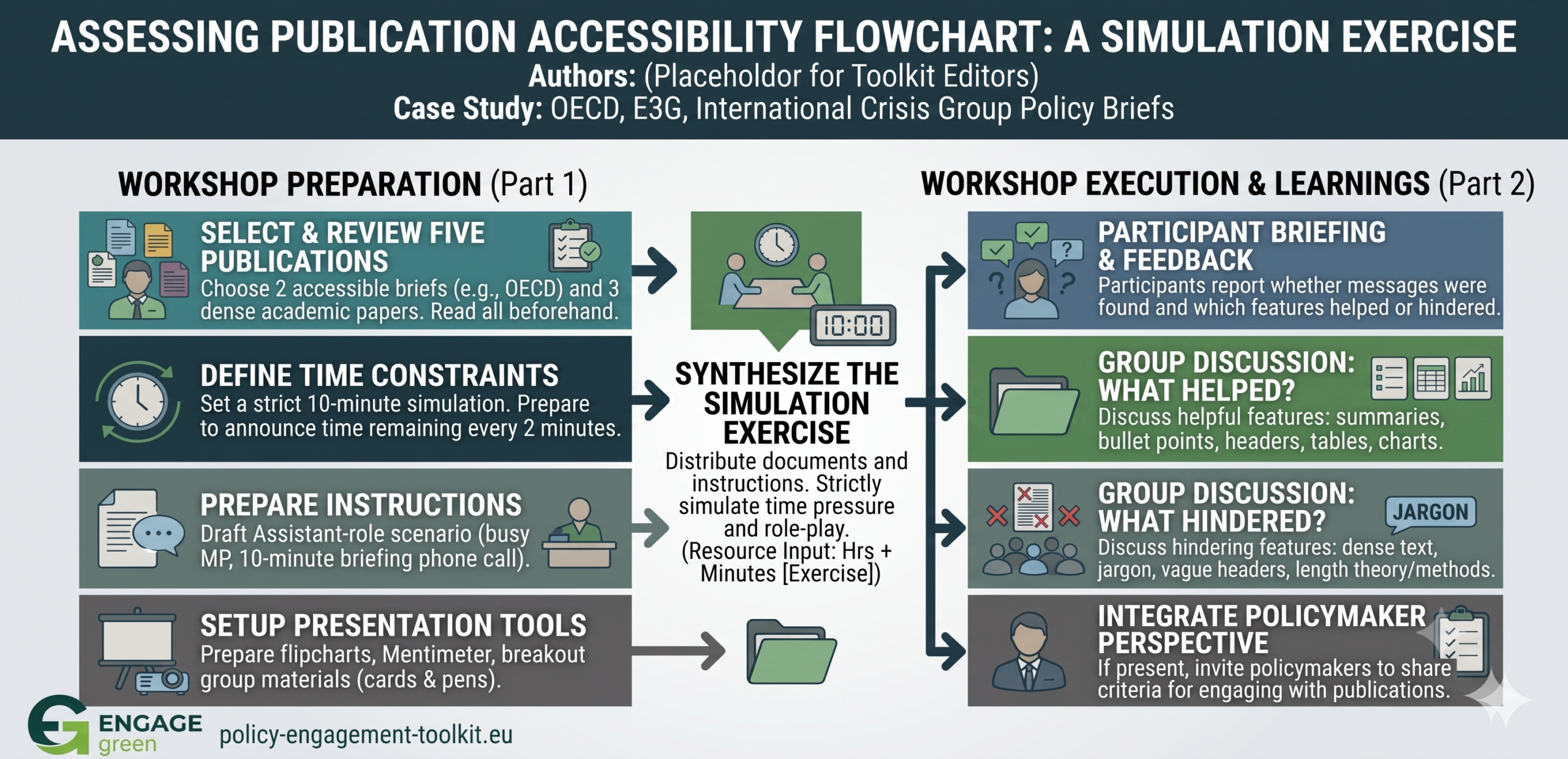
  • This exercise simulates the role of a parliamentary assistant to help researchers understand what busy policymakers undergo when reading policy publications.
  • It can be used in workshops or self-learning contexts: participants must identify the key messages of five policy publications within ten minutes.
  • The exercise highlights the importance of visual clarity, easily identifiable key messages, plain language, and visual elements such as bullet points, highlighted headers, tables, and graphs.


How does the format work?

Step 1: Select five publications between two and twenty pages each. Many researchers struggle to appreciate what it feels like to read publications on unfamiliar topics, so it is important that the publications cover a range of subject areas (e.g., environment, climate change, health, international security, education, AI). Choose two well-structured, accessible policy briefs that present their key messages up front —I recommend the policy briefs of theOECD, E3G, or the International Crisis Group.

Choose three other publications such as academic publications, which are more difficult to overview, because they lack elements like summaries, bullet points, or visualizations. Publications featuring a lot of body text, methods sections, and academic jargon are ideally suited for this exercise.

Step 2: Distribute either printed or electronic versions of the publications to participants along with the following instructions:

“You are working as an assistant to a member of parliament, who has a full schedule of committee meetings, interviews, and panel discussions today and tomorrow. Your boss has received five publications by post and needs topical expertise on the issues they cover. She has to take a phone call lasting approximately ten minutes and leaves the publications on your desk, asking you to brief her on their key messages once she is done. You have ten minutes to browse the publications. You are NOT allowed to use AI to summarize them. Can you identify the key messages within ten minutes? Which publications made it easy to do so — and which were difficult to review?”

Step 3: To add a degree of time pressure, announce the remaining time every two minutes. Participants must stop after ten minutes. Afterwards, ask them whether they were able to identify the key messages in each publication, and which features helped or hindered them.

Features that tend to help include summaries at the beginning, bullet points, meaningful headers and subheadings, tables, and clear, easy-to-read charts.

Features that tend to hinder include dense body text, generic or vague headers, jargon, and lengthy theory or methods sections.

For groups of up to ten participants, it is recommended to discuss the findings in plenary, using flip charts or interactive tools such as Mentimeter. For larger groups, participants should be split into breakout groups and given cards and pens to record their answers, which can then be shared and discussed in plenary.


Possible challenges and how to address them

Participants may find the exercise stressful or become frustrated when trying to identify key messages in publications on unfamiliar topics. This is an intentional phenomenon: policymakers rarely have much time and are regularly expected to engage with expert publications across a wide range of subjects.

Some participants may point out that policymakers increasingly use AI tools to summarize publications — a valid observation. But even AI-generated summaries can run to several pages. Moreover, printed publications remain in use in many countries and institutions.


Tasks and resources: Brief description of the tasks and resources needed by scientists, knowledge exchange officers/research managers, and policymakers

Workshop facilitators

Facilitators are responsible for selecting the five publications and making them available — either in print or electronically. They should read all five publications themselves before the workshop. Preparation will require approximately 60 to 120 minutes; conducting the exercise will take between 20 and 40 minutes.

Scientists and other participants

Participants browse the publications to identify their key messages and take part in the subsequent discussion. The exercise and discussion together require between 20 and 40 minutes.

Policymakers

If policymakers are present, the facilitator should involve them in the discussion and invite them to share what criteria a publication must meet for them to engage with it.


Sources and further reading

Please add URL or publications, if applicable.


See also contributions on the following issues

The editors of the toolkit will add the information in this section.


Do you want to know more about the policy engagement toolkit?

Do you want to share your experience in policy engagement? Do you think about contributing to the policy engagement toolkit? Feel free to contact Tome Sandevski via science-policy@pvw.uni-frankfurt.de

Other