Author: Tome Sandevski

Bringing Policymakers into the Lab: Lessons from the Practice Day ‘Future Technologies for Energy and Security’ at TU Darmstadt

Key features in a nutshell

  • A full-day “Practice Day” (Praxistag) combining laboratory tours, live demonstrator presentations, and structured networking across different university locations.
  • The “Practice Day” (Praxistag in German) at TU Darmstadt brought together about 30 representatives from policymaking institutions, NGOs, associations, and businesses with 10 researchers from various academic disciplines.
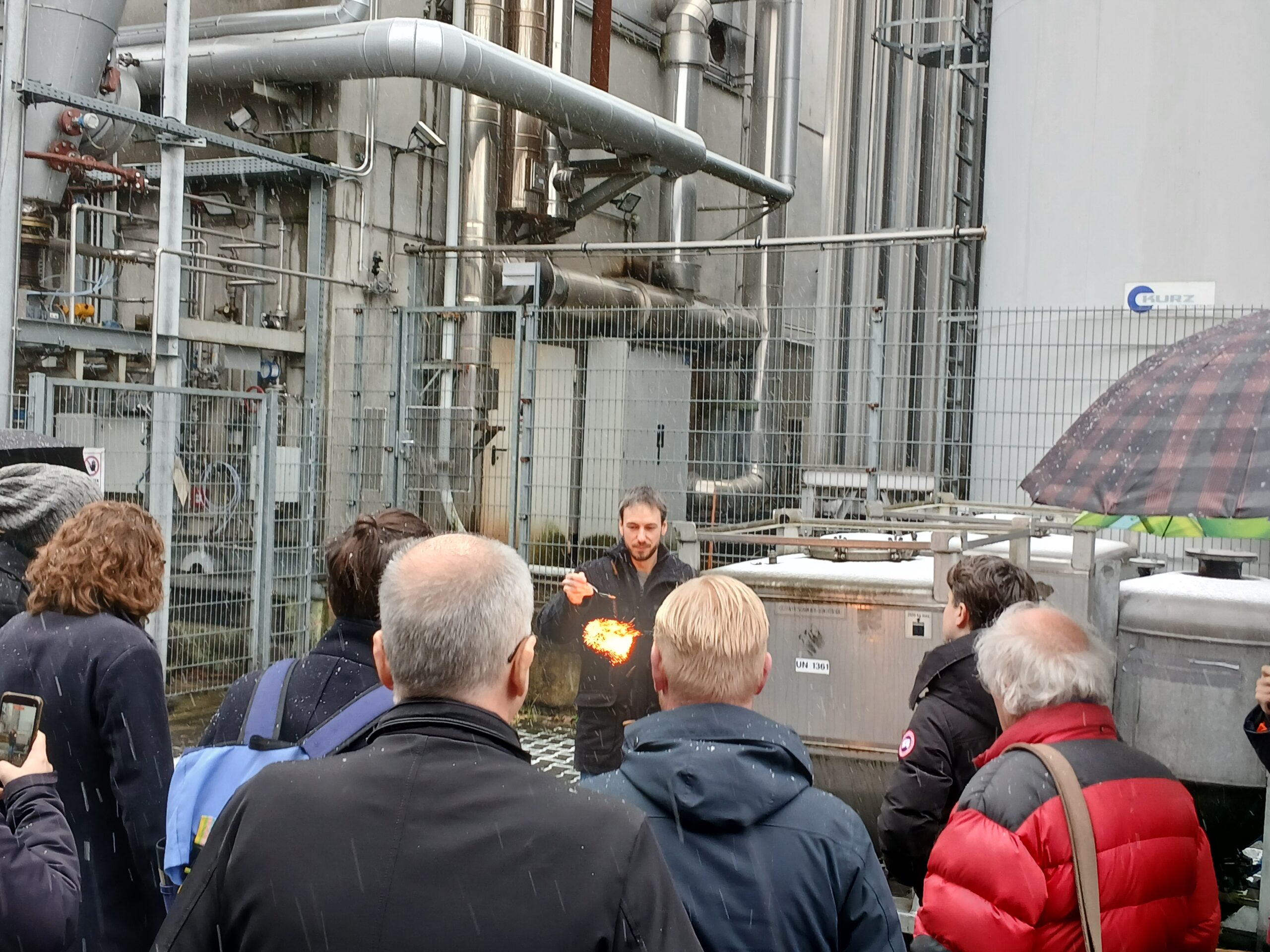
  • The guests from practice organisations toured the labs of the Metal Energy Hub, the Smart Homes EHub and the Digital Resilience Xchange (DiReX) Centre at TU Darmstadt. The practioners were acquainted with state-of-the-art research while the researchers learned about policy questions.
  • Delegating event management and targeted participant outreach to dedicated research managers and knowledge exchange officers drastically reduces researchers’ administrative workload and maximises event impact.


How did the format work?

Step 1: Conceptualisation

The Policy Engagement Unit at Goethe University Frankfurt—which coordinates the Erasmus+ project ENGAGEgreen and the Mercator Science-Policy Fellowship Programme of the Rhine-Main Universities (TU Darmstadt, Goethe University Frankfurt, and Johannes Gutenberg University Mainz)—approached researchers at the Metal Energy Hub and the Digital Resilience Xchange (DiReX) centre to explore interest in a policy-oriented event.

A joint team of five researchers, research managers, and knowledge exchange officers co-designed the event and scheduled it for 29 January 2026.

Core Aims of the Event:

  • Provide an applied overview of cutting-edge research on renewable energy storage and digital resilience during emergency and crisis situations in Germany.
  • Connect researchers from TU Darmstadt directly with regional, national, and local policymakers, as well as stakeholders from industry, NGOs, and public administration.

Step 2: Planning & Targeted Outreach

Researchers and research managers at TU Darmstadt compiled an initial list of 150 key institutional stakeholders. To broaden outreach, the Policy Engagement Unit at Frankfurt reviewed organisational charts across 60+ relevant public sector bodies and identified over 200 tailored contacts.

  • Invitations: Official invitations were sent out in early December 2025 to approximately 350 policy professionals and stakeholders.
  • Registration Rates: By mid-January 2026, around 35 external practitioners and 10 researchers and research managers from TU Darmstadt had registered (yielding an effective conversion rate of ~10–12%).
  • Logistics: Catering was finalised and targeted reminder emails were dispatched two weeks prior to the event.

Step 3: Implementation

The event took place on 29 January 2026.

  • 09:00–09:30 | Registration & Welcome: Assembly at the Metal Energy Hub offices (Campus Lichtwiese, TU Darmstadt).
  • 09:30–11:30 | Lab Tour 1 – Metal Energy Hub: Presentation of research on innovative green technologies (e.g. zero-carbon energy storage via iron powder oxidation and reduction), followed by a guided laboratory tour led by Dr Marius Schmidt.
  • 11:40–12:10 | Lab Tour 3 – Energy-Autonomous Smart Home (eHub): Guided visit by Dr Joachim Schulze, highlighting rapid self-sufficient emergency power setups for photovoltaic system owners.
  • 12:10–12:40 | Group Transfer: Shared commute from Campus Lichtwiese to the City Campus of TU Darmstadt.
  • 12:40–13:30 | Networking Lunch: Joint light lunch at the Application and Transfer Centre Digital Resilience Xchange (DiReX) to maintain group cohesion during the campus transition.
  • 13:30–15:15 | Lab Tour 3 – Digital Resilience Xchange (DiReX): Presentation on resilient digital municipal infrastructure designed for disaster management, including interactive demonstrator tours led by Prof. Dr Michèle Knodt and Prof. Dr Bernd Freisleben.

Step 4: Post-Event Follow-Up

Within one week of the event, the Policy Engagement Unit distributed presentation slides and a comprehensive contact directory of all participating researchers to the external practitioners.


Challenges and how to address them

Overall, the event ran very smoothly, but it’s worth being explicit about why, so other universities can calibrate their own expectations. The researchers, research managers, and knowledge exchange officers involved had already been collaborating for some time through the ENGAGEgreen project and the Mercator Science-Policy Fellowship Programme. This meant established working relationships, shared routines, and mutual trust were already in place before planning even began. Researchers could focus entirely on presenting their findings, while research managers and knowledge exchange officers handled the organisational side.

Universities without this kind of existing infrastructure should expect the first edition of a comparable event to take noticeably more coordination time, simply to build the working relationships that this team could already draw on.


Tasks and resources

Researchers

  • Prepared accessible, non-academic presentations and core policy pitches.
  • Set up interactive laboratory setups and physical demonstrators.
  • Co-developed the thematic scope and suggested relevant expert contacts.

Research managers and knowledge mobilisers

  • Managed target group identification across 60+ public sector organisational charts.
  • Handled mailing lists, invitation workflows, catering, and social media coverage.
  • Coordinated campus transfers and facilitated session moderation.

Policymakers

  • Represented local, regional, and national ministries, political parties, NGOs, and businesses.
  • Engaged in active Q&A sessions during lab demonstrations.
  • Established direct contacts with academic researchers for long-term policy advice.


Pictures


Do you want to know more about the policy engagement toolkit?

Do you want to share your experience in policy engagement? Do you think about contributing to the policy engagement toolkit? Feel free to contact Tome Sandevski via science-policy@pvw.uni-frankfurt.de


Navigating Science-Policy Interactions: An Introduction to the ENGAGEgreen Policy Engagement Toolkit

What is the ENGAGEgreen Policy Engagement Toolkit?


The ENGAGEgreen Policy Engagement Toolkit offers a comprehensive overview of the diverse formats scientists, research managers, and knowledge mobilisers can leverage to bring academic expertise into policymaking.

While numerous guides already cover traditional practices like writing policy briefs or giving parliamentary evidence, our toolkit fulfils a distinct, broader purpose based on four core motivations:

  1. A Multidimensional Definition: In line with the University of Oxford’s widely used definition, we view policy engagement as an umbrella term describing ‘the many ways researchers and policymakers connect and explore common interests at various stages in their respective research and policymaking processes.’ Engagement extends far beyond policy briefs; it encompasses pairing schemes, policy fellowships, hackathons, and research site visits. Structured, easily accessible overviews of these formats remain rare, especially cross-border examples that transcend regional or national silos.
  2. Addressing Real-World Constraints: Academic policy engagement is often hampered by time constraints, funding limits, and institutional recognition hurdles. While this toolkit cannot eliminate structural barriers, it offers practical decision-making guidance to help users select the right format for their specific capacity, saving valuable time and resources.
  3. An Inclusive Stakeholder Approach: Effective policy engagement relies on strong institutional ecosystems. This toolkit addresses researchers, policymakers, research managers, and knowledge mobilisers alike. Clarifying roles and mutual needs strengthens institutional capacity and support structures.
  4. Bidirectional Knowledge Exchange: While incorporating academic research improves policy quality, engaging with policymakers simultaneously generates fresh, real-world research questions. We explicitly treat policy engagement as a two-way street.


How is the Toolkit Structured?

The toolkit is designed not as a rigid recipe book or a theoretical treatise, but as an adaptable collection of modular chapters. Each chapter delivers:

  • A concise breakdown of a specific policy engagement format or structure.
  • Concrete, real-world case studies contributed by scientists, research managers, knowledge mobilizers, or policymakers.

These practical examples illustrate that there is no one-size-fits-all approach to science-policy interaction.


Is Policy Engagement Too Time-Consuming?

Not necessarily. Major commitments—such as drafting a 500-page commissioned report or serving on a multi-year advisory board—are highly time-intensive. However, many agile, lightweight formats exist.

The matrix below illustrates the typical net time investment required for various engagement formats:

Note on Support Structures: Time investment depends heavily on institutional support. A researcher drafting a report or organizing a workshop entirely alone faces a vastly different workload than one supported by professional event managers and knowledge brokers.


Key Features of the Toolkit

  • Pragmatic, Non-Dogmatic Guidelines: Formats are described based on general practical standards rather than rigid rules. For example, while we define policy briefs as short texts (typically 2–6 pages), longer variants exist in practice.
  • Focus on Cross-Cutting Skills: Alongside specific formats, the toolkit addresses essential strategic skills: reaching target audiences, timing input effectively according to political cycles, understanding institutional contexts, and evaluating impact.
  • Reflective Case Studies: Each chapter features real-world examples allowing practitioners to reflect on what worked well, what failed, and what they would adapt in hindsight.
  • Multilingual & Context-Sensitive: The toolkit is published in English, Czech, French, German, Italian, and Spanish. Content varies slightly across languages to reflect regional policy cultures (e.g., explicit policy recommendations are standard in Anglo-Saxon policy briefs but less common in German-speaking contexts). English versions are released first, followed by translated editions.
  • Realistic Resource Estimation: Required time is measured in net working hours dedicated to a single iteration of a format (excluding external delays or waiting periods). To maintain relevance across different national spending structures, monetary estimates are deliberately omitted in most cases.


Sources and Further Reading

University of Oxford (2024), Policy Engagement: What is Policy Engagement? University of Oxford Policy Engagement Network. Retrieved April 10, 2024.


Help Us Expand the Toolkit

This toolkit is a living document based on desk research, practitioner feedback, and practical experience rather than a formal academic study. Because policy engagement cultures vary widely across countries, we actively encourage international contributions.

If a format operates differently in your national context, or if you would like to contribute a case study, we welcome your input!

Get in touch or contribute:

Contact Tome Sandevski at science-policy@pvw.uni-frankfurt.de

The 4-Minute Window: Mastering the High-Impact Policy Pitch

Key features in a nutshell

● This exercise asks participants to prepare and deliver a four-minute policy pitch on their own research topic, followed by structured peer feedback
● The exercise is grounded in a central insight: what matters in science–policy communication is not how much researchers know but what policymakers should understand and remember; methods and research design of individual research projects are secondary; overarching key findings and their policy relevance come first.
● Participants leave the exercise with a concrete, tested communication product they can use in future policy engagement activities.
How does the format work?
Researchers are often well-prepared to present their work to academic audiences. Presenting to policymakers requires a fundamentally different approach — one that many researchers have never been explicitly taught. This exercise creates a structured opportunity to practice exactly that, using the participants’ own research topics as the raw material.

The task

Prepare a concise, four-minute presentation on your research topic. Your goal is to communicate the relevance and key aspects of the research topic clearly, compellingly, and accessibly, including, where appropriate, a set of policy options. Make sure you present complex content in an illustrative and practical manner so that non-experts can grasp the significance of your topic. Slides may be used. The target audience is policymakers.

Step by Step guideline for researchers

Step 1: Know your audience

What does your target audience already know? Why is your topic relevant to them — and which specific aspect is most likely to resonate? A topic such as “fish stocks in the North Sea” might be of interest to a ministry of fisheries for economic reasons, to a ministry of tourism for its effects on coastal communities, or to a parliamentary committee for its implications for EU regulation. Tailor your pitch accordingly and ask yourself: Why should policymakers care about this?

Step 2: Establish context and relevance

Formulate two or three key messages and embed your topic in a broader context, linking it to current societal challenges or practical applications.
Ask yourself: What should policymakers remember in six months or a year? Why does this topic matter? Are there current events that connect to your topic? (e.g., “The volcanic eruption in Iceland is a reminder that coastal regions worldwide are at risk.”) It is worth researching recent policy developments in advance or speaking with policymakers beforehand to understand their current priorities.
Connect your findings to a concrete societal or political reality. For example: “A rise in ocean acidification could put 100,000 fishing jobs at risk.” Concrete figures and real-life examples create an emotional connection to the topic and make the practical relevance of scientific findings tangible.
Step 3: Make policy recommendations or discuss policy options
Present possible courses of action. Indicate concrete, implementable steps and, where possible, embed them in the current policy context. Explain why certain measures might be politically feasible or advisable. Enumerate the pros and cons of various policy actions.
Step 4: Check your presentation for clear structure, academic jargon, the effective use of visualization and energy
● Structure. Use a clear, informative title that signals the relevance of the topic (e.g., “The Effects of Climate Change on Coastlines: Why Action Is Needed”); an engaging opening – a striking statistic, the correction of a common misconception, or the potential of a new technology – draws the audience in immediately; questions can serve as a useful structural device (e.g., “What happens when coastlines shrink?” → “How can we prevent it?”)
● Language. Avoid technical terms (e.g., “hydronumerical methods”) – or explain them in plain language; be aware of terms whose meaning differs between academic and policy contexts (e.g., significance, risk, long-term/short-term); this also applies to terminology that is familiar within the research system but unfamiliar to outsiders (e.g., Horizon funding, collaborative research centers, principal investigators, peer review); test your pitch with a non-specialist audience before the workshop: Are all terms trulyunderstandable?
● Visuals. Avoid overloaded slides; label figures directly with key messages rather than expecting the audience to interpret them; use consistent design elements; visualize change over time or use comparisons to make the scale tangible (e.g., seagrass meadows versus the CO₂ emissions of a steak)
● Delivery. Avoid vague or hedged formulations; use direct address where appropriate (e.g., “I would therefore ask you to consider…”); speak with energy and engagement — vary your emphasis to underline key points, maintain eye contact even when reading from notes, and keep strictly to the (four-minute) time limit
● Funding. The goal of a policy pitch is to support evidence-informed decision making through scientific expertise – not to secure research funding; if you wish to advocate for funding, make this transparent from the outset through the title or framing of your pitch. conflating policy engagement with fundraising risks undermining your credibility with policymakers

Tasks and resources: Brief description of the tasks and resources needed by scientists, knowledge exchange officers/research managers and policymakers

Workshop facilitators
Introduce the exercise by briefly explaining the difference between communicating to academic audiences and to policy audiences. Distribute the task description and guidelines in advance so that participants can prepare their pitches before the workshop. After each presentation, facilitate structured peer feedback using the guidelines above as a framework. The exercise works well in groups of six to twelve participants, with feedback rounds of five to ten minutes per presentation. For larger groups, if two facilitators are available, group sessions are an option to save time and enable more personal feedback within a smaller cohort.
Researchers 
Prepare a four-minute policy pitch based on your own research, applying the guidelines above. During the feedback round, give and receive constructive feedback: Is the audience clearly defined? Are the key messages clear? Are there concrete policy options? Is the language accessible to a non-specialist?
Policymakers
If policymakers are present, invite them to give feedback from their own perspective after participants have presented their pitches. Their input on what they actually find useful and what they find confusing or unconvincing is typically the most memorable and instructive feedback participants receive.

Sources and further reading

Conrad, Paulina; Sielemann, Katharina; Sandevski, Tome (2025), Tipps zur Vorbereitung von Vorträgen und Policy Briefs für den Science-Policy Dialog [Tips for Preparing Presentations and Policy Briefs for Science-Policy Dialogue], https://www.allianz-meeresforschung.de/app/uploads/2025/07/science-policy-dialog-tipps.pdf
Cairney, Paul; Kwiatkowski, Richard (2017), How To Communicate Effectively with Policymakers: Combine Insights from Psychology and Policy Studies, Palgrave Communications 3, 1-8.

Four Roles, Five Researchers: A Role-Playing Exercise on Scientific Advice

Key features in a nutshell

  • Whether and how scientists should make policy recommendations is a contested issue; this exercise puts participants in the shoes of researchers who must decide whether to respond to a request from policymakers; it builds on the four ideal-typical roles put forward in Roger Pielke book, The Honest Broker
  • The scenario appears simple at first glance, but it proves to be genuinely sophisticated once participants discuss the various options in small groups – positions that initially seem clear-cut often turn out to be harder to defend than expected
  • The exercise takes about 30-60 minutes; it can be integrated into training on science for policy and is especially suited to workshops bringing together participants from different academic disciplines

How does the format work?

Step 1 (5–10 minutes): The workshop facilitator introduces the following scenario: participants are researchers and members of an interdisciplinary research group on healthy nutrition. The research group receives a request from the mayor’s office and must decide whether to accept it. The facilitator shares the scenario description, either as printed copies or electronically, and divides participants into groups of 3–5 people.

Step 2 (15–5 minutes): Each group discusses the following questions:

  • Which researcher’s position do you find most convincing, and why?
  • Would you accept the request from the mayor’s office? What conditions, if any, would you set? While the scenario appears to be quite simple, it turns out to be sophisticated once the participants discuss the various options in small groups; ask at least one person per group to take notes of the discussion and present the answers of the groups in the following plenary session
  • Which positions correspond to Roger Pielke’s typology?

Using a second worksheet, groups then match Pielke’s four roles to the five researchers in the scenario by drawing connecting lines. Definitions of all four roles are provided directly on the accompanying worksheet, so no prior familiarity with Pielke’s book is required. Importantly, the matching is not one-to-one: a single role can apply to more than one researcher, and a researcher’s position can reflect more than one role. Groups note down a brief justification for each match. This task tends to generate the liveliest discussions since several researcher positions resist a clean fit.

Ask at least one person per group to take notes so the group’s discussion can be presented in the following plenary session.

Step 3 (10–25 minutes):

  • Convene all participants in plenary and ask whether they would accept the request from the mayor’s office – by show of hands or using an anonymous digital polling tool, which tends to allow more candid responses on a contested question like this one
  • Ask one group to share its responses with the others; ask the remaining groups to add any aspects not yet covered
  • Ask groups which match in the matching exercise was most difficult to agree on and why; This question often reveals more about the four roles than the matching exercise itself, since it forces participants to articulate exactly where a researcher’s position becomes ambiguous.

Tasks and resources: Brief description of the tasks and resources needed by scientists, knowledge exchange officers/research managers and policymakers

Workshop facilitators

The facilitator prepares a slide explaining the exercise. They provide printed or electronic copies of both worksheets — the scenario and the matching exercise — divide participants into groups, keep time during the group discussion, and moderate the concluding plenary session.

Researchers or research managers as participants

Researchers or research managers take part in the group discussion and connect the positions of the researchers in the scenario to Pielke’s four roles, noting their reasoning for each match. One member per group presents the group’s findings; other members are welcome to add their own perspectives during the plenary discussion.

Policymakers

If policymakers take part in the workshop, they are invited to share their perspective on the request and on the conditions proposed by the groups — including whether such conditions would be realistic or acceptable from their point of view. They can also speak to their expectations regarding scientific expertise more broadly.


The worksheets are available below:

V_ov_fourrolefiveresearchers_worksheet_rmu_20260730


Sources and further reading

Pielke, Roger (2007), The Honest Broker. Making Sense of Science and Politics. Cambridge: Cambridge University Press.


Do you want to know more about the policy engagement toolkit?

Do you want to share your experience in policy engagement? Do you think about contributing to the policy engagement toolkit? Feel free to contact Tome Sandevski via science-policy@pvw.uni-frankfurt.de


Get Started, Keep Learning! A Facilitator’s Approach to Policy Engagement Training

Key features in a nutshell

  • Hands-on exercises beat slide decks: Participants gain a far deeper understanding of policymaking by analyzing real-world policy documents, organizational charts, and invitation pitches rather than consuming lectures passively
  • Teach competencies while considering capacities: Training builds the competencies needed for effective policy engagement, but capacities – time, funding, institutional access to policymakers, support structures – determine whether those competencies can actually be applied; there is no one-size-fits-all: effective policy engagement means matching formats and channels to participants’ resources and motivation.
  • “Get started, keep learning!” is the key message for the training: Participants should not wait to engage with policymakers until they have become policy experts themselves or mastered every possible format; by the end of the training, they need the confidence and skills to get started, knowing they will keep learning along the way.
  • Policymaker voices are essential: Having Members of Parliament or their staff, policy professionals from ministries, EU institutions, or international organizations talk about their tasks, routines, and experiences is invaluable; invite policymakers to join sessions whenever possible.


How does the format work?

Facilitating 33 workshops since 2019 – ranging from 60-minute crash courses to two-day intensive retreats – has been an ongoing process of practice, feedback, and refinement. Here are the core insights gained from continuously evolving these sessions.


From Slide Heavy to Hands-On (Practicing What We Preach)

In early workshops, a recurring piece of feedback was that I covered too many slides at too fast a pace. This was an eye-opener: while I was advising researchers to deliver concise key messages rather than overwhelming policymakers with information, my own slide decks were doing the exact opposite.

The Shift: I radically reduced the presentation slides in favor of active learning; today, participants work through various exercises (e.g., readability checks of policy briefs, audience mapping, crafting elevator pitches, analyzing organizational charts).

Pre-Workshop Preparation: Optional pre-workshop exercises (15–45 min) are offered to help participants get the maximum value out of the live session.

Result: Hands-on exercises are consistently rated highly since they help participants understand the importance of targeted communication and the constraints under which policymakers operate – and learning through doing tends to stick better than learning through listening.

Importance of capacities: In theory, researchers have many ways to engage with policymakers. In practice, capacities – time, funding, institutional access, support structures – determine which of these are realistic. A senior professor with a seat on an expert body, support by a dedicated secretariat, and institutional access has far more options than a doctoral researcher who is not yet known to policymakers and struggles to cover travel costs to a policy event in the capital.

The Shift: Rather than presenting a “one-size-fits-all” menu of engagement formats, the training actively addresses structural barriers. Facilitators must help participants identify time-efficient formats tailored to their specific career stage and available resources.

Empowering Early Action: I make clear that my workshops are not academic introductions to policymaking. Participants do not need to become policy experts nor master every detail of drafting policy briefs or organizing policy events.

The Shift: What they need is enough understanding to get started sooner rather than later. They leave with checklists covering what to address next, and with the confidence to begin engaging – knowing that further learning will come with practice.

Involving policymakers: Incorporating guests from ministries, the European Commission, international organizations, or parliaments (usually staffers) for a 1-to-2-hour concluding Q&A session has proven to be very effective.

The Shift: Participants consistently find it valuable to hear directly about policymakers’ constraints, routines, and expertise needs. The policymakers involved are typically approachable and encourage participants to reach out proactively. In in-person workshops, they are usually invited to lunch as well, which further supports informal exchange and networking.


Tasks and resources: Brief description of the tasks and resources needed by scientists, knowledge exchange officers/research managers and policymakers

Workshop facilitators

While individual workshops run between 60 minutes and two days, developing their structure and content has taken several months in total over the years. After each session, I review participant feedback and update the relevant material, including repeated revisions to the slide decks. Cutting slides was painful but proved essential.

Researchers and research managers as participants in workshops

Participants are informed in advance that the workshop involves hands-on exercises, including optional preparatory ones. Most enjoy the exercises and group discussions, which keep the sessions lively. Participants typically spend between two hours and two days in the workshop.

Policymakers

Policymakers join for a single 1–2-hour session. In in-person workshops, they are also invited to lunch – a valuable opportunity to connect with the researchers and research managers.


Do you want to know more about the policy engagement toolkit?

Do you want to share your experience in policy engagement? Do you think about contributing to the policy engagement toolkit? Feel free to contact Tome Sandevski via science-policy@pvw.uni-frankfurt.de


Marine and Environmental Researchers Learn to Pitch: A Case Study from DAM and Helmholtz Forum Earth and Environment

Key features in a nutshell

  • In 2025, the German Marine Research Alliance (DAM) and the Helmholtz Forum Earth and Environment organized two competence-building workshops on science–policy dialogue; about 40 of the approximately 50 participants went on to prepare and present four-minute policy pitches four to six weeks after the initial workshops
  • After each pitch, participants received structured feedback from their peers and the workshop facilitators; mst participants kept to the time limit and delivered well-structured presentations; the most common challenges were explaining the relevance of their research to policymakers, avoiding technical jargon, and especially formulating concrete policy options
  • The exercise proved to be an effective way to translate workshop content into practical skills and to prepare participants for future engagement with policymakers


How does the format work?

In January and June 2025, the German Marine Research Alliance (DAM) and the Helmholtz Forum Earth and Environment organized two competence-building workshops on science–policy dialogue in Berlin. Around 60 researchers and knowledge exchange officers from various research institutions participated across both workshops. Each workshop ran from noon to noon over two days and covered topics, including the roles of policymakers, understanding policymaking contexts, and an overview of policy engagement formats.

To make the workshop content applicable in practice, the facilitators invited participants to prepare a policy pitch as a follow-up exercise. The process unfolded in four steps.

Step 1: Introduce the exercise
In the final 30 minutes of each workshop, the facilitators explained the aims and structure of the follow-up exercise. Participation was optional. Participants who chose to take part were invited to present a four-minute policy pitch four to six weeks after the workshop. Several virtual dates were offered, and participants could select the one that suited them best. The exercise instructions were also sent to all participants in writing after the workshop.

Step 2: Participants prepare their pitches
Between the workshop and the follow-up session, participants prepared their policy pitches independently. Facilitators were available for questions by email, though none of the participants made use of this offer.

Step 3: Conduct the virtual pitch sessions
The virtual follow-up sessions lasted between 90 and 120 minutes. Each participant presented a policy pitch of no more than four minutes, followed by peer feedback and input from the facilitators. The peer-to-peer feedback proved particularly constructive, participants’ observations were thoughtful and constructive.

Step 4: Summarize and share the feedback
After the sessions, the facilitators compiled the key feedback points and shared them with all participants. This summary formed the basis for the written guidelines on preparing policy pitches and policy briefs, which were subsequently published on the DAM website.


What the exercise revealed: results and common challenges

Of the 50 workshop participants, 42 went on to present a policy pitch in the follow-up sessions – an outstanding participation rate of 84 percent for an optional exercise.

What worked well:

  • Most presentations were well structured and within the four-minute time limit
  • Peer-to-peer feedback was consistently constructive and generated substantive discussion
  • Participants reported that the exercise helped them apply what they had learned in the workshop to their own research

Common challenges:

  • Technical jargon: Several participants used terms familiar within their field without realizing these would be unfamiliar to a policy audience
  • Relevance framing: Explaining why their research matters to policymakers – rather than to fellow researchers – proved difficult for a number of participants
  • Policy options: Formulating concrete, actionable policy options based on research findings was the most consistently challenging element of the exercise.


Tasks and resources: Brief description of the tasks and resources needed by scientists, knowledge exchange officers/research managers and policymakers

Workshop facilitators

Facilitators introduce the exercise during the final session of the workshop, set the virtual follow-up dates, send written instructions to participants, moderate the pitch and feedback sessions, and compile and distribute a summary of the key feedback points afterwards.

Researchers and research managers (workshop participants)

Participants prepare a four-minute policy pitch on their own research topic between the workshop and the follow-up session, present it in the virtual session, and provide peer feedback on their fellow participants’ pitches.

Policymakers

Policymakers did not participate in the pitch sessions in the 2025 editions of this exercise. However, they did participate in the initial workshops, where they emphasized the importance of concise, accessible, and policy-relevant presentations. Future editions of the exercise could benefit from including at least one policymaker in the feedback sessions.

Do you want to know more about the policy engagement toolkit?

Do you want to share your experience in policy engagement? Do you think about contributing to the policy engagement toolkit? Feel free to contact Tome Sandevski via science-policy@pvw.uni-frankfurt.de

The ‘By the Way, We Need Funding’ Trap: Why Policy Engagement is Not a Funding Pitch

Key features in a nutshell

  • Policy engagement is about providing scientific expertise to policymakers – not about securing research funding; lobbying for funding is legitimate, but it must not be conflated with policy engagement; researchers who wish to raise the issue of funding with policymakers should make this transparent from the outset rather than camouflaging fundraising as policy engagement
  • Mixing policy engagement with fundraising risks undermining researchers’ credibility with policymakers, one of the most valuable and hardest-to-rebuild assets a researcher has
  • When researchers advise policymakers on funding policies, they should proactively disclose any conflicts of interest

What is the issue?

Imagine you receive a phone call from your insurance company. The representative informs you that there are new research reports on fire insurance, contents insurance, dental insurance, and travel cancellation insurance they would like to discuss with you. What is your first reaction: ‘How thoughtful, they know I take an interest in research!’ or ‘There’s a catch. They want to sell me something!’?

Most people would assume the latter, and they would usually be right. Researchers who raise the issue of funding at meetings or events not set up for that purpose risk triggering exactly the same reaction from policymakers. To avoid this, researchers must clearly separate policy engagement from lobbying for funding. Failing to do so creates two distinct problems:

Loss of credibility. Researchers enjoy a high degree of credibility among policymakers — but this credibility is fragile. Once a researcher is perceived as more interested in fundraising rather than offering expert advice, they may lose access to policymakers entirely. Rebuilding that trust is difficult and time-consuming.

Shift in the impact dimension. The questions that typically guide policy engagement are: Which evidence the policymakers taken up? How has our work influenced policy? Have we gained new research ideas through the engagement process? Combining policy engagement with fundraising introduces a different set of questions: How much funding was acquired? How did my institution benefit financially? Over time, institutional leaders may begin to evaluate policy engagement activities primarily based on funding secured – which fundamentally changes the nature and purpose of policy engagement.

Lobbying for research funding is perfectly legitimate and necessary. Policymaking institutions routinely consult individual researchers, scientific institutions, and academic associations when designing new funding programmes, and such input is genuinely valuable. Researchers and institutions can and should raise the issue of funding with policymakers. When doing so, the following principles apply:

Be transparent about your goals from the outset. When organising a meeting or event at which funding will be discussed, policymakers must know this in advance. Raising funding unexpectedly – particularly at an event convened for a different purpose – is likely to be perceived as discourteous and may have the opposite effect.

Do not present funding as the answer to every policy problem. Researchers understandably want more resources, but policymakers are there to solve policy issues. If an event is convened to discuss how energy consumption can be reduced, the answer should not be ‘by giving my research group more funding’. If researchers consistently respond to policy questions with calls for more funding, policymakers will begin to see them as fundraisers rather than experts.

Demonstrate expertise before expecting recognition. Policy engagement can result in researchers being recognised as credible, go-to experts. But this recognition must be earned. Researchers should not assume that a strong academic reputation automatically translates into visibility in policymaking circles.

Researchers should avoid the following at policy events:

  • Complaining about the lack of research funding at events that are not about funding policies
  • Speaking disparagingly about other research institutions or researchers
  • Focusing on research gaps, equipment needs, unfilled positions, and publications in academic journals, rather than on the concrete contributions their expertise can make to a policy problem and its societal or economic benefits

What to do when policymakers ask researchers to advise on funding policies?

When researchers are explicitly asked to advise on research funding – as part of a consultation, an expert committee, or a funding programme design process – the following principles apply:

  • Disclose conflicts of interest proactively. Researchers should clearly communicate how they or their institution would benefit from the funding being discussed. This transparency is essential for maintaining credibility and for ensuring that policymakers can properly weigh the advice they receive. Researchers can simultaneously be the most qualified experts on a topic and potential beneficiaries of the funding they are recommending. This dual role is not inherently problematic, but it must be acknowledged explicitly. A researcher who advises on energy research funding while leading an energy research group should say so clearly.
  • Focus on the evidence, not the ask. When advising on funding priorities, researchers should ground their input in evidence about societal needs and research gaps – not in the interests of their own institution or research group. Policymakers are more likely to act on advice that is clearly oriented to the public good than institutional self-interest.
  • Consider involving an independent intermediary. In situations where conflicts of interest are particularly pronounced, researchers may consider channelling their input through an independent body – such as a learned society, an academic association, or a science advisory council – rather than engaging with policymakers directly.


Tasks

Researchers

Researchers should be clear in their own minds – and transparent with policymakers – about whether a given interaction concerns policy engagement or fundraising. Some overlap is inevitable, particularly when advising on funding programmes. In those cases, researchers should disclose conflicts of interest proactively and ensure that policymakers are not surprised by a funding conversation they did not expect. A useful self-check: researchers should put themselves in the shoes of someone being asked for money without warning – would they appreciate being put on the spot?

Knowledge mobilisers

Knowledge mobilisers can support researchers by drafting clear institutional guidelines on the distinction between policy engagement and fundraising, and by establishing transparent procedures for managing conflicts of interest. When organising policy events or dialogue formats, they should brief researchers in advance on the purpose of the event — and make it explicit that fundraising at events not designed for that purpose is counterproductive.

Policymakers

Policymakers who notice that researchers are conflating policy engagement with fundraising should feel empowered to address this directly.

They can clarify the purpose of a meeting at the outset and redirect conversations that drift towards funding to a more appropriate forum.

Do you want to know more about the policy engagement toolkit?

Do you want to share your experience in policy engagement? Do you think about contributing to the policy engagement toolkit? Feel free to contact Tome Sandevski via science-policy@pvw.uni-frankfurt.de


What Have We Achieved? A Pragmatic Guide to Assessing Policy Engagement

Key features in a nutshell

  • No One-Size-Fits-All: Assessment criteria must match the scope, duration, and goals of your specific engagement activity; a single breakfast talk requires a different evaluation than a multiyear expert commission
  • Planning is key: Understanding the effects of a format is much more feasible once it is strategically agreed upon beforehand what effects the format is desired to have
  • Understand effects beyond policy change: Direct legislative change is rare and multicausal; process indicators – such as relationship building, follow-up requests, and mutual learning – are often more realistic measures of success
  • The right combination of resources and focus: There are almost endless possibilities when assessing one’s project but usually limited resources; to make the process and the results useful, it’s best to focus on specific aspects or questions that help projects grow or change and that match the resources of the project (e.g., to collect and assess data)


What is the issue?

How can researchers and research managers better understand the effects of their policy engagement activities? This is highly relevant for policy engagement activities to justify the time and financial resources invested, to demonstrate accountability to funders, and – most importantly – to reflect on and improve future interactions. It can also enable better alignment between the needs of policymakers and what advice science can provide.

However, as discussed in our article on Policy Engagement Goals, success looks vastly different depending on what you set out to achieve. External factors such as political timing, shifting government priorities, resource constraints, or sheer luck heavily influence outcomes as well.

A multiyear advisory board presenting a high-profile report operates in a different reality than a research team hosting an introductory lunch briefing on an emerging topic. Therefore, understanding different effects is not a standardised checklist but a flexible instrument, which starts with agreeing on goals and desired effects .

Possible goals of policy engagement can:

  1. Policy change: shaping how challenges are framed, approached, and dealt with (e.g., legislation, directives),
  2. Raising visibility, building trust, and expanding networks
  3. Mutual learning: understanding policymaking, and gaining ideas for your own research
  4. Open-ended informing of policymakers

Four levels of effects criteria

Different effects levels can be roughly identified, depending on the objectives and goals of the policy engagement activity as well as the resources available to examine them. It should be noted that exploring these effects can be a time-intensive activity in itself, which may require some expertise. For researchers and knowledge mobilisers, it can therefore be helpful to team up with experienced researchers or practitioners if possible.

Here we name four distinct levels of effects

Level 1: Reach and participant composition (input & output)

  • What it measures: Who attended your activity and in what capacity?
  • Key indicators: Number of participants, institutional diversity (e.g., representation from ministries, parliaments, NGOs, or think tanks), and the fit of the policymakers (i.e., the policymakers dealing with the policy issues)
  • When should it be used: Ideal for initial, low-cost formats (e.g., public panel discussions, introductory webinars, or policy breakfasts)

Level 2: Interaction quality and relationship building (process)

  • What it measures: Was the interaction perceived as valuable, and did it result in follow-up activities?
  • Key indicators:
    • Qualitative/quantitative feedback: Surveys (e.g., via the Impact Unit Evaluation Platform) or short debriefing interviews asking both researchers and policymakers whether the activity was rewarding and informative
    • Follow-up activities: Unsolicited requests from policymakers after the event, organisation of joint events, informal follow-up conversation
  • When should it be used: Essential for workshops, roundtables, and ongoing dialogue series aimed at long-term network building.

Level 3: Referencing and document citations (uptake)

  • What it measures: Did your research findings inform policy discussions or official publications?
  • Key indicators: Policymakers reference the findings or recommendations of individual researchers or research groups in media statements, press releases, or speeches; citations of academic publications or policy publications by researchers in policy documents like strategy papers, parliamentary inquiries, party platforms, or policy reports
  • Tools: Policy citation databases such as Overton, Dimensions, or PlumX make it easy to track where academic work is cited in policy literature worldwide
  • Caveat: Being cited in official policy documents indicates visibility and engagement, but it does not automatically mean that a policy was altered; note also that policy citation rates vary heavily across disciplines (e.g., public health and economics yield far higher citation counts than cultural studies)

Level 4: Attributable policy change (direct impact)

  • What it measures: Did the scientific evidence directly shape a policy decision, legislation, or government programme?
  • Key indicators: Explicit statements by decision makers in legal texts, parliamentary speeches, press releases, or official memoirs confirming that scientific advice influenced a specific decision
  • Caveat: Attributable policy change is the highest bar and exceptionally rare; research is almost always one of many competing inputs in the policy process; expecting every engagement effort to yield direct policy change is unrealistic and leads to frustration


Tasks and resources

Researchers

Researchers are well positioned to reflect on how the interaction felt from their own perspective, if it resulted in sustainable connections and advanced their research. They are also a valuable source when it comes to understanding demands or challenges policymakers face by looking at questions that were asked, concerns that were raised, or topics that were (controversially) debated.

Research managers and knowledge mobilisers

Research managers typically design and distribute feedback questionnaires and track key data like number of participants, downloads, or follow-up contact between researchers and policymakers over time. They can also support researchers in documenting instances in which policy change is attributable to their work by, for example, monitoring government publications, coordinating with communications teams, or interviewing policymakers and their teams. Furthermore, (participant) observations or question-based protocols are helpful in documenting and assessing specific interactions or formats.

Policymakers

Policymakers contribute primarily through feedback and through their own public or written statements. Their input is most valuable when it is solicited directly and specifically through, for example, short structured questionnaires after an event or brief follow-up conversations, rather than assumed from silence or general goodwill.


Sources and further reading

Impact Unit (2026), Evaluation platform, https://evaluationsplattform.impactunit.de/, accessed on 20 August 2026.

Neicu, D., Cauchi, J., Otto, J., Lehto, S., & Dantas Faria, J. C. (2020), Monitoring the Impact of Science and Evidence on Policy, in Šucha, V. & Sienkiewicz, M. (eds.), Science for Policy Handbook, Elsevier, pp. 152–164. https://doi.org/10.1016/B978-0-12-822596-7.00014-0

Newson, R., King, L., Rychetnik, L., Milat, A., & Bauman, A. (2018), Looking Both Ways: A Review of Methods for Assessing Research Impacts on Policy and the Policy Utilisation of Research. Health Research Policy and Systems, 16, Article 54. https://doi.org/10.1186/s12961-018-0310-4

Overton (2026), Tracking Research Impact in Policy Documents. [Online Resource], accessed on 14 August 2026.

Reed, M. S. (2022), The Research Impact Handbook: Generating and Assessing Impact from Research. Fast Track Impact.


Do you want to know more about the policy engagement toolkit?

Do you want to share your experience in policy engagement? Do you think about contributing to the policy engagement toolkit? Feel free to contact Tome Sandevski via science-policy@pvw.uni-frankfurt.de


Expectation vs. Reality: A Researcher’s Guide to Handling Frustration with Policymakers

Key features in a nutshell

  • Manage your expectations about your possible impact, timelines, and feedback
  • Understand how policymaking works is a key prerequisite for avoiding frustration
  • Communicate and build relationships proactively to avoid being misquoted and to create long-term connections
  • Reflect on your engagement and give policymakers regular feedback

What is the issue?

If you talk to researchers about policy engagement a familiar theme comes up: frustration. Below are the frustrations I hear most often and what you can actually do about them.

A quick disclaimer: none of the quotes below are verbatim. They’re composites of things I’ve heard in one form or another over the years of talking to hundreds of researchers and running workshops on policy engagement.

  • ‘I don’t see any impact’

You’ve heard it – maybe you’ve said it yourself: ‘I wrote a 100-page commissioned report for the ministry and clearly showed that X is a problem. And then … nothing happened.’ Or: ‘I spent over a year on an expert body. We came up with a dozen solid recommendations, but none of them got implemented.’ Or the softer, more deflated version: ‘The policymakers didn’t seem particularly interested in my findings. I think they’d already made up their minds. So, I’m not sure why they even asked.’

What you can do
First, remember that, in most cases, policymakers  under no obligation to follow scientific expertise. There’s an important difference between evidence-based and evidence-informed policymaking – policymakers operate under political, financial, and legal constraints that scientific evidence simply doesn’t touch. A recommendation might be perfectly sound and still be politically unpopular.

And ‘no visible impact’ doesn’t mean ‘no impact’. Think about smoking: the scientific evidence on its health effects was solid by the 1950s, but it took policymakers around the world decades to act on it. That doesn’t mean the early evidence was wasted – it just means impact is often slow, indirect, and hard to trace back to a single report or meeting.

Second, policymaking timelines can simply work against you. A government commissions an expert body, the body reports back two years later – except by then there’s a new government that isn’t especially interested in your findings. Or, a hearing is legally required before a bill passes, but by the time you’re in the room, minds are already made up. None of this is personal. It’s how the machine works. The more you understand policymaking processes, the less these moments will sting.

And sometimes ‘no impact’ is really about something else: invisibility. Your input quietly shapes a paragraph in the final policy paper, but your name never appears anywhere near it – no acknowledgement, no citation, nothing you can point to. That’s a real and valid frustration, and it’s worth raising directly with whoever commissioned your input, even if it rarely gets fixed retroactively.

  • ‘They cherry-picked the one line that fit their agenda’

Sometimes the frustration isn’t that your research gets ignored, it’s the opposite: it gets used but selectively so. A single data point, a caveat-free soundbite, or a conclusion lifted out of its context ends up in a press release, speech, or website. It can feel like your work is being weaponised for an argument you never intended to make.

What you should do
Understand that policymakers aren’t reading your work the way peer reviewers do; they’re looking for a clear, usable takeaway, and nuance rarely survives that translation. You can reduce the risk (not eliminate it) by being proactive about framing: write a plain-language summary yourself, flag the caveats you really don’t want dropped, and offer a one-line ‘if you quote one thing, quote this’ takeaway. If a selective quote does happen and it materially distorts your findings, it’s fair to reach out – directly or via a follow-up statement – and set the record straight, calmly, and without assuming bad faith. More often than not, it’s less about ideology and more about compression: complex findings getting flattened into a single line because that’s what fits in a press release.

  • ‘Policymakers just don’t get it – they lack even the basics’

Researchers are often genuinely surprised that policymakers don’t know what – from a researcher’s perspective – feels like basic vocabulary: exponential growth, the laws of thermodynamics or how ‘significant’ is not the same as ‘important’. Terms get lost in translation, too: ‘short-term’ might mean decades to a climate scientist or historian but days or weeks to a policymaker.

What you can do
Remember that policymakers come from diverse backgrounds; some might share your discipline, most won’t. And here’s an example of reframing: interdisciplinary research teams often need months to develop a shared vocabulary among scientists. Why would it be any different for policymakers?

Thus, invest in simplifying your language. Take a science communication course, ask your press office for feedback or run your text through tools like the De-Jargonizer or Readable.com. Talk about your research with people outside your field regularly. And ask policymakers directly for honest feedback on how you’re coming across.

One more thing: don’t assume policymakers know your field’s landmarks. They’ve probably heard of Nature and Science, a handful of elite universities, and the scientists who show up in the media. The Journal of xyz Quarterly – no matter how prestigious in your world – likely means nothing to them. They probably do not know the big names in your field. The same applies to the issue of time constraints in research institutions, how research projects work, or what terms like ‘PI’ stand for.

  • ‘They expect the impossible from me’

There’s often a real gap between what policymakers ask for and what research can actually deliver. This shows up in a few different ways. First, some questions sound simple to policymakers but are almost impossible for researchers to answer with a Yes or No: “Do unhealthy diets cause cancer?” or “Do tax cuts reduce unemployment?” Real-world outcomes rarely have a single cause, and most research findings come with genuine uncertainty attached – something that doesn’t always translate into a soundbite-friendly answer.

Second, questions about the future are just as tricky: “When will the next flood happen?” or “Will China invade Taiwan in the next few years?” Research can identify risks, trends, and probabilities, but it can’t offer certainty about events that haven’t happened yet.

Third, there’s the jump from findings to recommendations: “You found that people who commute by bike are healthier than those who drive or take public transport. So what policy would you recommend?” Solid research doesn’t always translate neatly into a specific policy option; that step usually involves knowledge about policy priorities and trade-offs that go beyond what the data alone can tell you.

Fourth, policymakers sometimes ask for fast turnarounds without realising how research actually works: “Can you analyse the impact of last month’s heatwave on public transport, within the next two weeks?” Rigorous analysis takes time, and that mismatch in expectations can become a real source of friction.

What to do:
When you’re asked a question like this, explain clearly what your research can and can’t tell. Communicate uncertainty honestly rather than glossing over it, and, above all, stay patient. Policymakers usually aren’t testing you; more often, they simply don’t know how research works, and a calm, clear explanation goes a long way.

  • ‘I honestly have no idea what they’re talking about’

Policymakers reference legislation, court rulings, key documents, or events you’ve never heard of. You might not be familiar with the actors or processes involved, and policymakers think about legal and economic angles that may not even be on your radar as a scientist. Even well-prepared researchers can get lost because a lot of what policymakers know is tacit knowledge, the kind you only pick up by being in the room.

And yes, policymakers have their own jargon too. Spend time in Brussels and you’ll be drowning in acronyms: DG, MFF, CAP, Acquis. I once sat in a meeting in a federal ministry in Berlin where someone said, “During the last LP, Schmidt wanted Directorate 4 to focus on …” It took me a while to figure out LP meant Legislaturperiode (legislative period), who Schmidt was, and what Directorate 4 actually did.

What you can do
Unless policy analysis is your day job, it’s completely normal to feel lost sometimes, even political scientists and legal scholars struggle with this. You don’t need to memorise organisational charts to have a good conversation with a policymaker. If you’re new to the field, get an overview by skimming key policy documents or organisational charts beforehand. And it’s absolutely fine to admit you’re new, policymakers generally respect that more than a bluff. Ask questions, always. If you’re invited to a policy event, ask your hosts for a briefing beforehand. Tacit knowledge only comes from talking to people , so make informal one-on-one conversations with policymakers a habit, not a rare occurrence.

  • ‘Appointments get cancelled all the time – like my time doesn’t matter’

Colleagues in Brussels tell me there’s basically a 50/50 chance that an MEP cancels their panel appearance two hours before it starts. Another researcher told me how he learned that a minister cancelled a meeting while he was already on the train to the capital. This happened twice within two months. Meanwhile, the same researchers are sometimes asked to produce a thorough analysis of a breaking policy issue with just a few days’ notice.

Policymakers – especially MPs and senior decision makers – are dealing with schedules that get reshuffled by events completely outside their control. And to be fair, most of them have no idea that researchers are juggling teaching, administration, and research deadlines just as tightly.

What you can do
When organising an event, always ask policymakers to name a substitute in case they can’t make it. Do the same for one-on-one meetings. Rather than sinking four hours into preparing for a meeting with a minister that gets cancelled last-minute, ask in advance whether a policy officer could step in instead. Be upfront about your own scheduling constraints. Offer virtual meetings as a fallback. And it’s completely fair to explain that very short-notice requests for expertise are hard for you to fulfil too.

  • ‘My contacts keep changing; I feel like I’m starting from scratch every time’

High turnover is simply a feature of democratic institutions. Members of Parliament lose their seats or switch committees. New governments bring in new ministry leadership. Career civil servants rotate units every few years. It’s exhausting to feel like you’re rebuilding relationships from zero again and again.

What you can do
Accept turnover as a structural feature, not a personal setback. Build relationships across the political spectrum, including with opposition parties, who may be in government next. Cultivate good working relationships with staffers, parliamentary group advisors, and policy officers, they tend to stick around longer than the politicians they support, and they carry institutional memory with them. Keep factsheets and policy brief, which you can quickly update if need be.

  • “I wanted the decision maker; I got fobbed off with a low-level staffer’

First, this one usually reveals a common misconception. Staffers and policy officers are not ‘low-level’ but often the people with the greatest expertise on a specific issue – more than their superiors – and they’re the ones who synthesise scientific findings for the people above them. Second: if a decision maker turns down a meeting and sends someone else, it doesn’t mean they’re not interested. If they truly didn’t care, they wouldn’t send a representative at all.

What you can do

Appreciate the fact that a representative was sent on the decision maker’s behalf – engage with them properly and keep them in the loop. And if you’re inviting a decision maker to an event, be realistic about fit: does the role you’re offering (speaker, panelist, silent attendee) match their priorities? Is it a 20-minute slot or a two-day commitment? Where is it – the capital, their constituency, somewhere else entirely? And is it during a sitting week or recess? Getting these details right massively improves your odds.

  • ‘Radio silence after the meeting – they never follow up’

Again: policymakers are busy. Silence after a meeting doesn’t mean disinterest.

What you can do
Follow up yourself! A few weeks or months later, reach out and say you’d like to continue the conversation, maybe you have new findings, or there’s a recent policy development worth discussing. Make it a habit to tell policymakers, right from your first meeting, that you’d like to stay in touch. And don’t take it personally if there is no follow-up meeting; their priorities shift constantly, and their calendar might simply not allow it.

  • ‘They listen to the media, NGOs, and think tanks more than to scientists’

It can be baffling – even insulting – for scientists when policymakers reference a business association’s report, an NGO campaign, a consultancy’s analysis, or a tabloid headline instead of ‘proper’ scientific evidence.

What you can do
Scientific expertise is one source of knowledge among many for policymakers, not necessarily the most important one. Different actors play different roles in the ecosystem: think tanks and consultancies can turn policy analysis around far faster than academic institutions ever could. NGOs, trade unions, and business associations can mobilise and campaign in ways researchers simply can’t. Instead of feeling sidelined, follow the key NGOs, think tanks, and media outlets in your field: your findings can reach policymakers indirectly through them. Treat these actors as channels for your message, not competitors for attention.

  • ‘They don’t show up to our policy events or use our knowledge exchange products!’

Scientists pour weeks or months into organising a policy event or into developing a knowledge exchange product like a policy publication series, an interactive website, an app, a simulation exercise, a fellowship, a placement scheme, an expert hotline, and policymakers simply don’t show up, or never end up using it.


What you can do

First, validate demand before building. Policymakers are flooded daily with position papers, event invitations, and other information. Before investing significant time and budget into developing apps, simulation games, fellowship schemes, or complex portals, ask your target group what they actually need and how much time they have. Involving policymakers early in the planning process provides crucial feedback on content, length, and format.

Second, prioritise targeted communication over mass outreach. Avoid generic mass emails or mailing: they are usually filtered out immediately. Map out relevant parliamentary committees, ministerial units, or party officials, and tailor your invitation or product directly to their current agenda. Explain clearly and concisely what specific insight they gain by attending the event or using the product. Following up with a brief phone call or personalised message takes time, but it is far more effective than spending months on an app that no policymakers use.

Third, join forces with established actors. If your institution is new to policy engagement or lacks direct channels to decision makers, partner with organisations that already have a proven track record (e.g., research networks, think tanks, NGOs, foundations). Joint events or joint formats like co-authored policy publications or dialogue formats tend to draw in policymakers far more effectively than going it alone.

  • ‘I mentioned I needed funding, and nothing came of it’

Sometimes researchers engage with policymakers, partly hoping this will open the door to funding, and end up disappointed when that funding doesn’t materialise.

What you can do

Separate policy engagement from fundraising. Policy engagement is about mutual learning and evidence exchange, not direct grant acquisition. Most individual policymakers or ministries do not hand out research grants directly outside established funding programmes (e.g., national research agencies or EU frameworks). Approach policy conversations with the goal of providing value rather than seeking financial backing. Do not camouflage fundraising as policy engagement.

Do you want to know more about the policy engagement toolkit? Do you want to share your experience in policy engagement? Do you think about contributing to the policy engagement toolkit? Feel free to contact Tome Sandevski via science-policy@pvw.uni-frankfurt.de

 

Sources and further reading:

De-Jargonizer, scienceandpublic.com

Readable, readable.com

Hemingway Editor, hemingwayapp.com

Lloyed, James (2016), So you want to change policy? Six steps for academics looking to achieve policy change, LSE Blogs, accessed on 05 August 2026.


Do you want to know more about the policy engagement toolkit?

Do you want to share your experience in policy engagement? Do you think about contributing to the policy engagement toolkit? Feel free to contact Tome Sandevski via science-policy@pvw.uni-frankfurt.de


Policy Engagement by Design: How to Integrate Science-Policy Interactions into Funding Proposals

Key features in a nutshell

  • Before writing policy engagement into a proposal, check thoroughly whether it’s genuinely the right fit; half-hearted engagement helps no one
  • Learn the funder’s exact terminology and expectations: ‘engagement’, ‘impact’, and ‘stakeholder engagement’ aren’t interchangeable across funders; understand what the funders expect and what you can realistically deliver
  • Design policy engagement as something that benefits your research too and plan it for early in the project, not as an afterthought
  • Budget realistically, and define meaningful, proper indicators to track whether your engagement is actually working

What is the issue?

Most policy engagement doesn’t fail because researchers don’t care; it fails because there’s never enough time or money left for it. Planning it into the research project cycle from day one, instead of attaching it later, is what makes the difference. Also, more and more funders are requiring applicants to demonstrate that their research projects will reach stakeholders outside academia or achieve real-life impact. The following tips can help researchers integrate policy engagement in funding proposals.

  • Assess whether policy engagement aligns with your personal goals: If you have funding alternatives that don’t require policy engagement and you’re not intrinsically motivated to engage with policymakers, it may be worth applying elsewhere. But if policy engagement is a genuine requirement – and you have no realistic alternative – take it as seriously, as you would take financial reporting: not because it’s exciting but because it has to be done properly.

If you do have alternatives and are genuinely unsure whether policy engagement is for you, try this quick self-test. Rate the following two scenarios from 1 to 10, where 10 means “absolute disaster” and 1 means “not ideal, but I can live with that”:

Scenario 1: Not a single academic publication comes out of your research project.

Scenario 2: Every policymaker who reads your publications or attends your policy events tells you that it was a waste of their time.

If you rate Scenario 1 close to 10 and Scenario 2 close to 1, policy engagement probably isn’t the right fit for you right now. Half-hearted engagement tends to produce half-hearted knowledge exchange products, ones your project team won’t enjoy making and policymakers won’t use.

  • Read the funder’s guidelines carefully: Different funders use different terminology: policy engagement, science for policy, stakeholder engagement, impact, valorisation, science communication, knowledge transfer, or something else entirely. Check the guidelines for how the funder defines the relevant terms. If you’re unsure, call the grant officer. Use the funder’s own terminology in your proposal: if the call says, ‘stakeholder engagement’, use that phrase, since reviewers may not be familiar with terms like ‘policy engagement’ or ‘science for policy’.

Also check whether policy engagement is a hard requirement or genuinely optional. In highly competitive funding lines, even ‘optional’ features can be de facto requirements. Confirm that policymakers are actually the right target group for your project; businesses, schools, trade unions, or other groups might sometimes be a better fit. Look at previously funded projects and talk to your research support office or colleagues who have received funding from the same donor about their experience. Check which costs the grant will actually cover and what the funder expects you to achieve: Are they satisfied with a few policy briefs on your website, or do they expect documented policy change attributable to your project?

  • Demonstrate how policy engagement enriches your research: Researchers often treat knowledge exchange as monodirectional, without considering what they stand to gain: new perspectives, ideas for research questions or hypotheses, access to interview partners or institutions that can help disseminate surveys, or early input that sharpens the research itself. That’s also why it doesn’t work to plan all your policy publications or events for the end of the project. By then, there’s no time left to act on any feedback you receive. Plan your first policy engagement activities for the first half of the project instead. Include policymakers on advisory boards, and talk to them from the outset, ideally even before you submit your proposal. They may flag issues you hadn’t considered.
  • Design specific, creative, and realistic engagement formats: Don’t rebrand standard academic outputs as policy engagement. ‘We will invite policymakers to our academic conferences’, ‘Policymakers will read our academic publications’, or ‘Some of our PhD students will go on to careers in government’ are not credible strategies. Your findings still need to be translated into policymakers’ needs. Be creative: there’s far more to choose from than policy briefs and panel discussions. But whenever you’re planning something more involved – an interactive website, a dashboard, an app, a simulation exercise, a serious game, a podcast, a workbook, an expert hotline, a placement scheme – present the idea to policymakers before you apply for funding. Some ideas sound great on paper but simply aren’t practicable for policymakers. Ask about their needs and match them against your resources and interests; otherwise, you risk spending months developing an app or simulation exercise that no policymaker ends up using. If a policymaker is enthusiastic about your planned format, consider asking them for a short letter of support to strengthen your proposal.

Beyond policymakers themselves, talk to colleagues experienced in policy engagement, or to knowledge mobilisers, about realistic outputs. Decide what outputs, outcomes, and impact you’re aiming for, and stress-test whether they’re realistic. Claims like ‘We will run a two-day workshop at our university attended by 40 MPs from across the country, who will then amend existing legislation as a direct result’ are very unlikely to happen – avoid them. The policy-engagement-toolkit.eu site or the REF Impact Case Study Database are good places for acquiring an overview of what different formats can plausibly achieve.

Finally, think about partnerships – not just with policymakers but with other research institutions, think tanks, NGOs, or foundations – to amplify your engagement and share resources. Rather than organising your own policy events in the capital or launching your own policy brief series from scratch, consider joining forces with organisations that already exist.

  • Request a realistic budget: High-quality policy engagement requires adequate financial resources. Consult your institution’s communications, transfer, or research support staff when drafting your budget. Where possible, budget for professional services: moderators, workshop facilitators, graphic designers, website or app developers, scientific writers, event managers, knowledge brokers, or policy engagement trainers. These services can be expensive, but expecting early-career researchers to handle specialised tasks without prior training often leads to delays and suboptimal results. Be prepared to justify the costs: renting an event space in walking distance of the parliament buildings in the capital is more expensive than hosting a policy conference at a university 200 kilometres away, but it may be the only way to reliably reach busy policymakers.


  • Define clear and realistic monitoring, evaluation and learning metrics: Reviewers want to see how success will be tracked. Therefore, focus on meaningful qualitative and quantitative indicators like feedback by policymakers or follow-up activities. Show how feedback from policymakers will be continuously evaluated and used to refine project outputs.


Tasks and resources

Researchers

Assess team capacity, the motivation for policy engagement, and knowledge about policymaking early in the proposal phase; integrate policymakers into advisory boards; draft and co-design tailored engagement formats.

Research managers and knowledge mobilisers

Inform applicants about the requirements of various funders. Provide how-to guides (like this one) to applicants. Inform them about policy engagement formats. Track policy engagement across funding applications at your institution. Where possible, offer assistance in connecting applicants with policymakers.

Policymakers

Provide early feedback on research priorities prior to proposal submission; provide a letter of support if needed; participate in project advisory boards or dialogue sessions; offer insights on current policy workflows and information needs; test and utilise tailored policy outputs.


Sources and further reading

ENGAGEgreen Policy Engagement Toolkit (2026), Accessed on 10 August 2026.

REF 2021. Research Excellence Framework (2022), Impact Case Study Database, Accessed on August 10, 2026.


Do you want to know more about the policy engagement toolkit?

Do you want to share your experience in policy engagement? Do you think about contributing to the policy engagement toolkit? Feel free to contact Tome Sandevski via science-policy@pvw.uni-frankfurt.de


Other