Pooling Resources, Leveraging Policy Impact
How Universities Can Collaborate with Think Tanks, NGOs, and Foundations

Summary: Key features in a nutshell
- Researchers at universities can benefit from collaboration with think tanks, NGOs, or foundations by jointly organizing policy events, co-publishing policy-relevant research findings, pursuing staff exchange placements, or pooling resources in terms of expertise, funding, and support capacity.
- While scientists at universities contribute evidence through original research or a thorough synthesis of academic literature, policy experts at think tanks, NGOs, and foundations can translate academic findings into policy-relevant formats and identify appropriate target audiences and windows of opportunity.
- Think tanks, NGOs, and foundations are diverse entities. Think tanks range from advocacy-oriented institutes to academic research centers and contract research organizations. NGOs encompass advocacy organizations, service delivery bodies, professional associations, and business associations. Foundations provide grants to NGOs or research institutions and may also publish policy analyses or organize policy events.
- Collaboration works best when joint goals are clearly defined, reputational risks are assessed in advance, and practical arrangements—such as cost-sharing and publication rights—are agreed upon before collaboration begins.
- Collaboration with think tanks, NGOs, and foundations is an effective way to achieve impact as required by funding organizations.
Why collaborate? Challenges scientists face when engaging with policymakers
Research at universities is structured around projects that produce original research and thorough syntheses of academic literature. Scientists publish their findings in peer-reviewed journals but often face three recurring challenges when seeking to engage with policymakers:
Challenge 1: Communicating research findings effectively. Researchers tend to use scientific jargon and are often unfamiliar with the language and conventions of policy. Formats such as policy briefs or policy events differ substantially from academic publications or academic conferences.
Challenge 2: Identifying windows of opportunity. Knowing when to communicate findings requires regularly following policy debates, a time-consuming task. Scientists typically lack access to the tacit knowledge embedded in policymaking institutions.
Challenge 3: Reaching the right policymakers. Mapping relevant target groups by browsing parliamentary committees and organizational charts of ministries, European Commission directorates-general, or political parties is a demanding and time-intensive task.
By collaborating with think tanks, NGOs, and foundations, scientists can save time and resources while amplifying their policy impact. These organizations interact with policymakers regularly and enjoy a degree of visibility that most scientists or academic institutions struggle to achieve independently. Policy experts at think tanks, NGOs, and foundations closely monitor policy debates, know whom to approach, and are familiar with the language and framings that resonate in policy contexts. Rather than investing time and resources in publications or events that go unnoticed by policymakers, scientists can conduct research, publish findings, and organize policy events in collaboration with these organizations.
Challenge 4: Scarcity of resources. Activities such as organizing policy events (especially in capitals), engagement, dissemination, networking, or fundraising can be very expensive and time-consuming. Sharing costs, staff time, or infrastructure for specific activities, such as events or publications, can drastically reduce the total cost per partner.
What forms can collaboration take?
Collaboration between universities and think tanks, NGOs, and foundations can take several forms, ranging from low-commitment to high-commitment arrangements:
- Joint publications: Coauthoring policy briefs, reports, blog posts, or factsheets; the university contributes evidence; the partner organization contributes policy framing and dissemination reach
- Joint events: Co-organizing panel discussions, background briefings, parliamentary breakfasts, and workshops; the university contributes scientific credibility; the partner organization contributes its network and access to policymakers
- Staff exchanges and secondments: Researchers spend time at a think tank, NGO, or foundation to gain firsthand experience of the policy process; this is particularly valuable for early-career researchers
- Research collaboration: Jointly designing and conducting research projects, with the partner organization contributing policy-relevant research questions and access to policymaking stakeholders
- Shared knowledge and data platforms: Jointly maintained databases, evidence repositories, and policy tracking tools that reduce repeated data collection and allow all partners to draw from a common evidence base
- Long-term strategic alliances or frameworks: Instead of project-by-project collaboration, partners establish umbrella agreements that allow repeated cooperation (events, outputs, funding bids) without renegotiating administrative details each time. For instance, these agreements could foresee:
- Shared project management offices (PMOs): Partners establish a joint coordination unit responsible for timeline management, deliverables tracking, reporting, and risk monitoring across multiple joint activities; this reduces duplication of project coordination roles in each organization
- Shared administrative services (“back-office pooling”): Organizations pool functions such as finance, procurement, contracting, HR administration, or compliance management for joint projects; this reduces overhead costs and avoids parallel administrative workflows.
- Joint communications and dissemination units: A shared comms function handles policy briefs, press outreach, newsletters, and social media for joint work, ensuring consistent messaging while reducing duplicated communication staff effort
- Coordinated event logistics teams: Rather than each organization separately managing venues, catering, invitations, and registrations, a shared operational team (or rotating lead) manages all event logistics across partners.
Collaborations can be temporary (e.g. a single joint event) or long-term (e.g., series of events or publications, joint projects, or a strategic alliance).
How to find suitable partners: A starting point
Researchers and research managers can identify potential partners via the following routes:
- Websites like EU Agenda, Euractiv, and International Geneva list policy events and policy publications by various actors; similar websites exist at the national level but only in some European countries (e.g., Smart Thinking in the UK or Political in Germany); attending policy events in your field is one of the most effective ways to identify and informally assess potential partners
- Directories like the Open Think Tank Directory, NGO base, Philanthropy Europe Association, or the EU Transparency Register list numerous organizations that might offer collaboration opportunities; similar websites might also exist on the national level
Assessing a potential partner: Key questions
Before approaching a potential partner, researchers and research managers should work through the following questions:
On quality and reputation
- Participants and partners: What types of events does it organize? Have policymakers attended its events? Can it count on a valuable network of partners?
- Independence and governance: Does the organization have a clear political orientation or affiliation? Is it funded by industry, political parties, or business associations?
- Quality: does the organization have valuable Quality Assessment tools and procedures in place? What kinds of publications does the organization produce (policy briefs, reports, blog posts, factsheets)? Are the content and quality convincing?
On fit and feasibility
- Does the organization work on policy issues in your area of expertise?
- Does it publish joint publications or welcome guest contributions? Does it co-organize events with external partners?
- Is the organization active and visible? Is it posting regularly on social media, with content that is shared and engaged with?
- Do both organizations define “policy impact” in the same way (e.g., legislative change, public debate, implementation)?
- Is there alignment on policy positions, or at least on the degree of advocacy vs neutrality expected?
- Does the organization typically work at the same governance level (EU, national, local), or would coordination be cross-scale and complex?
- Are timelines compatible (academic research cycles vs. policy cycles vs. funding cycles)?
- Is there flexibility to adapt outputs mid-project if policy developments change direction?
- Does the organization have experience working with academic partners, or will there be a steep learning curve?
On practical arrangements:
- Does the collaboration involve cost-sharing? What costs need to be covered, and what is your budget?
- Who decides on the structure, layout, and publication dates of joint outputs? Who controls the guest list for events?
- Does a cooperation agreement need to be signed? Is there an official policy on logo use and institutional attribution?
- What happens in the case of disagreement over framing, conclusions, or recommendations?
- Who owns jointly produced outputs, and under what license can they be reused?
- How are indirect costs (overheads, admin time, institutional costs) covered?
- Are budget reallocations possible if project needs change?
- Are there conflict-of-interest disclosures required by any partner or funder?
- What safeguards exist to ensure independence of analysis and findings?
- Who has the final say on public messaging and media communication?
- Under what conditions can a partner withdraw from the collaboration?
Warning signs: When to be cautious
Not all potential partners are equally suitable. Researchers should exercise caution when
- An organization’s funding sources are opaque or dominated by industry interests whose positions conflict with independent scientific evidence
- An organization is closely affiliated with a political party or ideological movement in ways that could compromise the perceived neutrality of the research
- An organization expects researchers to endorse predetermined policy positions rather than contributing independent evidence
- An organization has a weak or inconsistent publication or visibility record, suggesting limited reach or impact
- The collaboration agreement gives the partner organization sole control over the framing, editing, or publication of joint outputs
Process overview: From first idea to active collaboration
The following sequence describes a typical pathway from initial interest to active collaboration. It is intended as a flexible guide, not a rigid protocol.
- Step 1: Define your goal. Clarify what you want to achieve: impact in terms of policy change, increased visibility among policymakers, joint research, or access to a partner’s network and events.
- Step 2: Map the landscape. Identify think tanks, NGOs, or foundations active in your policy area using the routes described above.
- Step 3: Assess potential partners. Work through the guiding questions above. Prioritize organizations whose publication quality, political independence, and working style align with your own.
- Step 4: Make initial contact. Reach out informally by attending an event, responding to a publication, or requesting a brief introductory meeting. Collaboration is more likely to succeed if it grows out of a genuine shared interest rather than a cold institutional approach.
- Step 5: Agree on the collaboration format. Decide together on the type of collaboration (joint publication, event, research project), the division of tasks, cost-sharing arrangements, and any formal agreements required.
- Step 6: Implement and evaluate. Carry out the collaboration, document lessons learned, and assess whether the collaboration achieved its intended goals. Successful collaborations often become the foundation for longer-term partnerships.
Roles and responsibilities in collaboration
The following overview describes the typical tasks and contributions of each stakeholder group in a university-think tank, university-NGO, or university-foundation collaboration.
- Scientific lead role (universities)
- Policy translation and engagement role (think tanks / NGOs / foundations)
- Coordination and operational management role (research managers / PMOs / secretariats)
- Stakeholder interface role (joint responsibility but often led by external partners)
- Governance and decision-making role (shared or assigned structures)
- Funding and compliance responsibility (often hybrid but needs clarity)
Universities / research centers / academies
Universities primarily take responsibility for scientific leadership and the integrity of the evidence base. Scientists contribute the core evidence base, original research findings, or syntheses of academic literature. A key adaptation required of scientists is to shift from academic to policy-oriented communication: while academic publications foreground methodology and theoretical debate, policy-oriented outputs emphasize practical applicability and concrete recommendations. Scientists also need to adapt their timing: whereas research projects unfold over months or years, think tanks, NGOs, and foundations typically time their outputs to align with current policy debates and legislative calendars. Scientists benefit most from collaboration when they are willing to invest time in understanding their partner organization’s working culture and communication conventions.
Knowledge exchange officers / research managers
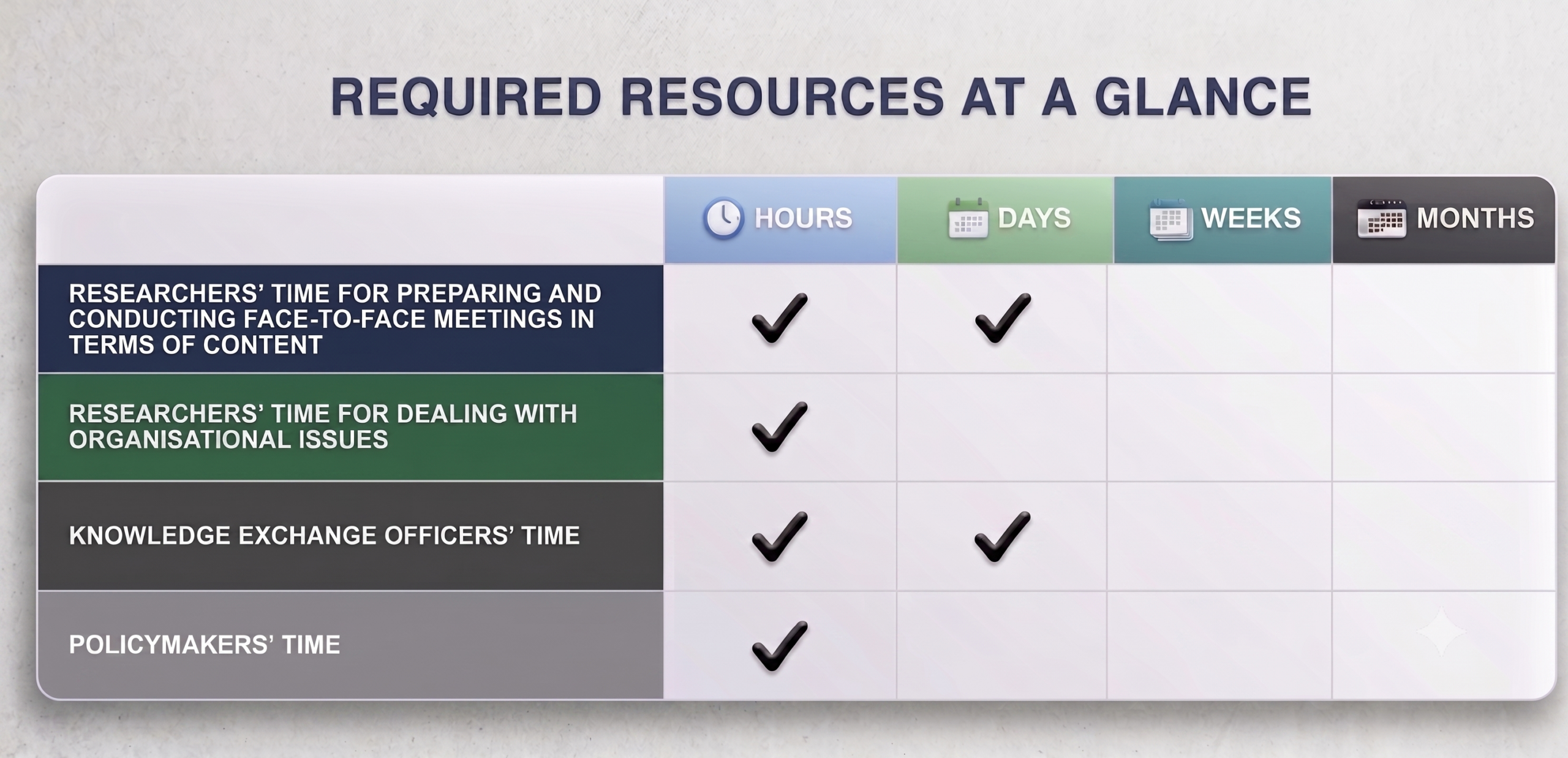
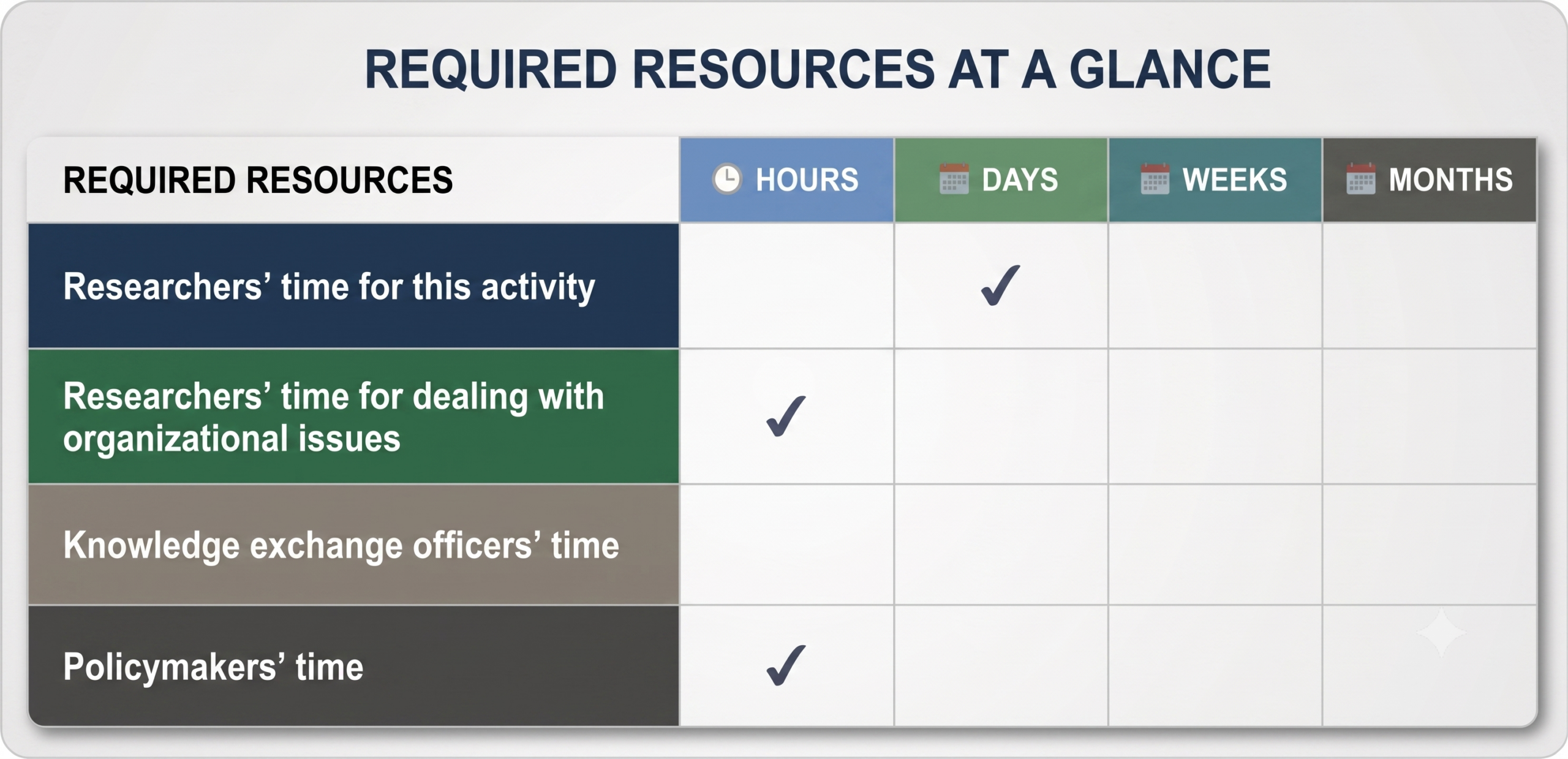
Research managers play a central coordinating role. They can map potential partners by assessing the quality, reach, and policy impact of their publications and events. They carry responsibility for operational delivery. They ensure that timelines, reporting requirements, and administrative processes are met, and they coordinate communication across institutions. They also manage budgets, contractual arrangements, and compliance obligations, providing continuity across partners and reducing administrative duplication. They handle legal and organizational matters like cooperation agreements, logo placement, cost-sharing arrangements, and institutional approval processes. They also serve as a bridge between the scientific team and the partner organization, helping to manage expectations and to ensure that timelines and deliverables are realistic for both sides.
Think tanks/ NGOs / foundations
Think tanks, NGOs, and foundations typically assume responsibility for policy translation and external engagement. They shape academic findings into formats that are usable in decision-making contexts, ensure that outputs are aligned with policy debates and timing, and lead or colead stakeholder outreach and dissemination. They also contribute policy intelligence by identifying relevant audiences and opportunities for engagement, helping to ensure that research is not only accurate but also strategically positioned to have impact.
Policymakers and other external stakeholders
Policymakers and their staff benefit from collaborations that produce timely, accessible, and actionable evidence. They are not operational partners in the collaboration but serve as the primary end users of the outputs. Their role is to define policy needs, provide feedback on relevance, and engage with evidence through consultations or policy processes. They are most likely to engage when outputs are framed around their specific decision-making needs and timed to coincide with relevant legislative or budgetary processes.
Do you want to know more about the policy engagement toolkit?
Do you want to share your experience in policy engagement? Do you think about contributing to the policy engagement toolkit? Feel free to contact Tome Sandevski via science-policy@pvw.uni-frankfurt.de