How to Organise Dialogue Events in regional Capitals

Case Study of the Second Impronta Granada Meeting and Entrepreneurship and Employability Workshop

Description

Organizing dialogue events in capitals or key urban areas requires a structured approach that balances the needs of local stakeholders with the goals of policymakers. These events provide a platform for researchers, businesses, and policymakers to co-create solutions for pressing territorial challenges, ensuring that the voice of the community is heard and considered. This contribution discusses strategies for organizing dialogue events in urban centers and leveraging them to foster inclusive policymaking in the context of entrepreneurship and youth employment.


Summary: Key Features in a Nutshell:

  • Objective: To create an effective structure for dialogue events that connect local stakeholders with policymakers to co-create sustainable solutions for employment and entrepreneurship.
  • Approach:
    • Clear goals for the event to align academic research with policy priorities.
    • Multi-stakeholder workshops to foster collaborative solutions.
    • Use of interactive tools (e.g., micropresentations, polling, feedback sessions) to ensure active participation.
  • Outcome: A transparent and inclusive process where local challenges are addressed through policy-driven solutions that are informed by academic research and local expertise.


How Does the Format Work?

  1. Setting Clear Objectives: Before the event, it is essential to define the goals and outcomes expected from the dialogue event. For the Entrepreneurship and Employability Workshop, the goal was to address youth unemployment and promote entrepreneurship in the Poniente Granadino region by involving UGR researchers, local businesses, and policymakers.
  2. Interactive Sessions and Workshops: During the event, interactive workshops and micropresentations were organized to encourage real-time feedback. Researchers shared data and insights, while policymakers discussed policy frameworks and how these could be integrated with academic findings to create actionable strategies.
  3. Engagement with Local and National Stakeholders: It is important to include both local actors and national policymakers in the discussion. The Entrepreneurship and Employability Workshop in Granada connected local youth and policymakers with national representatives, ensuring that the solutions developed were relevant and feasible at both levels.
  4. Post-Event Engagement: Ensuring that the event leads to sustained collaboration is key. Follow-up activities, including workshops and feedback surveys, should be planned to ensure that policymakers and researchers continue to collaborate after the event.

Challenges:

  • Managing Expectations: Different stakeholders have different expectations. Policymakers may focus on policy alignment while researchers may prioritize data accuracy. Balancing these priorities requires careful facilitation.
  • Sustaining Momentum: Keeping the engagement high after the initial dialogue event requires consistent follow-up, which may be hindered by time constraints or budget limitations.

Tasks and Resources:

Scientists

  • Tasks:
    • Present research findings relevant to youth employment and entrepreneurship.
    • Provide data-driven solutions for local development challenges.
    • Engage in workshops and policy discussions.
  • Required Resources:
    • Time for research dissemination and participation in events.
    • Communication tools for presenting research data and engaging with stakeholders.

Knowledge exchange managers and research managers

  • Tasks
    • Facilitate interactive workshops and ensure researcher-policymaker interaction.
    • Organize feedback loops and ensure ongoing communication post-event.
  • Required Resources:
    • Digital platforms for research dissemination and ongoing feedback.
    • Logistical support for organizing sessions and ensuring active participation.

Policymakers

  • Tasks:
    • Integrate research findings into local policies and allocate resources to support research-driven initiatives.
    • Ensure long-term collaboration between researchers and local communities.
  • Required Resources:
    • Policy expertise to interpret research data and incorporate it into decision-making.
    • Financial resources for post-event actions and implementation.


Examples

UGR County Councils refers to the initiative led by the University of Granada (UGR) under the ENGAGEgreen project, aiming to foster collaboration between academic researchers, local governments, and community stakeholders. This initiative focuses on addressing territorial challenges through co-created, research-driven solutions. The Second Impronta Granada Meeting is the third pilot event organized by UGR as part of this project, bringing together researchers, policymakers, and local communities to discuss and develop strategies for sustainable development in rural and urban areas.

The Entrepreneurship and Employability Workshop, which took place at the Second Impronta Granada meeting, successfully organized multi-stakeholder dialogues in an urban setting, enabling researchers, policymakers, and youth participants to collaborate in addressing employment and entrepreneurship challenges. The event’s interactive workshops helped align research with local policy, paving the way for further collaboration.

Sources and Further Reading


Case Study Details

How is the Format Conducted

Dialogue events in capitals, such as the Second Impronta Granada Meeting in Loja, combine workshops, networking sessions, and presentations. These events are organized with a mix of in-person and virtual participation to ensure accessibility for a broader audience. The inclusion of policymakers, researchers, and stakeholders from civil society allows for multi-dimensional dialogue on issues such as climate change, urban development, and social innovation.

For this event, an innovative dialogue event was held, where a combination of physical and virtual formats allowed for maximum participation from stakeholders. Researchers from the University of Granada and other partner universities participated by showcasing their work in thematic workshops. The event included a series of discussions, policy briefs, and presentations, as well as the important inclusion of local policymakers through the Impronta Granada platform, which bridges the gap between the academic community and decision-makers.


Available Resources (Main Tasks)

  • Securing venues in capital cities for large-scale meetings.
  • Coordinating with stakeholders from local and regional governments, universities, and research institutes.
  • Using online platforms such as Impronta Granada to promote dialogue and share research outcomes with a wider audience.


What Works? What Doesn’t? (Lessons Learnt)

What works:

The hybrid event format (in-person + online) allowed for wide participation and dynamic interaction. Micropresentations were particularly successful in translating research data into actionable policy recommendations.

What doesn’t work:

Sustaining momentum after the event remains challenging, particularly in ensuring long-term involvement from policymakers who face competing priorities. Additionally, ensuring equal participation across all sectors, especially among local businesses, can be difficult in regions with fewer resources.

How Do You Evaluate the Activities:

To evaluate the effectiveness of the dialogue events, surveys were distributed to all participants to assess their satisfaction with the format, content, and overall engagement. Key indicators such as the number of new collaborations formed, and the implementation of research insights into local policies, were also tracked to assess long-term impact.


Do you want to know more about the policy engagement toolkit?

Do you want to share your experience in policy engagement? Do you think about contributing to the policy engagement toolkit? Feel free to contact Tome Sandevski via science-policy@pvw.uni-frankfurt.de
Pairing Schemes of the Rhine-Main Universities: The Policy Fellowship Programmes

Key features in a nutshell

  • The Policy Fellowship Programmes of the Rhine-Main-Universities Darmstadt, Frankfurt, and Mainz allow policymaking professionals from regional and federal ministries, the European Commission and international organisations, NGOs, as well as journalists to visit the Rhine-Main-Universities to conduct meetings with scientists.
  • The initiatives aim at providing practitioners with scientific expertise on the policy issues they are dealing with while the researchers learn about policy perspectives on their research topics.
  • Record: 210 policymaking professionals have conducted about 2,800 meetings with about 730 scientists since 2016.


How does the format work?

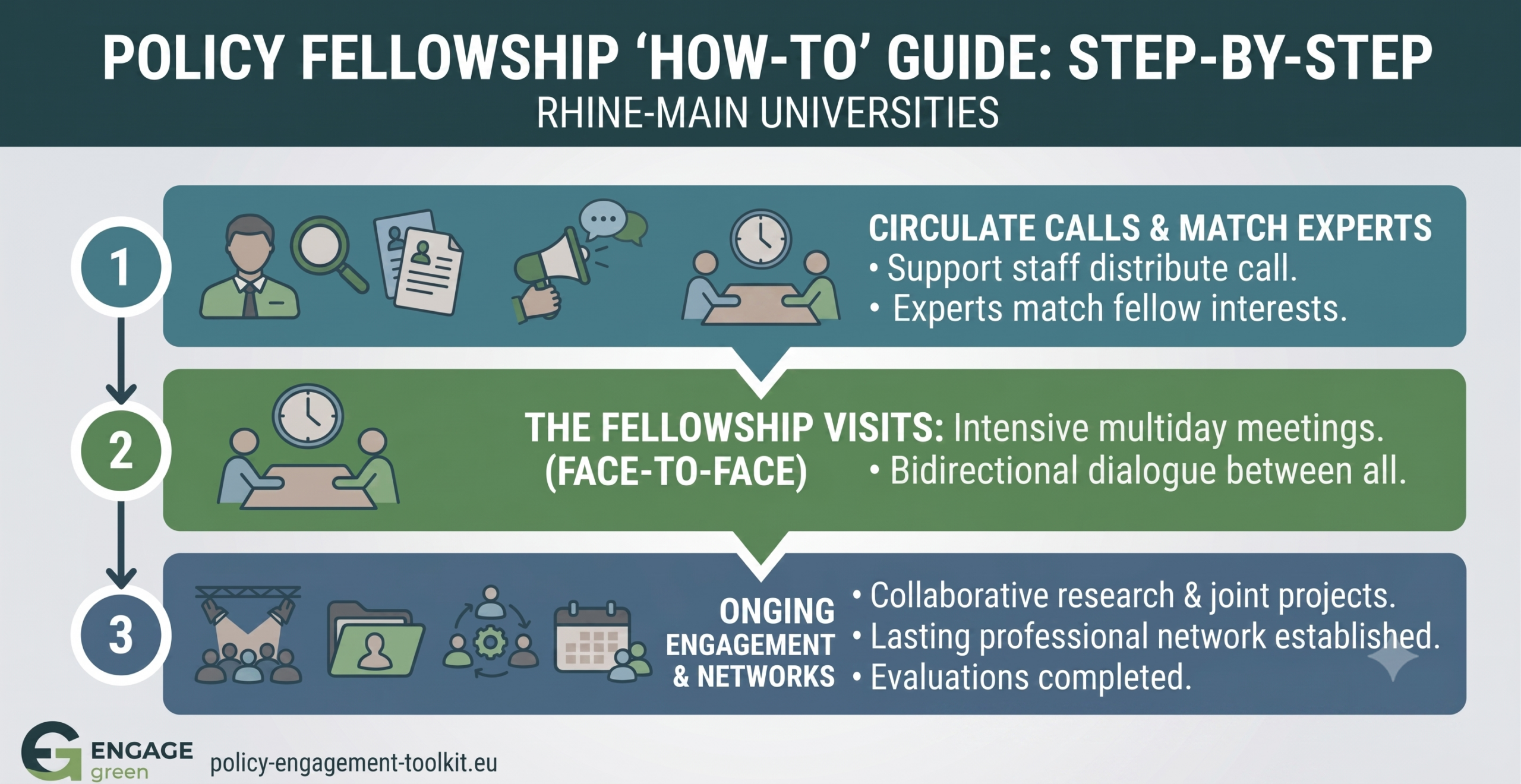
The Rhine-Main Universities – an alliance of  Technical University Darmstadt, Goethe University Frankfurt, and Johannes Gutenberg University Mainz – promote dialogue between scientists from various disciplines and policymakers via face-to-face meetings. The Rhine-Main Universities have established three dialogue programmes: The Mercator Science-Policy Fellowship Programme, the Science Meets Regions Fellowship, and the ENGAGE Policy Fellowship.

These programmes follow a very similar structure: The Rhine-Main Universities circulate calls for applications to hundreds of policymaking institutions, civil society organisations and media in Germany and abroad.

When applying to our programmes, policymaking professionals must elaborate on their need for academic expertise in motivation letters. Also, they have to provide a list of questions they would like to discuss with our scientists. Once accepted into the programmes, each policymaking professional receives a comprehensive list of researchers with whom they can meet. The policymaking professionals provide feedback on the list. The policy engagement unit at Frankfurt University schedules the meetings between the scientists and the policymaking professionals.

Each fellowship cohort conducts joint visits to the Frankfurt/Rhine-Main area twice during their fellowship, and each policymaker has meetings with approximately eight researchers during each visit. If the policy fellow needs scientific expertise in the future, they will have a network of 16 researchers they have already met and whom they can approach. Likewise, the participating researchers can approach their counterparts in policymaking institutions if they want to disseminate their knowledge. Our evaluations show that the participating policymakers and scientists are very content with the programmes. Both appreciate the office’s time efficiency and organisational support for policy engagement.

These face-to-face meetings have resulted in numerous follow-up activities such as joint events, talks by researchers at the institutions of policy professionals, and joint research projects.

Our fellowship programme brings professionals and scientists together in hundreds of meetings they would otherwise never meet. Our evaluation surveys show that about half of the researchers had no or only occasional contact with policymakers before participating in our programmes. The same observation applies to the participating policymaking professionals.

Thus, our dialogue initiatives prove that there is excellent potential for programmes bringing policymaking professionals and researchers together.


Challenges (and how to address them)

A very practical challenge is scheduling meetings with our scientists, who are often not at the universities daily. Thus, we must start planning the meetings three months in advance.

Another challenge is for the scientists to understand that the policy fellows are diverse. Some policy fellows have extensive knowledge of the topics they would like to discuss; they ask questions, such as “How does the use of smartphones affect the reading skills of children in primary schools?” Others are interested in rather big “big questions” in their policy fields (e.g., “How stable are financial markets?”), while some policy fellows use the time to gain an overview of unfamiliar topics (e.g. “What are algorithms?”).

Likewise, policymakers might talk with scientists who understand policymaking well while others speak to policymakers for the first time. We have prepared FAQ lists for policymakers and scientists and informed policymakers about the programme through bilateral phone calls or Zoom calls and an induction event.


Tasks and resources

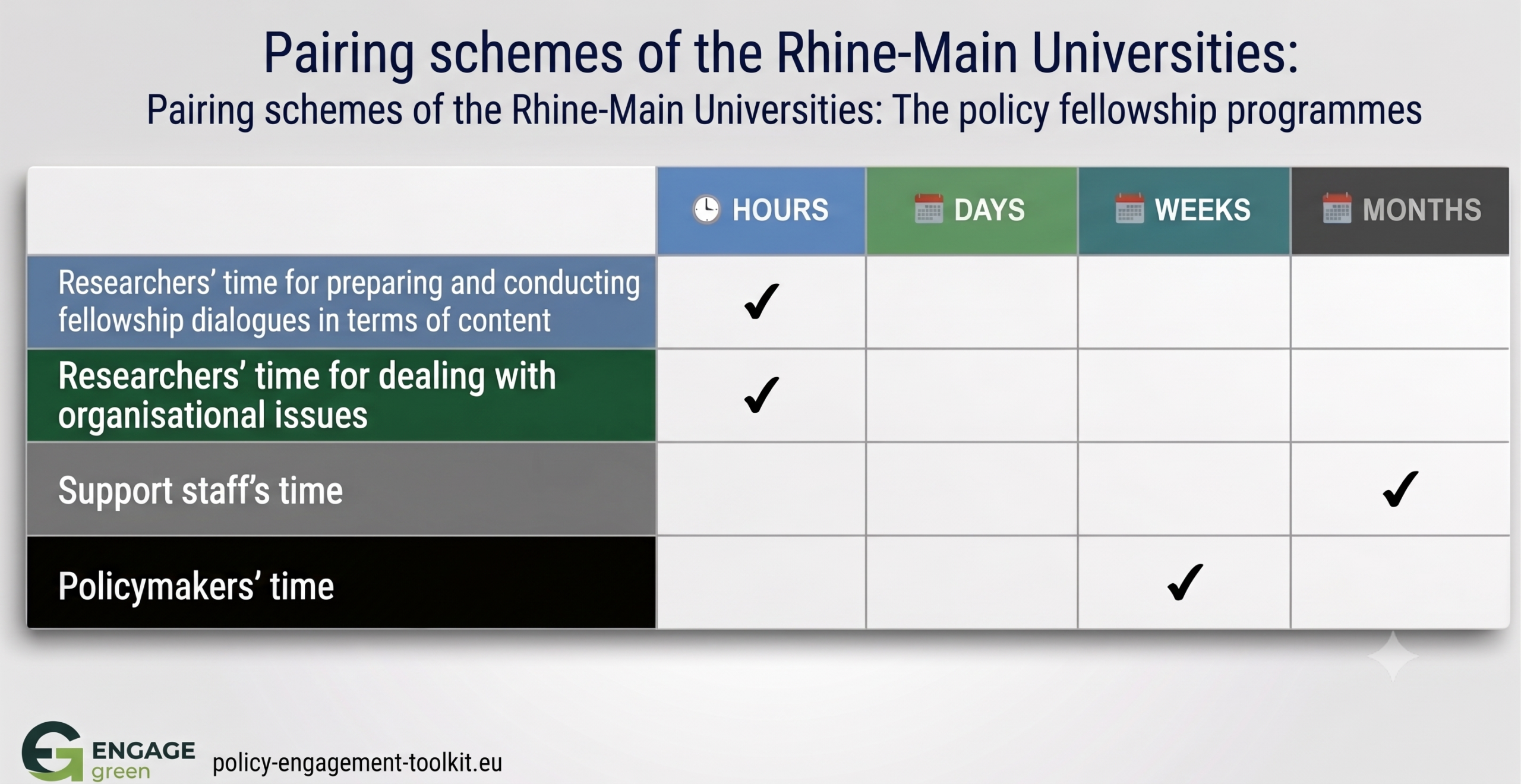
Scientists

The programmes are very time-efficient for scientists. Since the meetings are informal, they do not have to invest much time in preparing them other than reading the topics of interest of the policy fellows.

Knowledge exchange managers and research managers (Support staff)

The Rhine-Main-Universities created two new positions to coordinate their policy-dialogue projects. Our tasks include managing the application process, identifying possible experts for policymakers, assisting policymakers and scientists with organisational issues, scheduling 350 meetings per year, and other tasks. The programme is very resource intensive regarding support staff because we tailor some 16 meetings to the needs of the policy fellow.

Policymakers

The policymakers must submit an application, which takes them a couple of hours to prepare. We recommend that they spare 30 minutes of preparation time for each of the 16 scheduled meetings with our scientists. They have to conduct the meetings with our scientists. We also ask our policy fellows to participate in preparatory sessions, a feedback call, and two rounds of evaluations.

Required funding

We spend about 80% of our budget on financing two full-time positions. We have a modest budget for joint events, public relations, and travel. Stiftung Mercator provides about 60 per cent of our funds, while the EU and the three Rhine-Main-Universities contribute 20 per cent each.

Our policy fellows must cover the costs of travel to the Frankfurt/Rhine-Main area, accommodation, and dinners. We do not charge the policy fellows; other institutions, like the Centre for Science and Policy at Cambridge University or ETH Zürich, do so for their policy dialogue projects.


Sources and further reading

Tome Sandevski. How the Rine-Main Universities promote knowledge exchange between researchers and policymakers via face-to-face meetings. Knowledge of policy blog. 15 August 2023.  https://knowledge4policy.ec.europa.eu/blog/how-rhine-main-universities-promote-knowledge-exchange-between-researchers-policymakers-face-0_en


Do you want to know more about the policy engagement toolkit?

Do you want to share your experience in policy engagement? Do you think about contributing to the policy engagement toolkit? Feel free to contact Tome Sandevski via science-policy@pvw.uni-frankfurt.de
Bilingual Webinar: “Agri-food Policy: A Comparison between France and Italy”

Key Features in a nutshell

  • Bilingual webinars are the ideal format to virtually put face-to-face scientists and local/regional policymakers and break the language barrier.
  • The remote component and its short duration (1h an half maximum) allow flexibility in terms of time, which meets the needs of the often-busy schedules of policymakers.
  • Online formats such as webinars are more sustainable than in-person transnational meetings in terms of time, costs and inclusivity.
  • The Q&A and comments sections of the platforms allow the interaction with a broader public such as civil society.


How does the format work

Université Lumière Lyon 2 and Ca’ Foscari University of Venice have piloted the bilingual webinar format, within the framework of the Erasmus+ project ENGAGEgreen: Enhancing Institutional Capacities for Policy Engagement for Green and Digital Transitions.

This type of webinar format, with the addition of Remote Simultaneous Interpreting (RSI), allows local and regional policymakers, who might not be familiar or comfortable enough to carry out a discussion in a different language, to actively participate in the webinar.

In their inclusivity, bilingual webinars help foster stronger relationships among host institutions and policymakers, thus broadening the network, and engaging in the discussion also the civil society.


Participants (including organizers and speakers):

10 Researchers

1 Student

9 NGO/Civil society

7 University personnel (Research/Project managers)

4 Other (freelance, company, Coldiretti)


Before the webinar:

In preparation for the webinars, host institutions meet online bilaterally to decide on common topics, possible speakers and the target audience. Subsequently, host institutions and speakers agree on the agenda and time slots dedicated to each speaker, to be included in the online registration form and communication material to be shared on websites and social media.

It is advisable to share with the interpreter the presentations or other support materials.

The videoconference platform chosen for this webinar format is Zoom. It allows RSI, the creation and customization of a registration form and automated reminders to attendees (e.g. 1 week, 1 day and 1 hour before the event), as well as follow-up emails and surveys.

15 minutes prior the start of the webinar the Research manager (or other support staff) initiates a “Zoom practice session” together with speakers, moderator and interpreter. This is to confirm all technical aspects such as audio, selection of language, and sharing of presentations, are ready for a smooth presentation.


During the webinar:

During a 1-hour webinar, a lineup of 3 speakers (ideally 1 moderator, 1 researcher and 1 policymaker from the respective regions/nations) will shortly present their cases and related challenges, to be followed by a round of open discussion, and concluding with taking Q&A from the broader public.

With the support of RSI, which translates the conversation in real time, participants to the webinar are able to follow the discussion without breaks and without the possible misunderstandings of listening/speaking in a language that is not native.

Research managers (or other administrative staff) can support the back-end moderation of the webinar, such as select questions from the participants, and assist the speakers and translators in the event of technical issues.

The structure of the programme is as follows:

15 minutes before the start – practice session with speakers, moderator and interpreter

5 minutes of welcoming & project introduction

15 minutes for the presentation of Speaker 1

15 minutes for the presentation of Speaker 2

5-10 minutes of discussion among speakers

10 minutes for the Q&A

(It is advisable to keep the overall duration of the webinars under 2 hours).


After the webinar:

The webinar is followed by social media posts to communicate the outcomes of the discussion. An automated follow-up email is sent to all participants including a short evaluation questionnaire and the link to the ENGAGEgreen project’s website.

This format of webinars can also be replicated with other project partners or stakeholders or repeated annually as a form of follow-up and to take in the state-of-the-art of the topics discussed.


Challenges (and way to address them)

  • Identification of common topics of interests between the two national institutions. Mitigation measures: monitor common areas of study, investigate with other departments/units of the university about scientists/researchers to involve, contact the already existing network of policymakers.
  • Match schedules of the speakers. Mitigation measures: propose multiple dates and time slots well in advance from the final date of the webinar. Set preliminary and recurrent meetings, to confirm the agenda and keep everyone updated.
  • Possibility of increasing the number of languages and speakers, but this implies a longer duration and higher translation costs. Mitigation measures: investigate the possibility of using AI tools to generate subtitles or interpretation.
  • Production of promotion material in both languages and carry out parallel promotion both on- and offline. Mitigation measures: Create some draft posters/promo material in a common language (e.g. English) and have each partner translate in the respective native language. Moreover, each should disseminate the promo material with the respective networks/dedicated mailing lists.


Tasks and Ressources


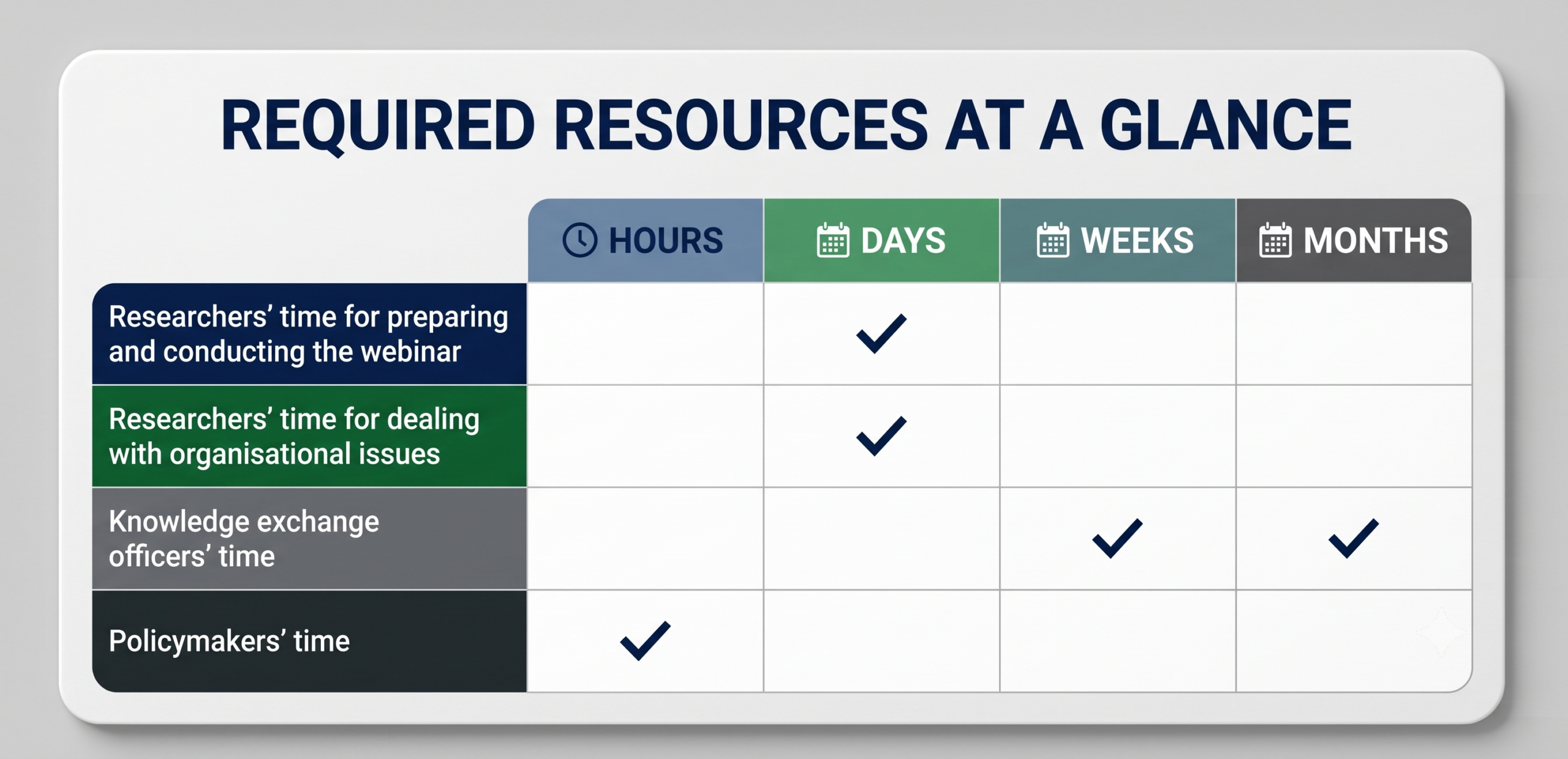
Project team

The personnel from the department/unit directly involved in a specific project liaise with other structures of the university/institution to identify the most suitable speakers on the chosen topic, both from academia and among policymakers and other organizations and stakeholders.


Knowledge exchange managers and research managers

Knowledge exchange managers and research managers play a key role in all phases of the organisation of webinars, from bilateral preliminary meetings to post-webinar debriefing. They can help identify possible topics for the webinars and coordinate the drafting of the programme. Moreover, they can assist in organising the webinar, like identifying the most suitable platform and setup the webinar, contact interpreters, or moderate the session. In addition to that, they can liaise with communication offices to give support in the preparation of press releases and social media posts before or after the webinars.


Speakers: Scientists/Researchers and Stakeholders

Researchers: The researchers need a clear understanding of the context in which they are speaking. Their contribution should balance scientific rigor with relevance for policy development. They should deliver high-value scientific content – not something obvious to the audience – while ensuring it is accessible to non-scientists. They must also adhere to the fast-paced timing typical of online events.

Stakeholder/Organization: It is important to involve individuals who represent a specific sector (for example, an economic sector) and who can effectively engage with researchers. This requires a sufficiently strong knowledge base to understand and meaningfully discuss the scientific issues presented.

Moderator: Given the complexity of connecting research and policy, the moderator’s role is to keep the discussion aligned with the objectives of the webinar. The moderator should be able to guide speakers back to the intended goals if the conversation diverges.


Required funding for activities

If the hosting institution does not have a licensed version of Zoom, which allows the webinar format, upgrade costs may apply.

Given the bilingual nature of this format of webinars, Remote Simultaneous Interpreting costs are required. AI-generated translation has not yet been considered.


Examples

Ca’ Foscari University of Venice website
Université Lumière Lyon 2 website

Engaging with the Policy Alumni Community

Key Features in a Nutshell

The event Engaging Green Policy Decision Making, organized by the project team of ENGAGEgreen of Ca’ Foscari University of Venice, its Alumni Brussels Chapter, and hosted by Ca’ Veneto (seat of the Veneto Region in Brussels), hosted participants from the alumni community living and working in the political capitals of Europe who are likely to be involved in policymaking institutions or other similar entities.

Held concurrently with the ENGAGEgreen Dissemination and Stakeholders Conference, the informal networking event gathered participants from a preexisting pool of contacts (alumni). Already familiar with the university and the region (subnational Italian government authority), they were more likely to attend, providing a natural opportunity for them to reengage with each other and explore the project’s topics.

The program includes a dialogue between a moderator and a researcher involved in the project in which the former leads the discussion with questions on the chosen topic and welcomes questions from the audience.

How does this Format work?

Before the event

Preliminary meetings between the project team and the hosting institution are organized to present the initiative and share the rationale of the event and to confirm the date and time and the possible supporting staff available. Consequently, the organizers arrived at a consensus regarding the conception of an event that would encompass the formality of an academic event while also incorporating the informality of a shared reflective moment. Given the busy schedule during a working day, it was organized outside working hours and at its conclusion a light cocktail was offered by the host institution.

One or more meetings with Alumni representatives are needed to align on topics, speaker(s), and promotion of the event.

Finally, the communication activity: a LinkedIn event post by Ca’ Foscari Alumni Brussels Chapter and promotion by the speakers and organizers.

During the event

All organizers meet in advance to finalize the setting and schedule and to welcome the attendees. Being an informal event, no registrations are required.

After the event

The organizing university sends a message of thanks for the co-hosts, and another for the participants, inviting them to follow the project’s updates on social media, and asking to complete a short questionnaire providing feedback on different aspects of the event.


Challenges (and way to address them)

  • Uncertainty about the number of attendees and spaces required; mitigation measures: set up a registration form with a deadline, so that the number of possible participants can be known at least a day in advance
  • Alumni present in the region; mitigation measures: scout beforehand regarding the presence of an alumni community; if not present, involve alumni from other partner universities present in the region or change the target audience depending on the co-organizers network there


Tasks and Resources

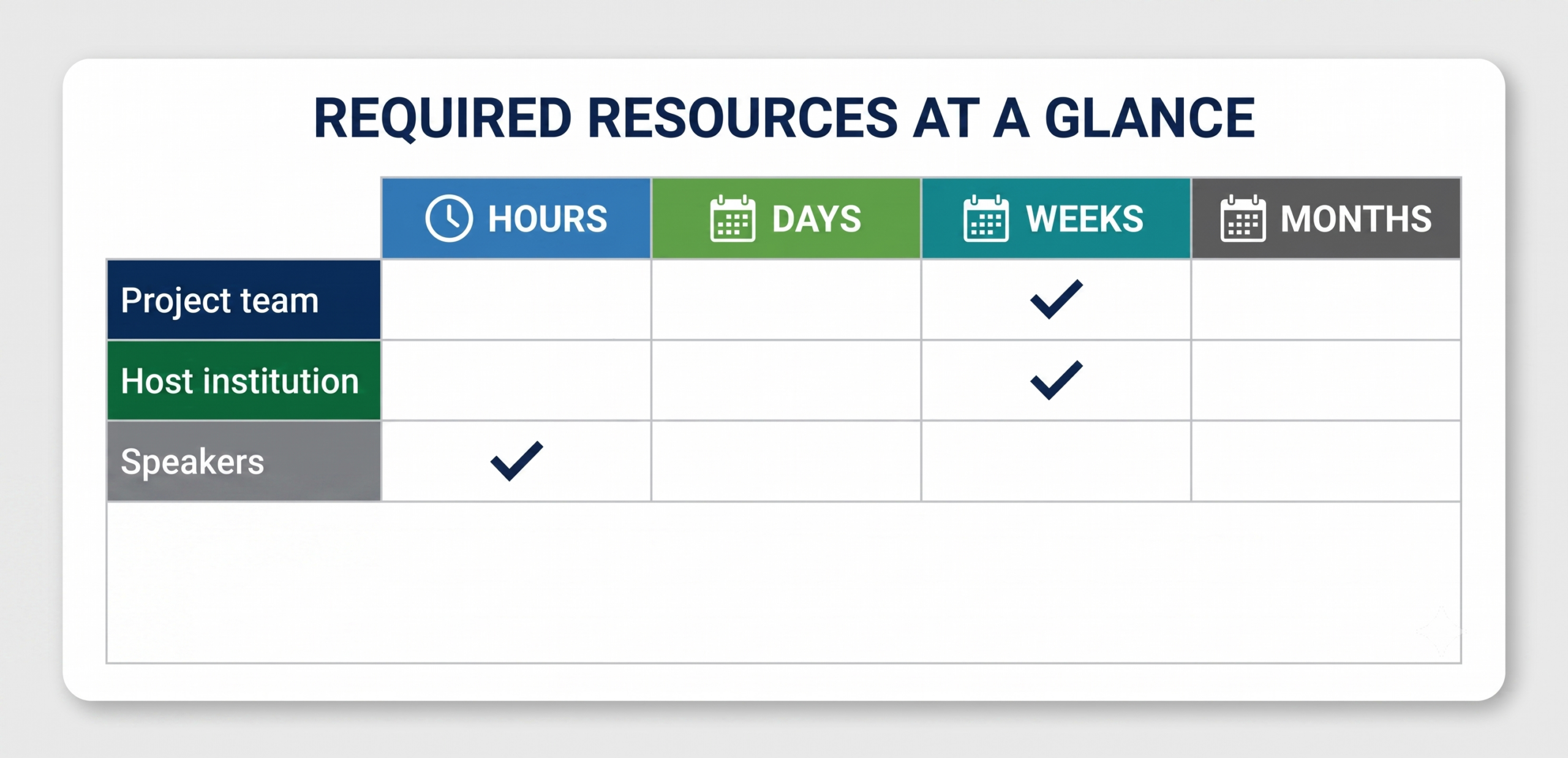
Project team and host institution

The personnel from the university directly involved in the project liaise with the host institution to identify the most suitable speaker or moderator on the chosen topic, both from academia and among policymakers and other stakeholders. They organize regular online meetings to coordinate on registration, support staff, and possible infrastructures/services needed (e.g., screen, microphone, promotional material to be printed).

Speakers

Moderator: Meets online with organizers and the main speaker to confirm the schedule and agree on topics and questions. In this case, the moderator is also part of the alumni community, a vital link to the target audience.

Professor: Meets online with organizers and the main speaker to define the topics, based on their expertise, and the attendees. Decide on the topic and try to identify the main issues that may concern the invited guests.


Do you want to know more about the policy engagement toolkit?

Do you want to share your experience in policy engagement? Do you think about contributing to the policy engagement toolkit? Feel free to contact Tome Sandevski via science-policy@pvw.uni-frankfurt.de
Hackathon: When Data Speaks

Description

The “When Data Speaks” Hackathon is a collaborative innovation event designed to connect the academic world with public administration and the technical community. Taking place over several days, it focuses on using data to improve the quality of life in the region. The event serves as a platform where students, IT professionals, and enthusiasts work together to solve specific regional challenges defined by local stakeholders.


Objectives

The primary goals of this initiative are to:

  • Connect diverse sectors: Build active partnerships between researchers, city officials, and technology students or experts.
  • Apply open data: Leverage public datasets to address concrete problems identified in the region.
  • Create practical solutions: Generate functional prototypes, analytical tools, or concepts that support regional governance and environmental sustainability.
  • Enhance decision-making: Demonstrate how data-driven insights can be integrated into public policy and community engagement.


How does the format work?

This format acts as an accelerator for innovation by bringing distinct groups together in a shared space. Unlike traditional meetings, it combines the technical skills of developers with the strategic needs of policymakers to produce immediate, tangible results. The core element is the use of “open data,” which ensures transparency and allows participants to build solutions using resources that are freely available to the public. It is also a learning experience, offering participants a chance to understand the intersection of technology and public administration.

The event typically spans 48 hours of intensive collaboration.

  • Participant recruitment: Participant recruitment combined broad outreach with targeted engagement to ensure a diverse pool of attendees. Organisers promote the hackathon through presentations at high schools, social media posts, institutional newsletters, and paid as well as organic advertisements on partners’ social network channels. Additionally, individual and personal invitations were sent to select students, professionals, and stakeholders with relevant expertise. The call for participation was further disseminated within scientific networks and partner communities, helping to attract motivated participants from academia, industry, and the public sector while fostering interdisciplinary collaboration.
  • Kick-off and Context: The event begins with an opening session where organizers present the specific challenges (e.g., traffic monitoring, climate resilience) and introduce the available datasets.
  • Education and Training: Participants attend workshops and lectures to learn about the data sources and relevant tools.
  • Teamwork and Development: Participants form interdisciplinary teams and select a problem to solve. They spend the majority of the time analysing data, coding, and building a proof of concept.
  • Mentoring: Experts from the city, university, and private sector act as mentors, guiding teams to ensure their solutions are technically sound and practically useful.
  • Evaluation: At the conclusion, teams present their prototypes to a jury of stakeholders. Projects are judged on their innovation, feasibility, and potential impact on the region.


Challenges (and ways to address them)

  • Resource Constraints for Organizers: Scientists often face difficulties balancing research duties with the logistics of event planning. Solution: Assign logistical tasks, such as venue management and registration, to support staff or student assistants.
  • Applicability of Results: Policymakers may worry that technical outputs will not fit existing legal or administrative frameworks. Solution: Involve officials directly in defining the challenges to ensure alignment with policy needs from the start.
  • Funding and Engagement: Securing budget and maintaining participant energy can be difficult. Solution: Build a coalition of diverse partners to share costs and provide varied expertise.


Tasks and resources

Researchers/Scientists:

  • Responsible for the content strategy: defining the challenges, curating datasets, and setting the agenda.
  • Manage the selection of mentors to guide the technical aspects.

Policymakers:

  • Identify pressing regional issues that can be solved with data.
  • Secure necessary funding through grants or partnerships and ensure the event aligns with strategic political goals.
  • Plan for the future implementation of successful prototypes.

Support Staff:

  • Manage operational logistics, including venue booking, catering, and participant registration.
  • Handle communication, such as social media promotion and press releases.


Required funding for activities

A successful event requires budget allocation for:

  • Operational Costs: Venue rental, catering for attendees, and technical infrastructure.
  • Personnel Expenses: Travel and accommodation for external experts, mentors, and speakers.
  • Incentives: Prizes for winning teams and marketing materials to ensure high visibility and attendance.


Do you want to know more about the policy engagement toolkit?

Do you want to share your experience in policy engagement? Do you think about contributing to the policy engagement toolkit? Feel free to contact Tome Sandevski via science-policy@pvw.uni-frankfurt.de

Other