
Bringing Policymakers into the Lab: Lessons from the Practice Day ‘Future Technologies for Energy and Security’ at TU Darmstadt
Authors





Key features in a nutshell
- A full-day “Practice Day” (Praxistag) combining laboratory tours, live demonstrator presentations, and structured networking across different university locations.
- The “Practice Day” (Praxistag in German) at TU Darmstadt brought together about 30 representatives from policymaking institutions, NGOs, associations, and businesses with 10 researchers from various academic disciplines.
- The guests from practice organisations toured the labs of the Metal Energy Hub, the Smart Homes EHub and the Digital Resilience Xchange (DiReX) Centre at TU Darmstadt. The practioners were acquainted with state-of-the-art research while the researchers learned about policy questions.
- Delegating event management and targeted participant outreach to dedicated research managers and knowledge exchange officers drastically reduces researchers’ administrative workload and maximises event impact.
How did the format work?
Step 1: Conceptualisation
The Policy Engagement Unit at Goethe University Frankfurt—which coordinates the Erasmus+ project ENGAGEgreen and the Mercator Science-Policy Fellowship Programme of the Rhine-Main Universities (TU Darmstadt, Goethe University Frankfurt, and Johannes Gutenberg University Mainz)—approached researchers at the Metal Energy Hub and the Digital Resilience Xchange (DiReX) centre to explore interest in a policy-oriented event.
A joint team of five researchers, research managers, and knowledge exchange officers co-designed the event and scheduled it for 29 January 2026.
Core Aims of the Event:
- Provide an applied overview of cutting-edge research on renewable energy storage and digital resilience during emergency and crisis situations in Germany.
- Connect researchers from TU Darmstadt directly with regional, national, and local policymakers, as well as stakeholders from industry, NGOs, and public administration.
Step 2: Planning & Targeted Outreach
Researchers and research managers at TU Darmstadt compiled an initial list of 150 key institutional stakeholders. To broaden outreach, the Policy Engagement Unit at Frankfurt reviewed organisational charts across 60+ relevant public sector bodies and identified over 200 tailored contacts.
- Invitations: Official invitations were sent out in early December 2025 to approximately 350 policy professionals and stakeholders.
- Registration Rates: By mid-January 2026, around 35 external practitioners and 10 researchers and research managers from TU Darmstadt had registered (yielding an effective conversion rate of ~10–12%).
- Logistics: Catering was finalised and targeted reminder emails were dispatched two weeks prior to the event.
Step 3: Implementation
The event took place on 29 January 2026.
- 09:00–09:30 | Registration & Welcome: Assembly at the Metal Energy Hub offices (Campus Lichtwiese, TU Darmstadt).
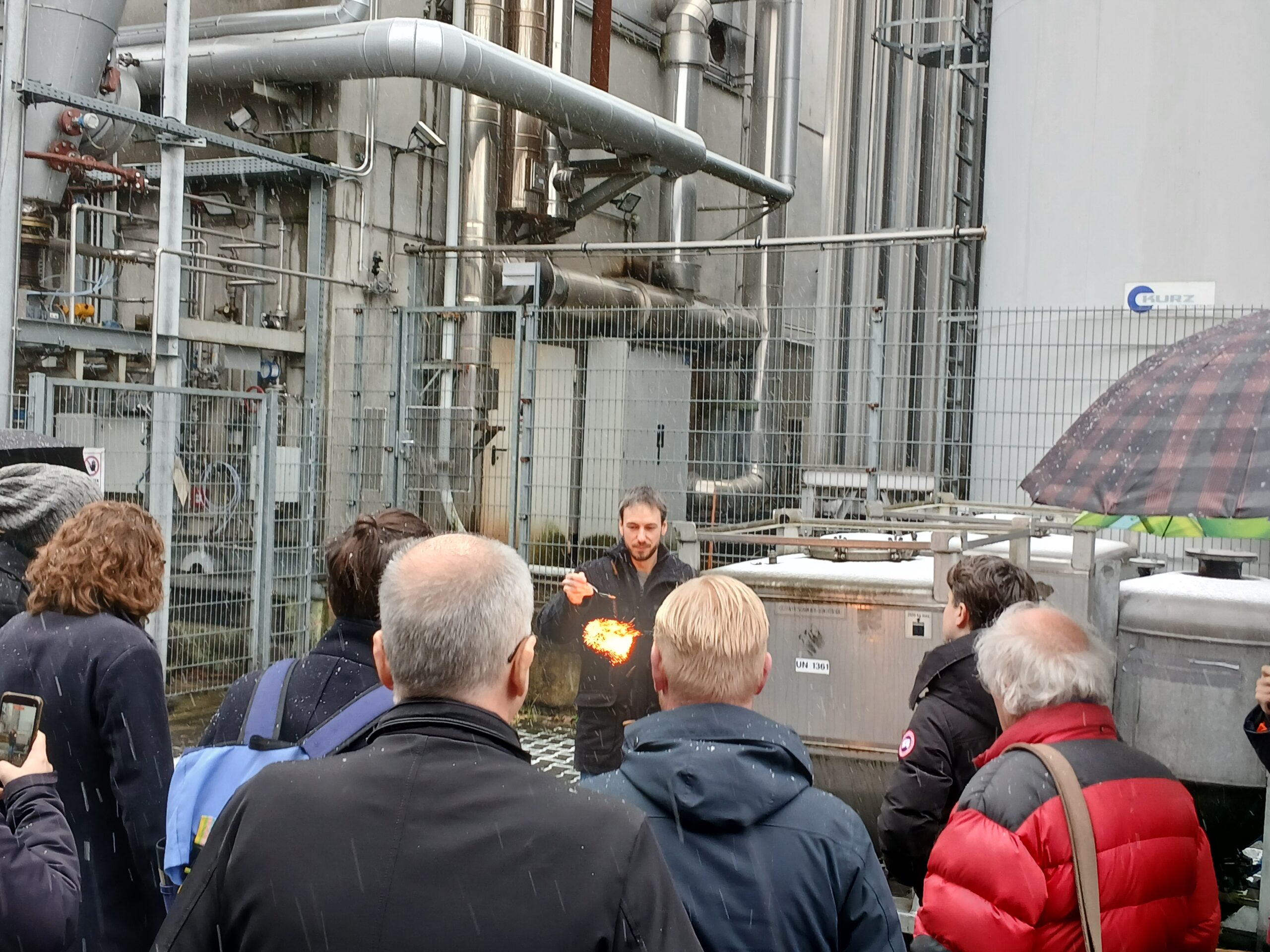
- 09:30–11:30 | Lab Tour 1 – Metal Energy Hub: Presentation of research on innovative green technologies (e.g. zero-carbon energy storage via iron powder oxidation and reduction), followed by a guided laboratory tour led by Dr Marius Schmidt.
- 11:40–12:10 | Lab Tour 3 – Energy-Autonomous Smart Home (eHub): Guided visit by Dr Joachim Schulze, highlighting rapid self-sufficient emergency power setups for photovoltaic system owners.
- 12:10–12:40 | Group Transfer: Shared commute from Campus Lichtwiese to the City Campus of TU Darmstadt.
- 12:40–13:30 | Networking Lunch: Joint light lunch at the Application and Transfer Centre Digital Resilience Xchange (DiReX) to maintain group cohesion during the campus transition.
- 13:30–15:15 | Lab Tour 3 – Digital Resilience Xchange (DiReX): Presentation on resilient digital municipal infrastructure designed for disaster management, including interactive demonstrator tours led by Prof. Dr Michèle Knodt and Prof. Dr Bernd Freisleben.
Step 4: Post-Event Follow-Up
Within one week of the event, the Policy Engagement Unit distributed presentation slides and a comprehensive contact directory of all participating researchers to the external practitioners.
Challenges and how to address them
Overall, the event ran very smoothly, but it’s worth being explicit about why, so other universities can calibrate their own expectations. The researchers, research managers, and knowledge exchange officers involved had already been collaborating for some time through the ENGAGEgreen project and the Mercator Science-Policy Fellowship Programme. This meant established working relationships, shared routines, and mutual trust were already in place before planning even began. Researchers could focus entirely on presenting their findings, while research managers and knowledge exchange officers handled the organisational side.
Universities without this kind of existing infrastructure should expect the first edition of a comparable event to take noticeably more coordination time, simply to build the working relationships that this team could already draw on.
Tasks and resources
Researchers
- Prepared accessible, non-academic presentations and core policy pitches.
- Set up interactive laboratory setups and physical demonstrators.
- Co-developed the thematic scope and suggested relevant expert contacts.
Research managers and knowledge mobilisers
- Managed target group identification across 60+ public sector organisational charts.
- Handled mailing lists, invitation workflows, catering, and social media coverage.
- Coordinated campus transfers and facilitated session moderation.
Policymakers
- Represented local, regional, and national ministries, political parties, NGOs, and businesses.
- Engaged in active Q&A sessions during lab demonstrations.
- Established direct contacts with academic researchers for long-term policy advice.
Pictures


Do you want to know more about the policy engagement toolkit?
Do you want to share your experience in policy engagement? Do you think about contributing to the policy engagement toolkit? Feel free to contact Tome Sandevski via science-policy@pvw.uni-frankfurt.de


Leave a Reply