


Tailored Expert Trainings
Author

Description
Practical trainings conducted by academic professionals for public administration employees – referred to as Tailored Expert Trainings – represent a dynamic form of cooperation between academia and the applied sector. These trainings facilitate the direct transfer of up-to-date knowledge from research, development, and university education into the day-to-day practice of public administration. They differ from typical commercial courses by their high degree of specialization, narrow thematic focus, and strong customization to the specific needs of participants.
The objective of such trainings is to strengthen the professional competencies of public administration officials through interactive instruction based on scientific know-how. The content is built around real-life problems and data from the public sector. The ability to work with real datasets and tailor the course material to the actual needs of participants is a key added value of this cooperation model.

Objectives
Tailored Expert Trainings aim to achieve the following core objectives:
- Transfer of specialized knowledge and skills that are not typically covered in commercially available courses and reflect the latest scientific and technological trends.
- Customizing content to specific participant groups and their institutional settings.
- Enhancing the practical applicability of expert knowledge through hands-on data work and real-world examples.
- Strengthening interdisciplinary and inter-institutional collaboration between university departments and public sector bodies.
- Building long-term relationships and partnerships, which may lead to contract research, expert consultations, or joint publicly funded projects.
- Providing researchers with valuable insights and inspiration for new research questions and applied studies derived from real-world challenges encountered by public administration professionals.
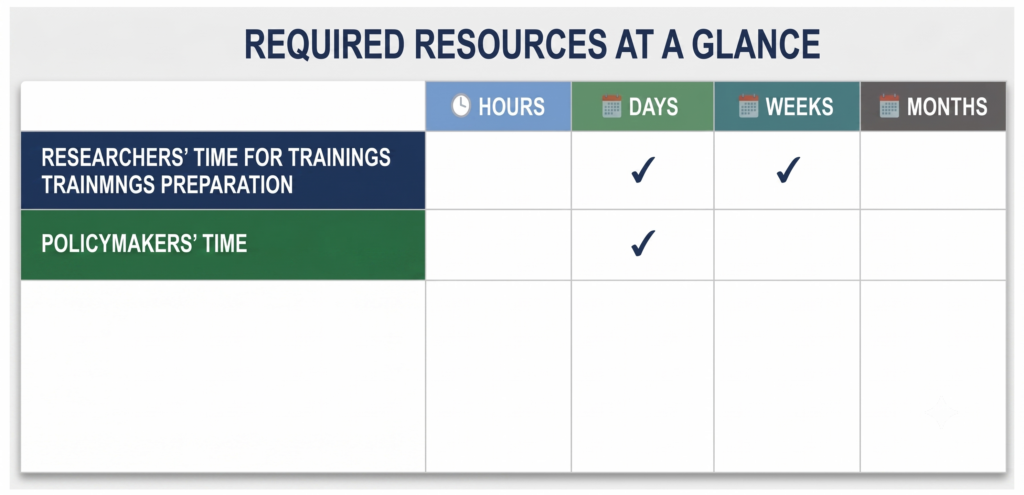
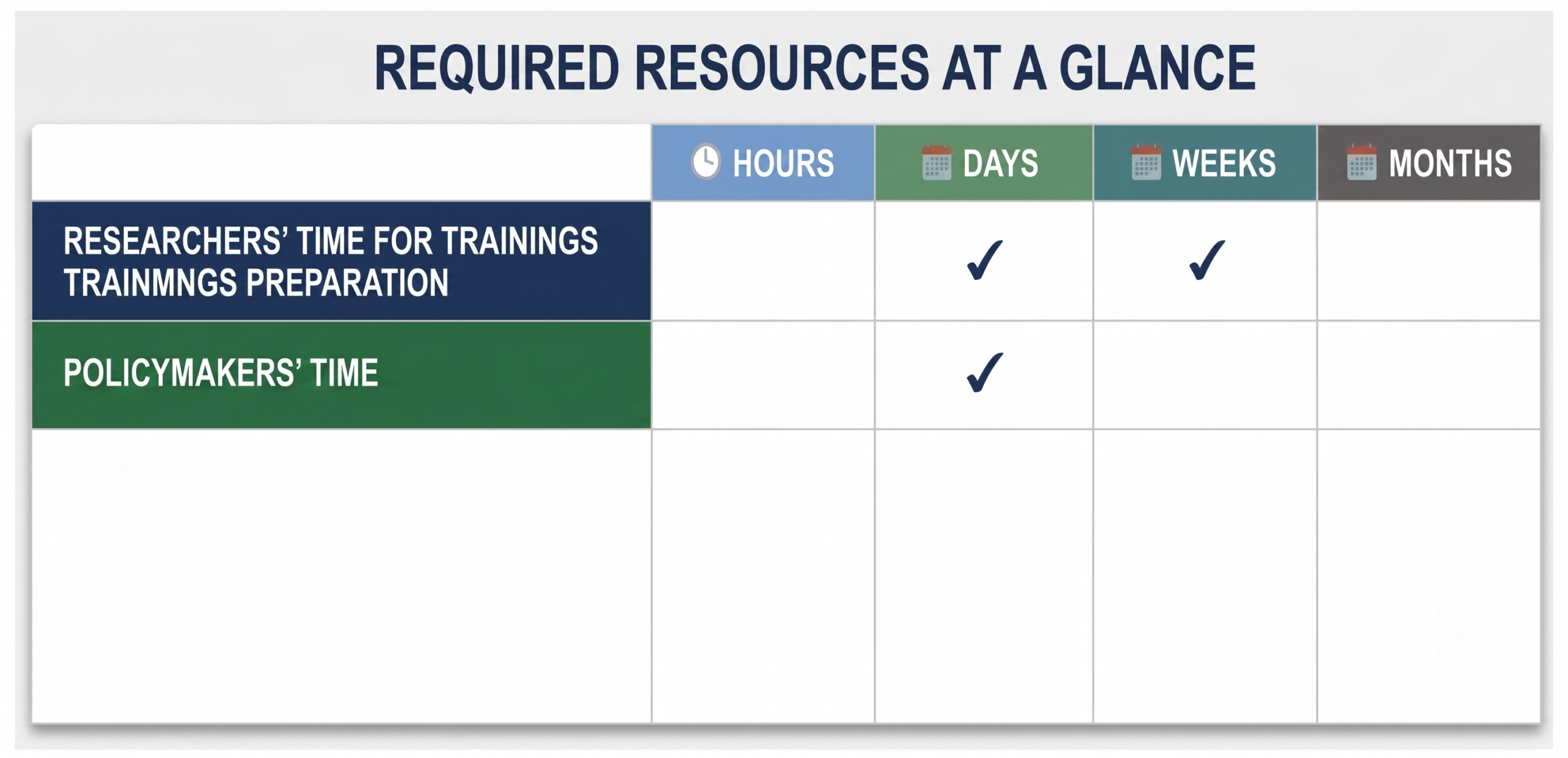
How does the format work?
Target Group of Participants
Potential training participants may include:
- Clerks, analysts, and technical staff in central and local government institutions, public agencies, and related organizations.
- Managers and department heads, project or team leaders.
- Mayors, deputy mayors, or other public administration representatives involved in adopting or implementing new technologies or procedures.
- The selection of training topics should be closely aligned with the profile and needs of the participant group.
Group Size
The recommended group size is 5 to 10 participants. Smaller groups enable higher interactivity, individual consultations, and flexible pacing of the training.
Duration and Timing
The recommended length of training is 1 to 2 working days, depending on topic complexity and the desired level of depth. To accommodate the availability of both public officials and academics, training is best scheduled outside the main teaching semester (e.g., during the summer or examination period).
Training Format
- Trainings are highly practice-oriented, emphasizing real-world examples, participant-led tasks, and hands-on engagement.
- It is advisable to work with real datasets and case examples that participants bring from their institutions.
- Avoid generic or simulated data – instead, aim to incorporate real institutional data under the guidance of the trainer during independent work phases.
- A two-trainer setup has proven effective – one leads the main lecture and demonstrations, while the other provides individual support to less advanced participants.
Trainers and Expertise
Trainings should be professionally guaranteed by a senior academic expert with experience in both research and practical application. Active involvement of PhD students and postdoctoral researchers is strongly recommended – they often contribute highly specialized and up-to-date knowledge. Pre-training preparation should include close communication with the participating institution regarding training goals, participant profiles, and expectations.
Example Training Topics
The following is a non-exhaustive list of possible themes. The content should always be customized:
- Use of open data, its analysis and application in decision-making.
- Geographic Information Systems (GIS) and cartography – visualization of spatial data.
- Fundamentals of process automation using scripting (e.g., Python, R).
- Use of graphic software for creating maps, infographics, and reports.
- Introduction to Artificial Intelligence and its use in public administration.
- Data analysis and visualization – building interactive dashboards, maps, and summary charts.
Benefits for Participants
Participants (civil servants, public managers):
- Acquisition of advanced skills and tools applicable to their daily work.
- Opportunity to work with their own data and discuss real problems.
- Enhancement of professional competencies and flexibility.
Academic Staff and Universities:
- Opportunities for real-world collaboration and applied research inspiration.
- Transfer of academic knowledge into practice.
- Establishment of long-term partnerships with the public sector.
Public Administration Institutions:
- Upskilling of employees in modern tools and methods.
- More effective internal processes.
- Enhanced innovation capacity and readiness for data-driven decision-making.
Challenges (and ways to address them)
Another potential challenge relates to the need for formal accreditation of trainings, especially in contexts where public administration institutions require officially recognized certification for their staff’s professional development. In some countries, such as the Czech Republic, accreditation can be granted by government bodies or professional associations (e.g., the Ministry of the Interior). However, the process often involves extensive documentation and compliance with formal standards, which may prolong the preparation timeline. To mitigate this, organizers should initiate accreditation procedures well in advance and maintain clear communication with accrediting institutions to ensure alignment with expected criteria.
A further challenge lies in managing the diversity of participant skill levels, which can significantly affect the group dynamic and the overall effectiveness of the training. Trainers must be flexible and responsive, ready to adjust the scope, depth, and pace of the content delivery in real time. Gathering feedback during the training—preferably through interactive formats—enables facilitators to make immediate modifications, such as skipping redundant sections or elaborating on more advanced topics as needed. Incorporating real-time feedback mechanisms and being prepared to adapt the training structure accordingly are crucial for maintaining participant engagement and ensuring the relevance of the training to all experience levels.
Required Funding for Activities
Trainings are typically funded by the contracting public institutions (municipalities, government bodies, etc.). The cost is calculated individually, based on university regulations and the financial capacity of the contracting institution. It includes trainer preparation, contact hours, and potential use of facilities or equipment. These trainings are considered highly specialized services, and may be funded from institutional training budgets or public grants.
Example
The Department of Geoinformatics, Faculty of Science, Palacký University Olomouc has been conducting specialized trainings for public administration professionals for over 15 years. The trainings are held irregularly and adapted to specific requests. They are accredited by the Czech Association for Geoinformation (ČAGI).
The courses focus on cartography, GIS, and remote sensing. The key principle is customization – including the use of participant data and institution-specific tasks. Trainings are held in university computer labs, typically using QGIS and ArcGIS. The format has consistently been evaluated by participants as highly beneficial.
An example of such a course was Unmanned Aerial Systems – Operation, Mapping, Photogrammetry, and Laser Scanning, conducted as part of continuous professional education. The two-day training (20 contact hours) combined lectures on UAV operation principles, relevant Czech and EU legislation, and sensor technologies with practical exercises in flying multirotor and fixed-wing drones, followed by data processing to produce orthophotos, digital terrain models, and 3D point clouds.
Do you want to know more about the policy engagement toolkit?
Do you want to share your experience in policy engagement? Do you think about contributing to the policy engagement toolkit? Feel free to contact Tome Sandevski via science-policy@pvw.uni-frankfurt.de


Leave a Reply