

Empowering Municipal Leadership: Engaging Mayors in Cultural and Territorial Development through the New European Bauhaus
Author

Esteban Romero and David Corado
Esteban Romero-Frías (erf@ugr.es) currently works as Vice-Rector for Social Innovation, Employability and Entrepreneurship at the University of Granada and Full Professor in the Department of Accountancy and Finance. His academic and research work focuses on public and social innovation, digital learning, and digital humanities. Through UGR MediaLab, which he has directed since its foundation, he has led various collaborative projects such as Impronta Granada and UnInPública, aimed at building bridges between universities, public institutions, and society to tackle regional challenges.
David Corado (davidcorado@go.ugr.es) is a conference interpreter, translator, and predoctoral researcher in the Languages, Texts and Contexts programme at the University of Granada. Trained at institutions such as the Universitat Autònoma de Barcelona and the Universitat Jaume I, he holds an FPU UGR–Santander research contract and is a member of Medialab UGR, where he takes part in projects such as ENGAGEgreen and #YoSigoUGR. He currently combines his teaching and research work with professional conference interpreting, collaborating on a voluntary basis with organisations, associations and non-profit entities. He has participated in academic projects, conferences and publications related to interpreting and communicative competences.
Summary: Key features in a nutshell
- Central role of municipal leadership in defining and showcasing cultural innovation across rural and urban areas.
- Introduction to the New European Bauhaus (NEB) funding framework as a tool for sustainable local development.
- Presence of national and European experts to train and inspire policymakers.
- Collaborative ecosystem linking mayors, cultural agents, researchers, and citizens.
- Integration of the event into the broader Impronta Granada and ENGAGEgreen frameworks for territorial innovation.
Description
This contribution documents the Impronta Granada Conference on Culture and Territory, held on 20 March 2025 at the University of Granada’s Breaker Space (V Centenario building). The event exemplifies how UGR provides a privileged platform for mayors and municipal representatives to present their local projects, gain visibility, and receive direct guidance on European funding opportunities such as those of the New European Bauhaus (NEB).
By placing municipalities at the centre of the dialogue between culture, territory, and innovation, the University of Granada fosters a governance model based on shared responsibility and mutual learning between academia and local administrations.
How does the format work?
The Impronta Granada Conference: “Culture and Territory” was conceived as a participatory policy dialogue space designed to:
- Strengthen the visibility of municipalities as cultural and social innovation actors.
- Provide capacity-building opportunities for local authorities to access EU programmes such as the NEB.
- Promote mutual learning between policymakers, academic experts, and cultural professionals.
The event was organised by Medialab UGR, under the Vice-Rectorate for Social Innovation, Employability and Entrepreneurship, and brought together over 60 participants, including mayors, councillors, cultural officers, researchers, and civil-society organisations.
The structure of the day reflected the three pillars of the New European Bauhaus — sustainability, inclusion, and beauty — and was divided into complementary segments combining training, inspiration, and peer exchange.
Why did it attract local policymakers?
- Presentation of the New European Bauhaus initiative by Laura Hagermann, Policy Officer at the European Commission, highlighting opportunities for municipalities to apply for NEB funding.
- Panel of mayors and cultural officers representing municipalities such as Purullena, Galera, Santa Fe, Alpujarra de la Sierra, Guadix, and Dúdar, who shared local experiences in decentralised cultural programming, heritage revitalisation and citizen participation.
- Keynote by Federico Buyolo, Director of Culture at the Ortega-Marañón Foundation, discussing “Culture and Territory: Development and Citizenship in Rural Areas” and emphasising collective intelligence as the basis for sustainable development.
- Networking session and policy roundtable, enabling local representatives to connect with university researchers and EU programme officers for project ideation and collaboration.
Challenges
- Ensuring continuity beyond the one-day conference through follow-up actions.
- Translating theoretical discussions (NEB principles) into actionable funding proposals.
- Balancing participation between urban and rural municipalities with uneven resources.
- Adapting European frameworks to the cultural and socio-economic context of small towns.
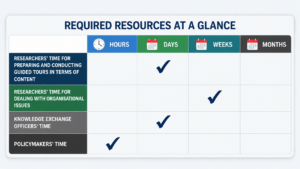
Tasks and resources
Scientists
- Presented and contextualised NEB principles for local adaptation.
- Supported municipalities in identifying project ideas aligned with EU frameworks.
- Collected and synthesised examples of culture-driven territorial innovation.
Knowledge exchange managers and research managers
- Coordinated event logistics, registration, and communication.
- Facilitated connections between local governments and funding opportunities.
- Produced press releases and audiovisual documentation to ensure dissemination.
Policymakers
- Participated as speakers and presenters, sharing municipal cultural projects.
- Engaged in dialogue with European Commission representatives and national experts.
- Explored opportunities to integrate NEB principles into local development strategies.
Case studies
Impronta Granada Conference: “Culture and Territory” (Granada, Spain, 20 March 2025)
The event positioned mayors and cultural officers as primary agents of change. Each municipality had the opportunity to present its own cultural initiatives and challenges, reinforcing the visibility of local government action within a European framework.
Through the introduction of the New European Bauhaus, the University of Granada enabled direct knowledge transfer on EU funding schemes, linking local innovation to continental policy priorities.
The participation of high-level experts and the presence of European Commission representatives elevated the dialogue, turning the conference into a capacity-building milestone for municipal leadership in the province.
How is format conducted
The format combines formal presentations and participatory dialogues.
- Introductory session led by the Vice-Rectorate to contextualise Impronta Granada.
- Expert training segment introducing NEB principles and funding mechanisms.
- Municipal showcase where mayors present their ongoing or planned projects.
- Inspirational keynote by a national expert to foster reflection on culture and citizenship.
- Networking and informal exchange, promoting cooperation between municipalities and academic staff.
All sessions were held in-person at the University of Granada’s Breaker Space, with open registration and free participation.
Available resources (what are the main tasks)
- Event recordings, press releases, and photographic documentation.
- NEB funding guidelines distributed among attendees.
- Contact database of municipalities and cultural officers.
- Collaboration templates for joint project proposals (UGR–municipalities).
- Visibility through Medialab UGR, Impronta Granada, and institutional communication channels.
What works? What doesn’t? (Lessons learnt)
Works:
- Giving mayors a visible and vocal role creates strong engagement and legitimacy.
- Introducing European frameworks (NEB) empowers local leaders with practical knowledge.
- Involving national and EU-level experts strengthens credibility and institutional learning.
- Holding events at the university symbolises openness and institutional support.
Doesn’t:
- One-off sessions without follow-up limit continuity.
- Overly technical explanations may discourage smaller municipalities.
Lessons learnt:
- Combine expert presentations with local storytelling for better understanding.
- Provide written guides on funding schemes.
- Include time for informal dialogue between policymakers and researchers to spark collaboration.
How do you evaluate the activities?
Outputs:
- 1 major event with 60+ participants (mayors, cultural officers, researchers).
- 6 municipalities showcased cultural initiatives.
- Training session on NEB principles and funding opportunities.
- Press and media coverage across university and local outlets.
Outcomes:
- Increased awareness of EU funding among local governments.
- Strengthened cooperation between municipalities and the University of Granada.
- Creation of a provincial network of cultural policymakers committed to sustainable development.
Indicators:
- Number of municipalities represented.
- Participant satisfaction and follow-up contacts.
- Number of municipalities preparing NEB-inspired proposals.


Leave a Reply