

Incentives for Researchers to Engage in Policy Dialogue: The Impronta Granada Awards
Author

Esteban Romero and David Corado
Esteban Romero-Frías (erf@ugr.es) currently works as Vice-Rector for Social Innovation, Employability and Entrepreneurship at the University of Granada and Full Professor in the Department of Accountancy and Finance. His academic and research work focuses on public and social innovation, digital learning, and digital humanities. Through UGR MediaLab, which he has directed since its foundation, he has led various collaborative projects such as Impronta Granada and UnInPública, aimed at building bridges between universities, public institutions, and society to tackle regional challenges.
David Corado (davidcorado@go.ugr.es) is a conference interpreter, translator, and predoctoral researcher in the Languages, Texts and Contexts programme at the University of Granada. Trained at institutions such as the Universitat Autònoma de Barcelona and the Universitat Jaume I, he holds an FPU UGR–Santander research contract and is a member of Medialab UGR, where he takes part in projects such as ENGAGEgreen and #YoSigoUGR. He currently combines his teaching and research work with professional conference interpreting, collaborating on a voluntary basis with organisations, associations and non-profit entities. He has participated in academic projects, conferences and publications related to interpreting and communicative competences.
Summary: Key features in a nutshell
- Goal: align the University of Granada research with territorial needs and urban and local policy agendas.
- Governance: issued and coordinated by the University of Granada (Impronta Granada & Medialab UGR) in institutional partnership with the Provincial Council of Granada.
- Who can apply: members (or former members) of the University of Granada who since 2000 presented a Bachelor’s thesis, Master’s thesis, PhD thesis, or published a scientific article.
- What is valued: transferability to local challenges; impact, alignment with urban agenda, methodological innovation, academic quality, viability/sustainability.
- Incentive design: monetary awards and prime policy exposure—a 2-minute presentation at the Impronta Granada Meeting to the largest audience of regional mayors and provincial policymakers.
- Strategic benefit: the awards act as a bridge between university knowledge and municipal needs; they normalise policy-relevant research across all academic stages.
Description
This contribution explains how Impronta Granada, an institutional alliance between the University of Granada and the Provincial Council of Granada, incentivises policy-oriented research through the Impronta Granada Awards.
The awards recognise research that can be translated into territorial transformation projects addressing social, economic and environmental challenges in the province of Granada.
Importantly, the awards are not limited to senior researchers. They include Bachelor’s theses, Master’s theses, PhD theses and scientific articles, fostering early-stage policy awareness in students as well as consolidated academics.
Crucially, awardees present their work at the Encuentro Impronta Granada, the flagship event where UGR’s county-level Living Labs (UGR County Councils) are constituted and followed up, and where mayors and municipal policymakers are most present—creating a high-visibility gateway for research-to-policy dialogue.
How does the format work?
1 – Call & eligibility
Open to anyone in the University of Granada community (current or past) who has, since 2000, produced a dissertation, master’s thesis, a PhD thesis, or a scientific article.
The call is issued annually by the University of Granada through Impronta Granada and Medialab UGR, in institutional coordination with the Provincial Council of Granada (Diputación de Granada).
The Awards are part of the broader Impronta Granada strategy to connect university knowledge with territorial governance. While researchers and students are the main applicants, the initiative is conceived as a territorial knowledge activation mechanism, not solely as an academic award.
The first edition of the Awards was launched in 2024. The year 2000 was selected as the eligibility threshold to ensure:
- A sufficiently broad repository of research outputs.
- Inclusion of high-quality works produced before systematic digital archiving became standard.
- Recovery and valorisation of potentially underused academic knowledge.
This long temporal scope reflects the idea that valuable territorial knowledge may already exist within the university but remains untapped.
2 – Submission package
- Link to the full research work in a repository or external file.
- A project document (max. 10 pages) describing the territorial transformation derived from that research: cover page, executive summary, brief of the original work, relevance to provincial challenges, detailed proposal (objectives, resources, territory, actors/alliances, timeline), and impact (expected results, sustainability, indicators).
* Territorial transformation refers to the capacity of research results to inform, inspire or structure interventions addressing concrete challenges within the province of Granada.
It does not require immediate implementation. Instead, applicants must reinterpret their research into a structured proposal that:
- Identifies a specific territorial challenge (e.g., environmental, social, cultural, economic).
- Defines potential actors and partnerships.
- Outlines objectives, resources, timeline and indicators.
The goal is to translate academic knowledge into a feasible governance-oriented framework that could be piloted or considered by local institutions.
3 – Where to apply
- The internal university application manager: complete form + attach the project document (Word/OpenDocument/Google Drive).
4 – Evaluation criteria & award committee
Submissions are evaluated by a joint award committee composed of representatives from:
- The University of Granada (academic leadership and knowledge exchange representatives)
- The Provincial Council of Granada (Diputación de Granada). The presence of the Provincial Council ensures policy relevance in the assessment process.
Transfer-oriented scoring emphasising:
- Territorial impact (up to 4 points)
- Alignment with the urban agenda of Granada (up to 3) – This refers not only to the city of Granada but to broader provincial and regional development frameworks aligned with sustainability, cohesion and innovation principles. While not all researchers are initially familiar with these policy agendas, the call documentation explicitly explains the relevant strategic priorities to guide applicants.
- Methodological innovation (up to 3)
- Academic quality (up to 3)
- Viability & sustainability (up to 3)
5. Awards & ceremony
- Prize pool: €8,000 across four modalities:
* Bachelor’s thesis: 4 × €500
* Master’s thesis: 2 × €1,000
* PhD thesis: 1 × €2,000
* Scientific article: 1 × €2,000
- Obligation of awardees: present publicly at the Impronta Granada Meeting in front of institutional representatives, the research community and territorial stakeholders.
Challenges
- Ensuring projects are genuinely implementable in diverse municipal contexts (urban/rural, varying capacities). However, the awards do not require projects to be implemented. Neither researchers nor policymakers are obligated to execute proposals. The objective is to encourage research designed with territorial relevance in mind and to create opportunities for dialogue that may, but do not necessarily, lead to implementation.
- Balancing academic excellence with practical transferability and alignment to the urban agenda priorities.
- Securing consistent repository access and complete documentation for older research (since 2000).
- Managing high demand for visibility at the Impronta Granada Meeting within limited on-stage time (2-minute pitch).
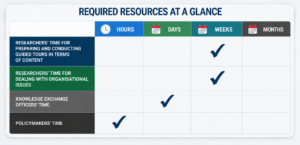
Tasks and resources
Scientists
- Identify territorial relevance and formulate a concise, implementable 10-page project derived from existing research.
- Prepare a clear 2-minute pitch for policymakers at the Encuentro.
- Define indicators and a feasible timeline for local deployment.
Knowledge exchange managers and research managers
- Operate the call, application guidance, and workflows.
- Coordinate the jury, ceremony logistics, and the Impronta Granada Meeting programme.
- Facilitate visibility across the University of Granada channels and matchmaking with municipalities.
Policymakers
- Policymakers do not unilaterally decide on the awards; however, representatives of the Provincial Council of Granada are part of the evaluation committee.
- Attend the Impronta Granada Meeting; listen to pitches that map onto local needs.
- Initiate follow-up conversations for piloting, co-funding, or integrating proposals into local agendas.
1st Edition – Impronta Granada Awards (2024)
- Call Launch: https://improntagranada.es/impronta/se-convocan-los-premios-ugr-diputacion-impronta-granada-para-tfgs-tfms-y-tesis-con-propuestas-de-impacto-para-la-provincia/
- Final Resolution / List of Awardees: https://improntagranada.es/impronta/el-consejo-de-gobierno-de-la-universidad-de-granada-aprueba-la-resolucion-de-los-premios-impronta-granada-2024/
- Award Ceremony (1st Impronta Granada Meeting): https://improntagranada.es/consejos-comarcales-ugr/i-encuentro-impronta-granada-reune-a-representantes-de-todas-las-comarcas-de-granada/
2nd Edition – Impronta Granada Awards (2025)
- Call Launch: https://improntagranada.es/impronta/la-universidad-de-granada-lanza-la-ii-edicion-de-los-premios-impronta-granada-para-impulsar-la-investigacion-con-impacto-territorial/
- Final Resolution / List of Awardees: https://improntagranada.es/impronta/acuerdo-definitivo-de-la-ii-edicion-de-los-premios-impronta-granada/
- Award Ceremony (2nd Impronta Granada Meeting – Loja): https://improntagranada.es/impronta/el-ii-encuentro-impronta-granada-refuerza-en-loja-la-alianza-entre-universidad-y-territorio/


Leave a Reply