

From local concern to policy dialogue: A case study on sustainable pest control through academic and municipal collaboration
Author

Esteban Romero-Frías (erf@ugr.es) currently works as Vice-Rector for Social Innovation, Employability and Entrepreneurship at the University of Granada and Full Professor in the Department of Accountancy and Finance. His academic and research work focuses on public and social innovation, digital learning, and digital humanities. Through UGR MediaLab, which he has directed since its foundation, he has led various collaborative projects such as Impronta Granada and UnInPública, aimed at building bridges between universities, public institutions, and society to tackle regional challenges.
David Corado (davidcorado@go.ugr.es) is a conference interpreter, translator, and predoctoral researcher in the Languages, Texts and Contexts programme at the University of Granada. Trained at institutions such as the Universitat Autònoma de Barcelona and the Universitat Jaume I, he holds an FPU UGR–Santander research contract and is a member of Medialab UGR, where he takes part in projects such as ENGAGEgreen and #YoSigoUGR. He currently combines his teaching and research work with professional conference interpreting, collaborating on a voluntary basis with organisations, associations and non-profit entities. He has participated in academic projects, conferences and publications related to interpreting and communicative competences.
Summary: Key features in a nutshell
- Originated from an academic participant’s observation of a local problem (pest outbreaks affecting agriculture).
- Mobilized the quadruple helix model (academia, policymakers, private sector, civil society).
- Resulted in a hybrid seminar/webinar on sustainable pest control, led by a UGR biotechnology expert.
- Emphasized biotechnological alternatives to chemical insecticides, with scientific insights and practical solutions.
- Included open debate and networking, fostering a replicable model for other territories.
Description
This case study showcases how a localized agricultural problem — a pest outbreak in the Vega de Granada area — evolved into a multi-stakeholder science-policy dialogue, coordinated under the Erasmus+ ENGAGEgreen framework through the University of Granada’s County Councils initiative. This process demonstrates the potential of the Living Lab methodology and quadruple helix collaboration in transforming grassroots concerns into informed public policy actions, fostering sustainable solutions through academic expertise and political engagement.
How does the format work?
The initiative began with the concern raised by a University of Granada academic, a nursing lecturer and participant in the Metropolitan Area County Council. Though pest control was not her field, she noticed a significant caterpillar infestation affecting local crops in Huétor Vega, her place of residence. She brought this issue to the attention of the County Council and, through the coordination team at the University of Granada’s Vice-Rectorate for Social Innovation, received direct contact information for local policymakers.
With the support of Huétor Vega’s mayor and local councillors, and the involvement of the University of Granada coordination team, a collaborative strategy was launched. The academic participant’s concern was matched with the expertise of Susana Vílchez Tornero, a Full Professor of Biotechnology and Director of the Biotechnology Institute of the University of Granada.
The coordination team proposed a public awareness seminar on sustainable pest control. The event was held in a hybrid format, allowing both in-person attendance (for networking and knowledge exchange) and virtual participation via live webinar. The seminar recording was made available online to ensure wider dissemination and long-term accessibility.
Challenges
- Mobilizing a cross-disciplinary response to a highly localized and technical issue.
- Aligning institutional logistics across academic, municipal, and technical domains in a short timeframe.
- Ensuring accessible communication to non-specialist audiences, while maintaining scientific rigour.
- Bridging the gap between academic knowledge and practical policymaking.
Tasks and resources
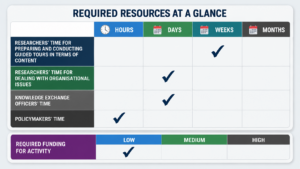
Scientists
- Identified and mobilized expertise in biotechnology and pest control.
- Delivered scientific content during the seminar.
- Provided practical, environmentally responsible alternatives to traditional pest control methods.
- Participated in a post-seminar debate to clarify technical issues for other stakeholders.
Knowledge exchange managers and research managers
- Coordinated stakeholder engagement and event logistics.
- Ensured hybrid technical setup and post-event dissemination.
- Facilitated connections between academia and public institutions.
Policymakers
- Supported the initiative logistically and politically.
- Participated in the event and discussion sessions.
- Helped promote the seminar locally to reach agricultural communities and interest groups.
Examples
- Seminar title: “Sustainable Alternatives for Pest Control in Agriculture”
- Event venue: La Sinsombrero, Edificio V Centenario, University of Granada
- Format: Hybrid (on-site + live webinar)
- Total participants: 40+, including academics, local policymakers, technical staff, and citizens.
Sources and further reading
- County Councils microsite: https://improntagranada.es/consejoscomarcalesugr/
Case studies
How is format conducted
- Triggered by grassroots concern.
- Coordination between academia and local government.
- Expert-led seminar (scientific input).
- Debate and open discussion among quadruple helix stakeholders.
- Recorded and disseminated for broader access.
Available resources (what are the main tasks)
- Coordination of event logistics and hybrid platform.
- Preparation of content and visual aids.
- Internal and external promotion of the event.
- Facilitation of stakeholder dialogue.
What works? What doesn`t? (Lessons learnt)
What works:
- Starting from a local concern makes the initiative highly relevant and participatory.
- Word-of-mouth and territorial networks are powerful for mobilising stakeholders.
- Hybrid formats enhance participation and long-term visibility.
- Scientific expertise can be activated quickly if institutional coordination is fluid.
What doesn’t:
- Highly technical content may need extra effort to be accessible to non-experts. This can be addressed by simplifying scientific or administrative terminology without losing accuracy, incorporating infographics, diagrams or short videos instead of purely technical presentations, and showcasing real-world cases or on-site demonstrations.
- Rural actors may need additional support to access online formats.
How do you evaluate the activities?
- Participant feedback after the seminar.
- Level of representation across the quadruple helix.
- Number of views/downloads of the recording.
- Initiatives launched or explored after the event (e.g., follow-up actions in Huétor Vega).


Leave a Reply