

How to recruit participants to establish a territorial dialogue model for science-policy cooperation
Authors
Authors: Esteban Romero and David Corado
Esteban Romero-Frías (erf@ugr.es) currently works as Vice-Rector for Social Innovation, Employability and Entrepreneurship at the University of Granada and Full Professor in the Department of Accountancy and Finance. His academic and research work focuses on public and social innovation, digital learning, and digital humanities. Through UGR MediaLab, which he has directed since its foundation, he has led various collaborative projects such as Impronta Granada and UnInPública, aimed at building bridges between universities, public institutions, and society to tackle regional challenges.
David Corado (davidcorado@go.ugr.es) is a conference interpreter, translator, and predoctoral researcher in the Languages, Texts and Contexts programme at the University of Granada. Trained at institutions such as the Universitat Autònoma de Barcelona and the Universitat Jaume I, he holds an FPU UGR–Santander research contract and is a member of Medialab UGR, where he takes part in projects such as ENGAGEgreen and #YoSigoUGR. He currently combines his teaching and research work with professional conference interpreting, collaborating on a voluntary basis with organisations, associations and non-profit entities. He has participated in academic projects, conferences and publications related to interpreting and communicative competences.
Summary: Key features in a nutshell
- Multi-phase recruitment strategy rooted in a Living Lab co-creation methodology.
- Stepwise stakeholder engagement: starting with university personnel (academia), expanding to policymakers, and later involving the private sector and civil society.
- Use of internal distribution lists, websites, word-of-mouth networks and local media outreach.
- Anchored in territorial identity and thematic interest.
- Progressive scaling from academic volunteers to a fully-fledged science-policy dialogue platform across 10 County Councils.
Description
This contribution presents the recruitment strategy used by the University of Granada (UGR) to establish the UGR County Councils. This is a territorial dialogue model that connects academia, policymakers, private sector actors and citizens under a Living Lab framework. The chapter outlines a step-by-step approach to attract participants from each stakeholder group, following the quadruple helix model, and to build a co-creation ecosystem aimed at fostering science-policy collaboration.
Recruiting participants is a foundational step in any science-policy dialogue initiative, especially when the model is grounded in the Living Lab methodology and the quadruple helix model. A Living Lab is an open and collaborative innovation ecosystem, where stakeholders from different sectors co-create solutions in real-life contexts. In this case, the UGR County Council Living Lab is applied to the territorial scale, where dialogue and experimentation take place within the everyday social and institutional fabric of Granada’s counties. The quadruple helix model brings together four key stakeholder groups: academia, policymakers, the private sector and civil society. Each helix contributes distinct knowledge, resources and perspectives that are essential to tackling complex territorial challenges related to sustainability, development and the creation of public policies.
Recruiting representatives from each helix is not only a logistical task, but a strategic imperative: it ensures the plurality of voices, territorial embeddedness and relevance of the co-created solutions. Without a carefully designed and phased recruitment process, the pairing scheme would lack diversity, legitimacy and real-world impact. In the case of the UGR County Councils, the stepwise recruitment of university teaching, research and technical staff laid the groundwork for trust, internal capacity and knowledge mobilisation. This was followed by targeted engagement with policymakers, which enabled meaningful pairing dynamics and eventually opened the ecosystem to business and citizenship. This inclusive, ecosystemic structure is what transforms a typical consultation exercise into a territorial innovation lab with long-term policy influence.
How does the format work?
The recruitment process was structured in following phases:
- Engaging the academic community (July–September 2024):
- Medialab UGR, the Social Innovation Lab of the University of Granada, launched an internal call for expressions of interest to teaching and research staff and technical-administrative staff of the University of Granada.
- Dissemination channels included the University of Granada internal mailing lists and the university’s official websites and media platforms.
- The invitation encouraged staff to connect based on territorial ties (origin, residence, or ongoing projects in a county).
- Building awareness and understanding (December 2024):
- A virtual training and orientation session was held with 46 initial participants, clarifying objectives, methodologies (Living Labs) and structure of the UGR County Councils.
- Participants were invited to co-create entries in the project’s microsite and begin identifying local challenges.
- An essential and often underestimated element in this recruitment process was the role of word-of-mouth communication. After the first internal training session with academic and technical staff, many participants organically became ambassadors of the initiative, spreading the concept of the UGR County Councils to their personal and professional contacts in local administrations. This informal, trust-based communication proved particularly effective in reaching mayors, councillors, and other local policymakers, especially in areas where institutional or digital outreach may not have been sufficient. The personal credibility of university staff played a key role in generating interest, securing early policy engagement and laying the foundations for stronger science-policy connections.
- Activating the second helix – policymakers (December 2024–January 2025):
- Thanks to the networks and outreach capacity of the academic participants, local political institutions (municipalities’ councils, the county associations of municipalities, the Provincial Council of Granada and rural development groups) were approached.
- Policymakers’ contacts from previous University of Granada’s collaborations were leveraged to initiate this participation.
- Science-policy dialogue kick-off event (20 January 2025):
- The First Impronta Granada Meeting served as a public milestone where:
- University of Granada representatives presented local challenges and ongoing university projects within the counties of the Granada province.
- Policymakers responded and engaged in a debate originated by the presentation of the University of Granada representatives.
- Private sector and civil society stakeholders also attended through open calls and media promotion.
- The First Impronta Granada Meeting served as a public milestone where:
- Open call to the wider community: the 2 remaining helixes (February 2025):
- Following the event, a new public call was issued to further involve citizens and business entities.
- Channels included social media, local press, public webinars and community outreach activities.
Challenges
- Ensuring initial motivation and time commitment from university staff.
- Creating balanced representation across diverse disciplines and territories.
- Maintaining momentum between phases (academic engagement → policy dialogue → community outreach).
- Overcoming digital access barriers in rural areas.
- Translating expressions of interest into sustained, active involvement.
- Digital-only recruitment limits inclusion in certain rural areas.
- Scheduling conflicts for active professionals require flexible formats.
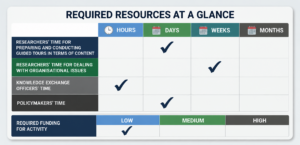
Tasks and resources
From a methodological viewpoint, the participant intake form was a crucial tool to structure, formalise and personalise the recruitment process. Designed to gather not only contact details but also qualitative information on participants’ territorial connections, motivations and project involvement, the form allowed a more meaningful and strategic matching of participants to the corresponding county councils. It helped ensure diversity in terms of roles (academia, public sector, private sector, citizenship), territorial relevance (attachment to one of the ten counties within the province of Granada) and thematic interest. Moreover, it facilitated initial mapping of expertise, needs and local engagement capacity . All this is essential for fostering authentic co-creation processes within the Living Lab framework. The form also reflected data protection compliance and transparent data handling, reinforcing trust and institutional professionalism throughout the recruitment phase.
Scientists
- Volunteered through an internal recruitment campaign.
- Identified local needs based on their territorial link.
- Acted as knowledge brokers in the councils.
- Presented ongoing University of Granada projects at the science-policy dialogue event.
Knowledge exchange managers and research managers
- Facilitated internal coordination and onboarding.
- Developed communication and engagement strategies.
- Managed documentation and feedback processes.
- Structured follow-up communications.
Policymakers
- Contributed to agenda setting and identification of local priorities.
- Discussed the current needs of their municipalities and counties in line with what researchers and technicians presented.
- Participated in co-creation of initiatives.
- Integrated council outcomes into municipal/regional policy agendas.


Leave a Reply