Information seminar for research managers and administrators (RMAs)

What is the format about?

Research managers and administrators (RMAs) can play a crucial role in connecting academia with policymakers for a number of reasons that go beyond their traditionally perceived administrative responsibilities:

1) RMAs systematically identify and monitor opportunities for collaboration through national, European, and international funding programmes. Thanks to their detailed knowledge of specific topics and calls and the strategic priorities of funding bodies, they are able to identify projects in which the involvement of public authorities is either essential or highly beneficial. In this way, RMAs help to bridge academic research and the practical needs of public administration at the national and local levels.

2) In recent years, the role of RMAs has become significantly more professionalised and expanded. They are no longer solely project administrators; they increasingly contribute to the design and co-creation of institutional strategies and support new forms of collaboration. This enables them to systematically integrate cooperation with policymakers into the long-term strategies of universities and to promote evidence-informed policymaking as a natural component of the universities’ “third mission”.

3) As part of university administration, RMAs also serve as key contact points. Policymakers often do not know which experts to approach on a specific topic, while individual researchers do not always actively communicate beyond their own academic communities. RMAs, however, have an overview of institutional research capacities across faculties and disciplines, allowing them to effectively mediate between the needs of public institutions and relevant academic experts.

The information seminar on evidence-informed policymaking and its integration into research and educational projects aims to equip RMAs with practical tools and knowledge that will enable them to effectively support collaboration between academia and policymakers.


How does the format work

Training on this topic is best delivered in a group format rather than through individual consultations. Research managers and administrators represent a highly heterogeneous group in terms of expertise, professional experience, and functional roles. A group-based setting therefore creates space for rich discussion, the sharing of diverse perspectives, and the exchange of practical experiences, all of which significantly increase the added value of the seminar compared to an individual format.

The seminar can be delivered at different institutional levels, ranging from individual faculties or universities to the national level through professional platforms and associations of research managers and administrators. The participation of institutional leadership is also highly beneficial, as it helps ensure follow-up conceptual support for the topic (for example, by enabling the establishment of dedicated impact manager positions within project support units). If delivered at the international level, the focus of the seminar should be adapted towards the exchange of experiences and good practices, taking into account differences in public administration systems, institutional frameworks, and policymaking processes across countries.


The information seminar for RMAs should cover the following areas:

1) Key benefits of collaboration between researchers and policy-makers in projects

  • Access to data and practice: Public authorities provide data, information, and case studies that are not typically accessible within the academic environment.
  • Mutual capacity building: Universities strengthen their ability to communicate with the applied sector, while public institutions gain access to the latest scientific knowledge.
  • Strategic and financial advantages: The involvement of non-academic partners is a key requirement in many funding programmes (Horizon Europe, Interreg, ERDF, national programmes).
  • Increased societal impact of research: Researchers can directly contribute to policymaking and enhance the relevance of their projects by engaging with major societal challenges such as climate change, public health, urban development, and digital transformation.

2) Mapping project opportunities in current funding programmes

  • Regular monitoring of open calls on funding agency portals and matching these calls with the strategic priorities of the university or faculty, as well as with the needs of public administration.
  • Building networks of contacts across project support units, institutional leadership, and individual departments or units, and sharing up-to-date information to coordinate researchers’ interest.

3) Specifics of project collaboration with public authorities at the local, regional, national, and European levels

  • Institutional structures and complex decision-making processes
  • Bureaucracy, legislative frameworks, public procurement rules, and related requirements
  • Limited time and human resources
  • Political influences and public expectations

4) Targeted science communication

  • Developing skills in interpreting scientific results for non-academic audiences, helping to formulate research objectives and outputs in ways that are understandable and relevant to policymakers.
  • Framing topics not primarily as research questions but as policy-relevant issues, including who is affected, how the issue relates to decision-making processes, and the broader policymaking context and related strategic documents.
  • Focusing on impact and added value of collaboration: offering concrete solutions to identified problems, saving time and resources, and increasing institutional efficiency and credibility.

5) Building sustainable infrastructure for collaboration beyond projects

  • Developing processes, tools, and platforms that facilitate long-term communication between academia and public administration.
  • Establishing networks of contacts (expert databases, thematic partnerships) and supporting various formats of collaboration, as further described in the ENGAGEgreen Policy Engagement Toolkit.

6) Strategic orientation of research activities: supporting socially relevant research topics based on an analysis of current public administration needs

  • Public authorities can ensure the practical use of research outputs in the day-to-day functioning of institutions, allowing project results to respond to real needs of citizens and communities.
  • Research results can be further utilised within public administration through follow-up policies and strategies, staff training and education, and the implementation of new digital tools or methodologies.


Challenges

One of the main challenges in implementing training focused on collaboration with policymakers is the low awareness of the relevance of this topic among research managers and administrators (RMAs). The topic is often perceived as marginal or as falling outside their regular project responsibilities.

It is therefore more effective to integrate the seminar into existing educational activities (workshops or conferences) for RMAs, rather than offering it as a standalone event, and to promote it through professional networks and internal institutional communication. When framed in this way, the training is perceived as a natural part of professional development rather than an additional or optional topic. At the same time, it is important to systematically raise awareness of the topic among researchers so that demand for this type of project support also emerges from the academic community itself.

Ensuring follow-up after the seminar is equally important. Awareness of relevant calls, project initiatives, and examples of good practice should be reinforced through institutional communication over the long term, enabling participants to practically apply the knowledge gained. This approach increases the likelihood that the seminar will not only enhance individual competencies but also lead to tangible changes in institutional processes and project practices.


Tasks and resources

The speaker should be well-informed about current funding opportunities and the existing structures that support various forms of collaboration with policymakers at the institution. Seminar participants do not need prior theoretical knowledge; however, it is recommended that they map the situation within their department or faculty in advance—for example, identifying who is engaged in collaboration with public authorities, which researchers are already working with institutions, and what forms of collaboration exist. This mapping enables participants to actively contribute to discussions and share concrete practical examples. Resources that can be used for preparation include internal databases and contacts within departments or faculties.


Example

RMA Power Week (19 -23 May 2025)

The RMA Power Week was a five-day professional workshop primarily aimed at research project managers, but also open to other administrative and technical staff involved in research support. It was organized by the Grant Office at the Faculty of Arts, Palacký University Olomouc. The workshop focused on key areas of research management, including the preparation of project proposals, science communication, effective financial planning and monitoring, research data management, and the use of artificial intelligence in project management. The workshop was supported by two ongoing Horizon Europe projects (Twinning calls), which aim, among other objectives, to enhance the competencies and capacities for project support at the participating institutions.

On the second day of the workshop, which focused on science communication in projects, a 60-minute session titled ‘Public Administration as a Project Partner’ was devoted to collaboration with policymakers. The presentation was divided into a theoretical and a practical part: the theoretical part covered all the key areas of the Information seminar described above, while the practical part presented concrete examples of ongoing projects and initiatives at the university. The session concluded with a discussion in which participants shared their experiences and reflected on how the insights gained could be applied in practice.


Do you want to know more about the policy engagement toolkit?

Do you want to share your experience in policy engagement? Do you think about contributing to the policy engagement toolkit? Feel free to contact Tome Sandevski via science-policy@pvw.uni-frankfurt.de
Format: Short Training Course for Research Managers

Summary: Key features in a nutshell

  • A short in-person training course for research and knowledge transfer managers of Ca’ Foscari University of Venice and local partner institutions
  • Dual format: presentation of research projects at different development stages, with a focus on policy engagement, followed by a roundtable with experts (research facilitator, research manager, and postdoctoral researcher)
  • Valuable opportunity to share best practices and tools and analyse key elements to consider during the project design phase, specifically on the impact of projects on policymaking
  • Networking opportunity at the end of the training course
  • Course hours are recognized as official training by the competent office within the university (all the staff from Italian Public Administration are required to attend at least 40 hours of training annually)


How does the format works?

Before the course

The ENGAGEgreen project unit of the Department of Economics at Ca’ Foscari, together with the office for Promoting Innovation and Knowledge (PInK), drafts the agenda and selects speakers through regular online and in-person meetings. Other tasks include:

Setting up a registration form with a timely deadline necessary to know the final number of participants, both to book the room and for providing the light refreshments foreseen as a networking moment at the end of the course.

Communication of the event on official social media accounts and the university’s internal newsletter targeted to research and knowledge transfer managers.

Contacting the university’s Human Resources and Development Office to confirm the procedure to approve participants’ training hours.

During the course

Registration of participants for the accreditation of training hours.

After the course

The organizers send a message of thanks to speakers and participants, inviting them to follow the project’s updates on social media and asking them to complete a short questionnaire providing feedback on different aspects of the event.


Challenges (and ways to address them)

  • Finalize the program well in advance to have enough time for promotion before the registration deadline. Mitigation measures: constant communication between organizers to keep them reminded of the timeline.
  • Speakers unavailable in-person at the last minute. Mitigation measures: set up an online meeting link in advance and select a room with the proper equipment in the event of a hybrid session.


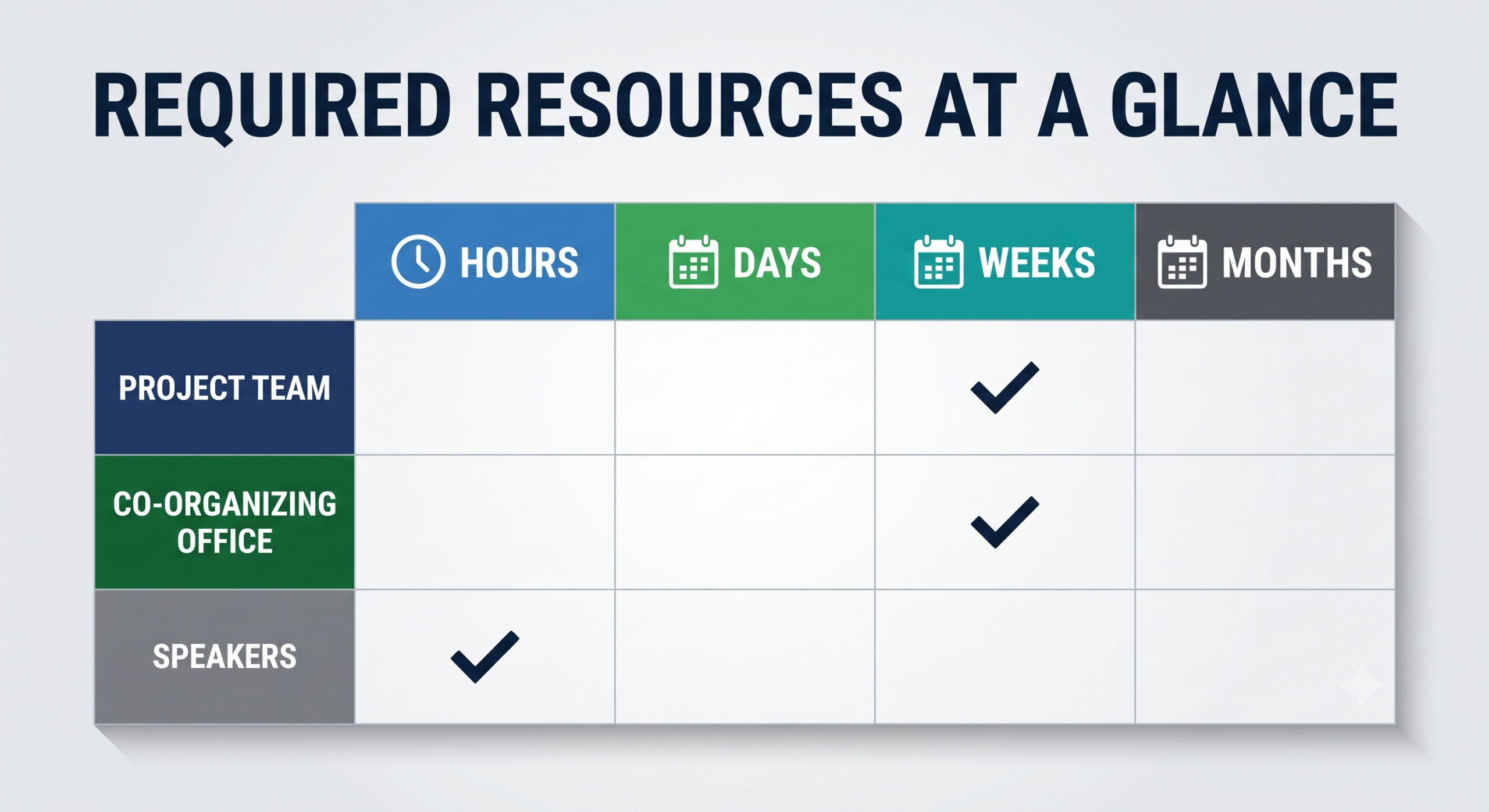
Tasks and resources

Project team

Coordinates agenda, speakers’ involvement, registration & communication, meeting room and catering services.

Co-organizing office

The office for Promoting Innovation and Knowledge, co-organizing the training, is involved in all preliminary phases, in particular to identify the most suitable topic and related speakers.

Speakers

They meet separately with the organizers to decide on the topic, time and other details relating to the presentations. They prepare the presentation material: slides and links to share with those present.


Required funding for activities

All speakers are affiliated with the university, so no funding is expected for their travel/accomodation.

Light refreshments (e.g., coffee break/snacks) are offered during the networking moment at the end of the training.


Sources and further reading

Ca’ Foscari University event webpage.

On-Site Visits: Students to Public Administration Institutions

Description

Organized visits of university students to public administration institutions (so-called on-site visits) represent an effective form of experiential learning, which brings together academic education and practical operation of the public sector. These visits offer students valuable insights into the functioning of state and local institutions, the challenges they face, and the tools and methods used in real-world administrative processes. At the same time, they strengthen mutual understanding between the academic and public sectors and often lay the groundwork for future collaboration in the form of internships, joint research, or employment.

Diverse selection of visited institutions, ranging from large central bodies to smaller local branches and specialized agencies, ensures a broad spectrum of perspectives on how public administration functions in various thematic and territorial contexts.


Objectives

On-site visits of students to public administration institutions aim to:

  • Provide students with practical insights into the functioning of public institutions and their internal processes.
  • Encourage critical thinking and active learning through interaction with professionals and real examples from practice.
  • Create opportunities for future collaboration – student internships, diploma theses, or expert consultation.
  • Build bridges between academia and practice, enhancing the relevance of university curricula.
  • Stimulate long-term partnerships based on mutual understanding of the needs and capabilities of both sectors.


How does the format work?

The core of the activity consists of an organized excursion, during which students visit 4–6 institutions per day (depending on location and travel time). Optimally, the program is spread over two days, allowing sufficient space for transfer, breaks, and in-depth discussions.

Visits are designed for smaller groups of students – ideally around 10, maximum 15 participants. Each visit lasts a minimum of 45 minutes, optimally 60–90 minutes. The structure typically includes:

  • A presentation by a qualified staff member.
  • If possible, a practical demonstration – software use, workstations, guided office tours, and examples of internal outputs.
  • A discussion session, which is a key component of the visit. Students are expected to prepare questions in advance.


Key phases in organizing the visit

  • Early planning – at least three months in advance to ensure institutional availability and logistics.
  • Careful selection of institutions – balancing thematic diversity and geographical distribution. Suggested examples:
    • Municipal and regional offices (transport, education, culture, planning, investments, etc.)
    • Cadastral office
    • Statistical Offices
    • Road and Motorway Directorate
    • Environmental and planning agencies
    • Financial administration
  • Preparation of students – prior study of basic facts about each institution. Students prepare independently based on brief guidelines provided by the teacher, which specify key aspects and topics to focus on during their individual pre-visit study.
  • Coordination with institutions – ensuring the content has added value (e.g., beyond publicly available facts), adapting to students’ level of knowledge, and encouraging informal insights.
  • Post-visit feedback – students complete a short questionnaire reflecting on what they found most useful or interesting, what could be improved, and any suggestions for future visits. This feedback can help refine the format and maintain quality over time.


Role of Participants

  • Academic staff:
    • Organize the program, coordinate logistics, and communicate with partner institutions.
    • Select institutions and plan the thematic focus.
    • Supervise the educational outcomes of the activity.
  • Students:
    • Prepare in advance; formulate and ask relevant questions.
    • Observe key themes across all institutions (e.g., HR, data usage, IT systems, organizational culture).
    • Prepare post-visit outputs – written reports, ideally in pairs, each focused on one transversal topic evaluated across all visits.
  • Public institutions:
    • Provide expert presentations and practical demonstrations.
    • Engage professionals capable of discussing technical issues (preferably beyond PR or marketing staff).


Benefits for Participants

Students:

  • Gain exposure to real working environments in public administration.
  • Learn to compare practices across institutions and evaluate effectiveness.
  • Establish personal contacts for future cooperation or employment.

Teachers:

  • Deepen ties with practice and enhance the relevance of their courses.
  • Strengthen partnerships with public sector actors.
  • Gain new ideas for research or thesis topics.

Public administration:

  • Raise awareness of their work among future professionals.
  • Identify potential interns, collaborators, or employees.
  • Receive feedback and fresh perspectives from academia.


Challenges (and ways to address them)

Although on-site visits offer clear educational and collaborative benefits, their implementation presents several practical and organizational challenges that must be anticipated and addressed effectively.

The most significant burden lies in the logistical organization of the entire program. Academic staff must identify suitable institutions, coordinate dates, plan transfers and time schedules, and ensure smooth communication with all involved actors. The complexity increases proportionally with the number of institutions and locations included. Ideally, these activities should be led by an academic with extensive knowledge of the field and strong professional contacts across relevant public sector organizations.

Another challenge is the availability and willingness of institutions to participate. To avoid scheduling conflicts or low engagement, it is essential to begin planning at least three months in advance. Clearly communicating the objectives and mutual benefits of the visit increases the chances of a positive response from institutional partners.

Maintaining active student engagement can also be difficult, particularly if the visits are not formally embedded in the curriculum. This can be addressed by integrating the activity into the course requirements – for example, through a system of credit recognition based on active participation, preparation of questions, and submission of reflective reports.

An often underestimated risk is the variability in the quality of presentations delivered by institutional representatives. If the presenters are not well informed about the background and expectations of the students, the sessions may become either overly basic or too technically advanced. Academic organizers should therefore provide the host institutions with a clear overview of the students’ academic profiles and study focus in advance. Additionally, it is helpful to encourage institutions to involve subject-matter experts rather than PR or administrative staff to ensure relevance and depth.

To further improve the experience and long-term quality of on-site visits, it is beneficial to collect feedback from students through a short evaluation questionnaire after the event. This allows organizers to identify the most valuable aspects of the visits as well as areas for improvement, contributing to the continuous refinement of future excursions.

Tasks and Resources On-site visits are financially undemanding for hosting institutions, requiring only time for preparation and delivery. The main costs fall on students (transport, possibly accommodation) and the organizing academic staff, who must coordinate the entire program.

The most significant burden lies in organizational time and effort, especially when multiple institutions or locations are involved. To support participation, universities may consider offering travel subsidies or integrating visits into funded field trip schemes.

Despite these costs, the educational and networking benefits make the activity highly valuable in the long term.


Example

On-site visits represent a structured form of experiential learning connecting university education with the real operation of public administration. Students visit selected institutions to observe data workflows, decision-making, and everyday administrative processes. The activity is typically integrated into specialized courses or field modules and combines expert presentations, guided tours, and discussions with practitioners. This format effectively bridges theory and practice, strengthens students’ professional orientation, and often initiates further cooperation such as internships or diploma theses.

The Department of Geoinformatics, Palacký University Olomouc, has been organizing student on-site visits for over 20 years as a mandatory part of the Geoinformatics and Cartography study program. During a three-day tour, students visit around 12 public and private institutions across the Czech Republic. The institutions include the Czech Statistical Office, Czech Office for Surveying, Mapping and Cadastre, Institute of Planning and Development Prague, MAPPA Ostrava, Olomouc Regional Authority, City of Olomouc, Directorate of Roads and Motorways, Czech Hydrometeorological Institute, and the Emergency Response Center 112. These visits are highly valued by both students and host institutions and often lead to follow-up collaborations on projects, consultations, or employ006Dent opportunities.


Do you want to know more about the policy engagement toolkit?

Do you want to share your experience in policy engagement? Do you think about contributing to the policy engagement toolkit? Feel free to contact Tome Sandevski via science-policy@pvw.uni-frankfurt.de

Other