Pairing Schemes for Groups of Policymakers and Scientists: The example of the SIMIL Programme in Catalonia
Authors:
Ada Domingo Ferrer, Víctor Carbajal Perelló & Enol Nieto Jiménez
Ada Domingo Ferrer holds a Bachelor’s degree in International Relations and Foreign Policy and a Masters in Geopolitics, Territory, and Security. Her main expertise is the analysis of geopolitical factors as a source of conflict in the Middle East and Eastern European regions. At the BETA Technological Centre, she is Governance Senior Technician for Sustainability projects. She is also the project manager of SMART4ENV, an initiative pursuing the excellence for Tübitak Marmara Research Center with respect to R&I capacities and scientific reputation in the field of smart environmental technologies for climate change challenges.
Dr Victor Carbajal Perelló holds a PhD in Applied Sciences, with a specialisation in Environmental Biogeochemistry. He is currently the coordinator of the Governance for Sustainability Unit at BETA Technological Centre. He is mainly involved in initiatives that contribute to increasing BETA TC ‘s impact in the RDI ecosystem, as well as in detecting and implementing new projects together with other stakeholders. In addition, he has participated in different research projects (Spain, Ireland, Portugal, and Ghana) on different topics; water quality, management and conservation of natural resources, governance, agri-food, and bioeconomy.
Enol Nieto Jiménez (enol.nieto@uvic.cat) is a project manager at the Beta Technological Centre of the University of Vic – Central University of Catalonia, where he also works on Governance for Sustainability. He is a jurist and political scientist (Universidad Autónoma of Madrid), an expert in eco-social transition, and holds a MSc in Latin American Studies from the Complutense University of Madrid.
Summary: Key features in a nutshell
- Pairing schemes offer a valuable platform for policymakers and scientists to collaborate, fostering a deeper understanding of complex issues and driving evidence-based policymaking. This guide provides a step-by-step framework for organising such initiatives, drawing on the experiences of the SIMIL Programme from the BETA Technological Centre (UVIC-UCC).
- The SIMIL Programme Pairing Scheme is a bridge between policymakers and scientists. It was born from the need to promote bidirectional dialogue within the science-policy interface to address the complexities of contemporary environmental challengesin a thorough way. This initiative aims to foster two-way understanding, empowering municipalities, especially the smallest ones and those in rural areas, with the knowledge and tools relevant to their specific context. Policymakers need technical knowledge to keep abreast of innovative solutions, and scientists need to be fully familiar with local realities. At this vital intersection between science and politics, collaboration is not only beneficial but essential. SIMIL facilitates collaborative development of solutions, overcoming traditional barriers, to pave the way for more informed and therefore more effective policymaking.
- By fostering collaborative dialogue and knowledge exchange, this programme addresses complex environmental challenges with evidence-based solutions. Through a series of face-to-face sessions and online interactions, policymakers and scientists work together to identify key challenges, explore innovative solutions, and inform policy decisions under a thematic priority common to all participants. This approach leverages the expertise of both sectors to create more effective and sustainable policies that benefit communities and the environment. These sessions are designed to create a dynamic and productive environment where policymakers and scientists can learn from each other, build relationships, and develop innovative solutions to pressing environmental challenges.
- The term “SIMIL” refers to replicating and comparing two things while highlighting their commonalities. The methodology aims to serve as a model – one that is replicable and adaptable to different contexts and formats of science-policy dialogue that may be created.
How does the format work?
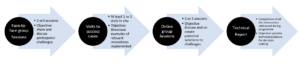
Figure 1: The SIMIL execution process
To initiate these group pairing schemes between scientists and policymakers, various approaches can be adopted (Fig. 1). The main aim is to share the different activities, phases, and methodologies that have been employed, providing a practical guide for research managers interested in implementing similar initiatives.
By documenting and presenting our strategies, this initiative seeks to offer a valuable resource that highlights effective practices and lessons learned. This guidance will support research managers in designing and facilitating their own collaborative efforts, fostering productive exchanges between the academic and political spheres to address complex public challenges.
Before starting the activities …
Prior to the commencement of the sessions, it is essential to conduct extensive outreach for the programme, engaging key stakeholders who can assist in promoting the initiative. Identifying and leveraging these influential actors will help ensure that the programme reaches its intended audience effectively.
A significant number of participants is crucial, given that the length of such programmes often poses challenges for consistent attendance, particularly among those from the political and administrative sectors. By maximising early participation, the programme can better accommodate potential drop-offs over time while maintaining robust engagement throughout its duration.
It is important to present the programme’s content and main focus areas in clear and accessible language to the policymakers, avoiding overly technical or scientific terms. This approach ensures that the objectives and scope are easily understood by all participants, regardless of their background.
Additionally, providing a detailed schedule with reserved dates for the various planned activities is essential. This helps participants organise their availability and fosters a sense of commitment to the programme’s timeline and goals.
Use registration as an opportunity to gather information necessary for the design of the sessions
A useful idea could be to launch a registration form for participants, including a section that provides preliminary information which can inform the initial sessions. By gathering an overview of the challenges faced by participating policymakers, the programme can be more effectively tailored to address these issues while remaining flexible enough to explore additional topics as they emerge.
This approach allows for the design of a programme that is responsive to the participants’ priorities, providing a foundational roadmap for the first activities. Although the challenges identified in this stage will not be definitive, they will serve as a starting point to guide discussions and foster productive engagement from the outset.
There are different formats for conducting the Pairing Schemes for groups of policymakers and scientists.
Face-to-face sessions
In-person activities will serve as the backbone of the programme, fostering personal connections among participants that will strengthen networks between administrations as well as between policymakers and researchers. These interactions are key to building lasting relationships and facilitating ongoing collaboration.
Types of exercises and activities to be carried out in the in-person sessions:
- Individual reflection (5 minutes): Participants reflect on their concerns, issues, and key aspects of the policy challenge they want to address and record their thoughts on a blank sheet of paper. They are free to refer to the support document containing information on the specific challenges in case of blockage.
- Group discussion (15 minutes): Participants in each group elect a spokesperson to record the collective ideas. They discuss the questions raised and contribute their thoughts to the DIN A-3 sheet (Fig 2).
| A positive experience lived in his municipality The Door-to-Door collection system has increased the percentage of the RS of all fractions. | A concern/need to express How can I involve or convince part of the population to develop the Door-to-Door system correctly. |
| A negative experience There are 2 neighbourhoods of the municipality where the collection through the Door-to-Door system does not work properly due to the inappropriate behaviour of part of the population. | A proposal for improvement or other comments or observations – Initiative to give away compostable bins and bags from the town hall. – Establish bonuses/sanctions. |
Figure 2: SIMIL real example of group discussion outputs.
- Presentation of group findings (5 minutes per group): Each group will present the items proposed and recorded in the worksheets (Fig 3) in a plenary session. Then, the groups of participants will contrast, confront, and complement the ideas raised. During the reading of the recorded items, each group will see its file projected in order to facilitate the understanding of the ideas and so that the participants from other groups who have not dealt with a certain challenge have the possibility to refute, complement, or comment on any aspect of it.
*Note: check that the tempos for each challenge are respected (flexibility according to the interest of the challenge).
- Open discussion (30 minutes): Participants from all groups can discuss, challenge, and complement the ideas presented. With this group session, consensual, and significant results will be generated which will be recorded internally to prepare a document of conclusions that will be delivered to the participants (Fig 4).
Online sessions
At the start of each session, it will be helpful to synthesise the results from the diagnosis phase to reconnect ideas and outcomes from previous discussions on the various challenges. This helps ensure that participants are aligned and focused. Based on these challenges, it’s important to establish strategic lines that guide collaboration.
Encouraging dialogue and co-creation enables identification of key technical resources and solutions necessary for addressing the challenges, which in turn informs future decision making. To streamline communication, consider organising participants into virtual rooms while ensuring a balanced representation of stakeholders, such as politicians, technicians, researchers, and experts.
Throughout the session, it’s beneficial for facilitators to actively support the participants, encouraging them to propose concrete solutions and documenting their contributions. Finally, bringing the groups together at the end allows for actions, resources, and other crucial elements that complement the strategic plans to be shared.
On-site visits
Explore case studies showcasing successful examples of the implementation of innovations and solutions proposed by academia to advance the scientific field. Emphasis will be placed on selecting examples that are relatable and applicable to the scale of the participating administrations, ensuring feasibility and fostering enthusiasm for adopting these changes.
These case studies should demonstrate practical and impactful outcomes, highlighting how academic contributions can address real-world challenges effectively. The focus on approachable and scalable models aims to inspire decision makers to view these solutions as tangible pathways for improvement in their own contexts.
Challenges
To thoroughly explore the challenges that public policies face regarding a specific topic, it is crucial to that to all participating public administrations be heard. This process may span one or more sessions, during which various problems – and often potential solutions –will emerge. A key step is to adopt the role of facilitators or mediators, ensuring that political representatives can freely articulate their issues. This will foster connections among political representatives and help researchers gain a deeper understanding of the political realities underpinning these challenges.
During these sessions, collaborative dynamics can enhance engagement and clarity. Tools such as mapping exercises can visually represent the identified challenges, making them easier to analyse. Group dialogue activities, sharing sessions, and collective problem-mapping discussions can further enrich the process. These methods aim to build a shared understanding of the issues while creating a foundation for collaboration between political representatives and academic researchers.
Tasks and resources
The goal is to share academic resources and knowledge in an accessible format tailored for public representatives, enabling them to gain deeper insights into the specific challenges faced by their administrations. Rather than offering predefined solutions to their issues, the aim is to provide tools and frameworks that empower them to address a broad range of problems effectively.
This approach encourages administrations to adapt the shared knowledge to their unique contexts, fostering a sense of ownership and flexibility in problem solving. By bridging the gap between academic expertise and public administration needs, the initiative seeks to equip decision makers with the capacity to devise informed and context-sensitive strategies.
Final report
This 74-page final report is becoming a valuable tool that represents the culmination of the joint process of dialogue and co-creation between representatives of the local administration and scientists during the first edition of the SIMIL Programme. It reflects the identified challenges, proposed innovative solutions, strategic actions, available technical resources, and possible economic considerations. This guide becomes a valuable tool to facilitate decision making and guide future initiatives in the municipal management of organic waste, thus consolidating the successes achieved during this first edition of the SIMIL Programme.
Key Recommendations
In conclusion, we provide a list of key considerations for those planning to implement a programme of this nature. These points serve as essential guidelines to ensure its success and effectiveness:
- Limit the scope: Focus on a manageable number of topics or challenges to ensure in-depth discussions; In our case, the focus was solely on a general topic, from which more limited categories were subsequently derived
- Balance expertise: Ensure a diverse mix of policymakers and scientists with complementary skills
- Utilize technology: Leverage online platforms for virtual meetings and knowledge sharing
- Promote collaboration: Encourage participants to form lasting relationships beyond the pairing scheme
- Continuously evaluate: Regularly assess the effectiveness of the programme and make necessary adjustments
- Define your objectives
- Clearly outline the goals of your pairing scheme; consider
- Knowledge exchange: Facilitating the transfer of scientific knowledge to policymakers
- Problem solving: Addressing specific challenges related to as specific policy areas
- Policy development: Informing the creation of evidence-based policies
- Network building: Fostering connections between policymakers and scientists
- Identify Participants
- Target policymakers: Municipal, supra-municipal, regional, or even national government authorities
- Select scientists: Researchers with expertise relevant to your chosen policy areas
- Consider diversity: Ensure a mix of backgrounds, perspectives, and experiences
- Develop a roadmap
- Create a detailed plan outlining the activities, timelines, and deliverables of your pairing scheme. include:
- Participant recruitment: Processes for attracting and selecting participants
- Topic selection: Identify key policy areas or challenges to focus on
- Meeting formats: Determine the structure and frequency of interactions (e.g., workshops, site visits, online discussions)
- Evaluation: Plan mechanisms to assess the effectiveness of the scheme
- Design work sessions
- Facilitate engagement: Employ interactive methods like group discussions, case studies, and roleplaying
- Provide support materials: Distribute relevant research papers, policy briefs, and other resources
- Encourage dialogue: Create a safe and inclusive space for open communication and debate
- Organise site visits
- Select relevant locations: Visit successful waste management projects, research facilities, or policymaking institutions
- Facilitate learning: Guide participants through the site, asking questions and encouraging discussion
- Promote networking: Foster connections among participants during the visit
- Collect feedback
- Use surveys or interviews: Gather feedback from participants on the effectiveness of the pairing scheme
- Analyse results: Identify areas for improvement and adjust future iterations
- Disseminate outcomes
- Publish reports: Share findings and recommendations with policymakers, researchers, and the public
- Organise events: Host workshops or conferences to discuss the results and promote collaboration
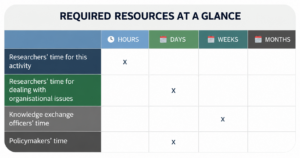
Required resources at a glance